
 Worksheets
Unit 5 Exam
Total questions: 17
Worksheet time: 9mins
What happens to the rotor system in a helicopter when the pilot raises or lowers the collective control? (5.A.2)
The engine goes to max power or idle
The thrust of the tail rotor increases or decreases
The pitch angle of the rotor blades increase or decrease as a whole unit
The swash plate tilts right or left to alter the pitch of individual rotor blades
True or False. Pitch stability refers to the movement of an aircraft’s nose up and down around its lateral axis. (5.A.1)
True
False
Which of the following are the three axes of flight? Select the three answers that apply. (5.B.1)
Tail axis
Longitudinal axis
Forward axis
Lateral axis
Vertical axis
Which of the following are ways that a control input can be transmitted to a control surface? Select all that apply. (5.B.1)
Hydraulic pressure
Wind tunnels
Electronic signals
Anti-torque pedals
Cable and pulley
How are flaps used during flight? Select all that apply. (5.B.2)
They increase lift
They are retracted at cruising altitude
They reduce drag during takeoff
They are retracted during descent
They are extended during landing
Trim systems are designed to ____________. (5.B.2)
a. relieve the pilot of the need to maintain constant pressure on the flight controls.
b. increase the speed of the aircraft.
c. decrease the fuel consumption.
d. enhance the communication system.
When a leading edge device is lowered, it increases the wing’s __________.
b. camber.
a. drag.
c. lift.
d. weight.
Which of the following is not a primary flight control surface? (5.B.1)
Ailerons
Flaps
Elevator
Rudder
How do quadcopters counteract the torque forces created by each of the four rotors? (5.B.3)
Rotors that sit on opposite sides from one another spin in opposing directions
All four rotors spin counter-clockwise
The main body absorbs all torque forces
A computer is used to limit the amount of torque from each rotor
An aircraft become progressively more difficult to control as the center of gravity moves aft.
True
False
An airplane’s rate of turn is _________.
equal to its airspeed.
inversely proportional to its airspeed.
exactly twice the airspeed.
always greater than its airspeed.
How should a pilot operate an airplane in a way that minimizes dangers from turbulence? Select all that apply.
Fly at maneuvering speed or slower
Accelerate to move quickly through turbulence
Reach a higher cruising altitude
Avoid areas of rough conditions
Avoid turning the airplane in any direction
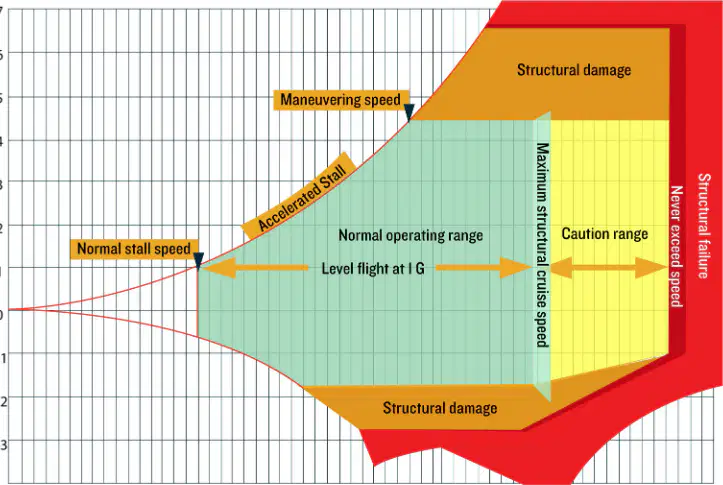
Use the Vg diagram to explain what could happen to an airplane and its occupants when it is maneuvering with an indicated airspeed of 160 mph and a load factor of -2.5 Gs. (5.C.2)
The airplane may experience structural failure.
The airplane will maintain level flight.
The airplane will climb rapidly.
The airplane will descend slowly.
The lateral axis of an airplane is located along which part of the airplane?
From nose to tail
From wingtip to wingtip
Vertically through the center
Diagonally across the fuselage
23. Describe how lift changes in a turn. (5.B.2)
An airplane requires a sideward force to change its lateral flight path. This force is generated
by banking the airplane’s wings and forcing some of the upward-lifting force to act sideways.
The vertical component of lift in flight, which originally acted to balance the aircraft’s weight in
straight-and-level flight, is broken into vertical and horizontal components in a turn. The
horizontal component of lift acts in the intended direction of the turn and is responsible for
“pulling” the airplane into the turn.
Does this make sense?
Yes.
No.
24. A pilot should operate an aircraft to avoid overstressing its structure by:
Maintaining appropriate speed and altitude
Ignoring weather conditions
Performing aggressive maneuvers
Flying with maximum payload
25. Describe what causes adverse yaw.
A difference in lift/drag between the wings.
A difference in thrust between the engines.
A difference in weight distribution.

