
 Worksheets
Stress and Coping
Total questions: 204
Worksheet time: 2hrs 21mins
There are two components of stress that can be appraised in two ways.
True
False
When we perceive that a stressor would help us grow, we're appraising it as...
Challenge
Threat
Harm-loss
I want to start dieting, but I think my chance of losing weight is still really small.
Is a form of...
Primary appraisal
Secondary appraisal
Tertiary appraisal
Which of the following is NOT a form of conflict according to Lewin and Miller?
Approach/Approach
Approach/Avoidance
Avoidance/Avoidance
Avoidance/Approach
Sarah wants to binge-watch her favorite series this weekend, but her family asks her to join their staycation in hotel.
This is a form of...
Approach/approach conflict
Avoidance/avoidance conflict
Approach/avoidance conflict
When you resolve your relationship conflict that stresses you out by talking it out with your partner, you are engaging in...
Approach-approach conflict
Emotion-focused coping
Problem-focused coping
Which one is considered as a healthy coping skill?
Distraction
Wishful thinking
Assistance seeking
Denial
The difference in individual's pain threshold can cause...
Denial
Assistance seeking
Medication delay
Direct action
Firza has stomachache for a week, but when he goes to the doctor, there are no problems found. Firza is experiencing...
Organic pain
Orogenic pain
Psychogenic pain
Psychotic pain
Which approach of pain control requires patients to picture a safe and comfortable place?
Relaxation
Distraction
Nonpain imagery
Pain redefinition
In which situation are avoidance strategies most useful for coping with stress?
when the individual has the power to change the stressful situation
when the individual has a low self-efficacy
when the individual has no control over the stressor
when the individual has a low self-esteem
After marking the test, Ms Glum noticed that one of her students performed poorly. When asked, the student informed her that they were not coping with the VCE workload due to procrastination. If Ms Glum was to suggest an approach coping strategy to this student, it would involve
efforts that evade a stressor and deal indirectly with it
efforts to confront a stressor and deal with it directly
taking steps to avoid the stressor
distancing oneself from the stressor
Tash is an elite gymnast and is attempting to be accepted into the next Olympic squad. The upcoming trials are causing Tash to feel very stressed as she feels under prepared.
If Tash were to use an approach strategy to reduce the stress that she is experiencing, which of the following may be an appropriate example?
speaking to a more experienced gymnast for advice
speaking to her friend about their plans on the weekend
going shopping to buy a new outfit
all of the above
Tash is an elite gymnast and is attempting to be accepted into the next Olympic squad. The upcoming trials are causing Tash to feel very stressed as she feels under prepared.
Tash would be said to have a high level of coping flexibility if she displayed which of the following characteristics?
an ability to recognise that her coping strategy is ineffective; to discontinue this ineffective coping strategy; and not implement any other coping strategy
an ability to recognise that her coping strategy is ineffective; to discontinue this ineffective coping strategy; and then to implement an alternative coping strategy
an ability to implement a strategy that she knows has worked in the past
an ability to implement a strategy that meets the demands of the stressor she is currently experiencing
Melissa and Naomi are discussing how worried they are about a forthcoming VCE Units 3&4 Biology SAC.
Melissa decides to spend an extra hour each night studying for the SAC, whereas Naomi finds herself watching TV for longer periods each night leading up to the SAC, and does not adequately prepare for the assessment.
Melissa has used an (a) strategy whereas Naomi has used an (b) strategy.
Simon teaches Spanish at a secondary school. In December, he was unexpectedly informed that he would not have a job at the school the following year, as his contract would not be renewed. Simon was devastated by this news
as it would cause him to be denied a home loan that he had just applied for.
Which of the following would not be considered an approach strategy for Simon after he lost his job?
making a list of appropriate jobs that he is going to apply for
seeing a careers advisor to get advice about finding a new job
denying that he had lost his job
looking at losing his job as an opportunity to retrain and start a new career
Ken recently lost his job. If it was said that Ken displayed high levels of coping flexibility, this would involve him
using the same coping strategy in all stressful situations
using no coping strategy for a stressful situation
adapting the stressful situation to match the coping strategy
adapting the coping strategy to match the stressful situation
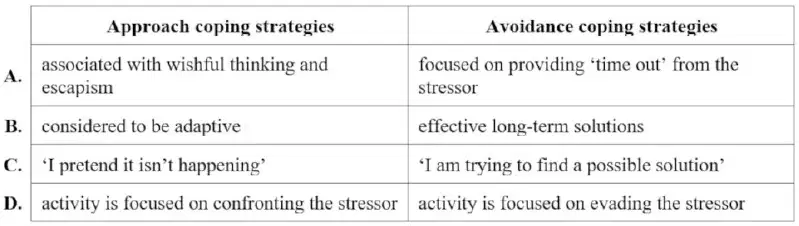
Which of the following is true of approach and avoidance coping strategies?
A
B
C
D
Within the next week, Cala has three VCE exams to complete. She wants to perform to a very high academic standard on all her exams, but she has noticed that her stress levels have increased and she is unsure if she can cope.
An appropriate coping strategy that Cala could use, that demonstrates context-specific effectiveness, would be
preparing a study schedule
meditation
exercise
listening to music
Place the 'descriptions' under the correct heading
target the stressor directly
evade the stressor
confront the issue head-on
develop a plan of action
engage in problem-solving techniques
procrastinate on dealing with the issue
use distractions to escape the stressor
deny the existence of the problem
withdraw from social interactions
seek support from others
adapt strategies based on the situation
assess the effectiveness of different approaches
modify coping techniques as needed
consider the context before responding
evaluate past experiences to inform current decisions
You are feeling stressed about your final exams and decide to implement a regular study timetable. This is an example of which type of coping strategy?
avoidance
approach
coping flexibility
adaptive
Kai was a distinguished and highly valued member of the Summerville Sharks Swimming Club. For several years, Kai had won numerous medals and awards in recognition of his exceptional performances. Recently, Kai began to feel stressed about competing in future events because he had finished in last place in the previous two races. He started to experience shoulder and back pain, which had a negative impact on her mood and enthusiasm for swimming.
Which one of the following options would be the most appropriate context-specific coping strategy for managing Kai's stressful situation?
mentally distancing himself from thinking about the upcoming competition
making an appointment with a physical therapist to reduce his shoulder and back pain
spending the weekend at the beach with his friends to improve his mood
speaking with a careers counsellor about job opportunities once he retires from swimming
The Coping Orientation to Problems Experienced (COPE) questionnaire is a self-report survey designed to measure a person's ability to cope with a stressful life event.
Which of the following statements from the COPE questionnaire most accurately describes an approach coping style?
I say to myself "This isn't real"
I turn to work or other substitute activities to take my mind of things
I make fun of the situation
I try to get advice from someone about what to do
Georgina attended a temple to help her cope with the stress of working as a paramedic. She found the temple was a relaxing space for meditation and contemplation, but she was still feeling distressed. Georgina sought advice of a psychologist to discuss coping strategies for dealing with trauma associated with her job. The psychologist advised her to engage in low-intensity exercise five times a week.
Which of the following identifies Georgina's approach to coping with stress?
high coping flexibility; as she has used multiple coping strategies
avoidance coping strategies as she was evading the cause of her stress
low coping flexibility; as she was still feeling distressed
context-specific effectiveness; as low-intensity exercise releases beta-endorphins
Whether a coping strategy works or not is influenced by two factors. They are
coping-specific effectiveness and coping flexibility
the plateau effect and resilience
desensitisation and the plateau effect
coping-specific flexibility and coping effectiveness
Which of the following is a limitation of avoidance strategies?
Long-term use of these strategies can lead to other problems
They tend to be maladaptive
They tend to only be useful in the short term
All of the above
(a) is the belief that success is based on ability
(a) is the process of controlling how one is perceived by other people.
(a) is the belief that success is based on hard work, learning, etc.
(a) is the belief to ones calabilities to pursue a particular task or goal.
(a) are personal reflections of your personal knowledge and skills.
He proposed the Thoery of Mindset
Carol Dweck
Albert Bandura
Edwin Locke
The Theory of Self-efficacy was proposed by?
Russel Belk
Kristin Neff
Albert Bandura
This theory was proposed by Ben Kuo
Theory of Coping Strategies
Cultural Dimension of Stress
Stress and the Filipino
Which among the given choices is NOT part of coping strategies?
Solution-focused
Problem-focused
Emotion-focused
Rommel Roy (a) Romanillos is my correct and complete name.
This type of stress is ongoing over a long period of time.
Acute
Chronic
Which of the following is a physical sign of stress?
rapid heartbeat
sweaty palms
nausea
all of the answers are signs of stress
All stress is bad.
True
False
This type of stress is positive stress.
Eustress
Distress
This type of stress is negative stress.
Eustress
Distress
Buying your first home is an example of ________ stress.
Eustress
Distress
T/F: Your body can benefit from small amounts of stress.
True
False
Losing your keys is an example of what type of stress?
Major life change
Catastrophe
Everyday problems
Environmental problems

What is a stressor?
A disease.
Your little brother or sister.
An irritant.
Is a source or cause of stress.
What is anxiety?
is a exaggerated fear of specific situations or objects.
is a rapid heartbeat, sweating, trembling, fear of losing control, shortness of breath, nausea.
is restlessness, tiredness, difficulty concentrating, irritability, muscle tension, sleep disturbance.
The feeling of dread, similar to fear. It may include worry, concern, stress, or nervousness.
What is a coping skill?
Strategies you put into place to help you manage stress
Running away from all of your problems
Anything that causes stress
Which of the following is a behavioral change to stress?
overeating
muscle tension
nervousness
impatient
Select two statements referring the meaning of stress at workplace
Individual problem tied to the personality and emotional
A problem induce by management shortcomings and poor supervision
Emotional state resulting from similarity perception between the level of occupational and ability
Availability of other rewarding employment or one's professional skills
When dealing with stress, which of the following is an example of a counterproductive coping technique?
Exercising
Meditation
Binge eating
Yoga
Being easily annoyed and unusually irritable can be an emotional warning sign of too much stress.
False
True
Losing weight can be a sign of too much stress
True
False
Which of the following activities is an example of scheduling regular "me time"?
Reading a book for 30 minutes every evening
Cooking dinner for the family
Cleaning the house
Running errands
What is a suggested way to pursue a hobby according to the self-care strategies?
Spend 5 minutes on it once a month
Block off dedicated time for it, even if it's just 15-20 minutes a few times a week
Only engage in it when you have a full day free
Avoid hobbies to focus on caregiving
Which of the following is a stress-reduction technique mentioned in the self-care strategies?
Watching TV for hours
Starting your day with 5-10 minutes of deep breathing
Drinking coffee
Skipping meals
What is one benefit of taking a 10-minute walk outside when feeling overwhelmed?
It helps you avoid responsibilities
It provides a calming break by focusing on the sights, sounds, and sensations around you
It increases your stress levels
It makes you more tired
How can writing in a journal for 15 minutes each night help caregivers?
It helps release thoughts and feelings onto paper
It increases anxiety
It wastes time
It disrupts sleep
Which of the following is an example of taking time for yourself as a caregiver?
Having a friend or family member stay with your loved one so you can take a nap
Skipping meals to save time
Working extra hours
Ignoring personal needs
What is a recommended activity to start your day with for stress reduction?
Watching the news
Deep breathing or meditation for 5-10 minutes
Checking emails
Skipping breakfast
Why is it important to block off dedicated time for hobbies?
It ensures you have time to engage in activities you enjoy
It makes you more stressed
It reduces productivity
It is unnecessary
What should you focus on during a 10-minute walk to help reduce stress?
Your to-do list
The sights, sounds, and sensations around you
Your phone
Work-related thoughts
How often should you schedule "me time" activities according to the self-care strategies?
Once a year
Regularly, such as every evening or once a week
Only when you feel overwhelmed
Never
What is one way to practice stress-reduction techniques in the morning?
Skipping breakfast
Engaging in deep breathing or meditation for 5-10 minutes
Checking social media
Rushing through your morning routine
What is a benefit of writing in a journal before bed?
It helps release thoughts and feelings onto paper
It keeps you awake all night
It increases stress
It is a waste of time
Which of the following is NOT a recommended self-care strategy for caregivers?
Taking a relaxing bath once a week
Ignoring personal hobbies
Scheduling regular "me time"
Practicing deep breathing exercises
What should you do if you feel overwhelmed as a caregiver?
Take a 10-minute walk outside
Ignore the feeling
Increase your workload
Skip meals
How can caregivers ensure they have time for their hobbies?
Block off dedicated time for hobbies, even if it's just 15-20 minutes a few times a week
Only engage in hobbies when they have a full day free
Avoid hobbies to focus on caregiving
Wait until they are no longer caregivers
What is the definition of stress?
CRA
the body’s automatic response to any physical or mental demand placed on it.
endless works
What is a coping skill?
Strategies you put into place to help you manage stress
Running away from all of your problems
Anything that causes stress
Choose the unhealthy coping skill.
Giving up on the situation
Coming up with a plan
Exercise
Hanging out with friends
What is chronic stress?
Stress that continues for a long period of time.
Stress that happens for a day.
Negative stress
Which of the following is not a stress-management skill?
Problem solving
Bargaining
Understanding self
Confidence building
Stress management is about learning:
How to avoid the pressures of life
How to develop skills that would enhance our body’s adjustment when we are subjected to the pressures of life
Time Management
None of the above
A limited amount of stress :
Can be exciting and prevent boredom
can help in reacting to opportunities quickly
Can increase your focus
All of the above
What is a stressor?
A disease
An irritant
Your husband
Situations, activities, and relationships that cause ‘trauma’ to one’s physical, emotional, or psychological self
By understanding ourselves,
we can
Know what we can and cannot do
Argue with anyone easily
Plan what and how we can improve ourselves
Feel confident about ourselves
How can we cope better with stress?
Learn to ignore it and it will go away
Drink lot of water in moderation to help numb the pain
Identify stress triggers and learn to deal with it in a positive manner
Go to the Doctors and ask for tranquilizers
If you have tried all of your usual coping mechanisms but still feel stressed out what should you do?
Watch TV
Take a nap
Seek professional support
Go shopping
The following can help reduce stress:
Fighting
Meditation
Yoga
Music

(Any type of change that causes physical, emotional or psychological strain)What does this statement define?
(a)

There are _____ types of stress.
4
5
3
6

Which one of the following is a positive form of stress that is beneficial to an individual?
Distress
Chronic stress
Eustress
Acute Stress
Which one of the following is not an example of Eustress stressors?
Failing a test
Taking a vacation
Buying a home
Getting a raise at work

Distress happens when you are faced with stressors that you are unable to cope with.(True/False)
(a)
Repeated instances of (a) stress can add up to a state of chronic stress.

Which of the following is not a type of chronic stress?
Emotional stress
Distress
Relationship Stress
Work stress

(a) are behavioral and cognitive strategies used to manage conditions and demands that are distressing to an individual

(a) Involves seeking both emotional and concrete aid from others or even advise.

There are (a) strategies to help with stress management.
Name any one strategy to help with stress management.
(a)

(a) stress is experienced as an immediate perceived threat, either physical, emotional or psychological.

People with moderate levels of psychological distress are twice as likely to die from heart disease and other chronic illnesses.(True/False)
(a)
(a) is sometimes referred to as cognitive reappraisal.
Which of the following is not an example of a stressor?
Job pressure
Running
Financial concerns
Relationship problems
What is stress?
Fighting
bodies response to real or imagined danger or other life events
school projects
Positive Stress is
Bad Stress
Stress that allows you to not do anything
Stress that is awesome
Stress that can help you reach your goals
What is negative stress
Stress that prevents you from doing what you need to do
Stress that is good
stress is amazing
Stress that allows you to be who you are
What is a coping skill?
Strategies you put into place to help you manage stress
Running away from all of your problems
Anything that causes stress
Choose the unhealthy coping skill.
Giving up on the situation
Coming up with a plan
Exercise
Hanging out with friends
What is chronic stress?
Stress that continues for a long period of time.
Stress that happens for a day.
Negative stress
Which of the following is not a stress-management skill?
Problem solving
Bargaining
Understanding self
Confidence building
Stress management is about learning:
How to avoid the pressures of life
How to develop skills that would enhance our body’s adjustment when we are subjected to the pressures of life
Time Management
None of the above
A limited amount of stress :
Can be exciting
can help in reacting to opportunities quickly
Can increase your focus
All of the above
The following can help reduce stress:
Fighting
Meditation
Yoga
Music
How can you identify you weaknesses?
Point out the areas where you struggle and what you find difficult to do
Think of anything that you are always good at
Think about what others appreciate about you
Take time off to think about what you do well
Which is a physical effect of stress?
Sweating
Blurred Vision
Upset Stomach
All of these are possible
Eating a healthy diet is NOT important to handling stress?
True
False
Which actions below that can you used to reduce your stress?
Sharing the problem with your boss for long time
Reducing the negative emotional with emotional focused coping
Seeking to master for adding kind of stress or conflict
Expending conscious effort to look for another stress
Have you coping with stress at work? how do you solve with mature defense mechanism?
Give some acting out to solve the problem
More assertiveness and compensation to coping the stress
Few opportunities for growth or advancement
Giving projection about the problem solving

Stress is a feeling which can affect the people
Mentally
Physically
Both Mentally and physically
None
Stress which is long lasting and has a bad impact on the body is
Acute Stress
Chronic Stress
Both of them
None of the above

Getting enough sleep help with stress
True
False

What are three HEALTHY things that help with stress
Eating junk food
Meditating
Relaxing or taking a nap
Talking to a friend
Positive Stress is
Bad Stress
Stress that allows you to not do anything
Stress that is awesome
Stress that can help you reach your goals
What is stress?
Fighting
bodies response to real or imagined danger or other life events
school projects
What is a coping skill?
Strategies you put into place to help you manage stress
Running away from all of your problems
Anything that causes stress
Choose the unhealthy coping skill.
Giving up on the situation
Coming up with a plan
Exercise
Hanging out with friends
Stress management is about learning:
How to avoid the pressures of life
How to develop skills that would enhance our body’s adjustment when we are subjected to the pressures of life
Time Management
None of the above
The following can help reduce stress:
Fighting
Meditation
Yoga
Music
What is a stressor?
A disease
An irritant
Your husband
Situations, activities, and relationships that cause ‘trauma’ to one’s physical, emotional, or psychological self
How can we cope better with stress?
Learn to ignore it and it will go away
Drink lot of water in moderation to help numb the pain
Identify stress triggers and learn to deal with it in a positive manner
Go to the Doctors and ask for tranquilizers
Which stress is considered the GOOD stress?
Eustress
Distress
What is positive stress?
A type of stress that is not THAT bad
Stress that causes you to perform better or get things done
Stress that has no physical or emotional symptoms
Stress that does not last long
Coping with stress involves
healthy living
healthy thinking
healthy actions
all of the above
Which is the following are the types of stress?
Distress, Eustress, Pressure, Hyperactive
Distress, Eustress, Hyperstress, Depress
Distress, Eustress, Hyperstress, Hypostress
Distress, Eustress, Depress, Anxiety
Which are the following is the methods of managing stress
Change Attitude and Behaviour
Action and Relaxation Techniques
Positive Thoughts
Solve the problem
Below are the pros of action techniques EXCEPT
Acceptance of life in the cycle
Sense of control
Effective use of time
Applicable at work and home
Any kind of change is a potential stressor in life. The more rapid and significant the change is, the greater is the resulting stress. Which of the following refer to this statement?
Joyless striving
Feeling over committed
Abrupt change
Feeling underskilled
Which the following is NOT the habits of highly effective people?
Be proactive
Put first things first
Have a good relationship with people.
Think win-win
Define a word stress.
Stress as tension, pressure or worry resulting from problems in one's life
Stress is bad condition in person's life
Stress is lonely life without any supporting systems
Stress is pressure that created by unhealthy mind.
What is negative stress
Stress that prevents you from doing what you need to do
Stress that is good
stress is amazing
Stress that allows you to be who you are
Positive Stress is
Bad Stress
Stress that allows you to not do anything
Stress that is awesome
Stress that can help you reach your goals
Positive Stress is
Bad Stress
Stress that allows you to not do anything
Stress that can help you reach your goals
What is negative stress
Stress that prevents you from doing what you need to do
Stress that is good
Stress that allows you to be who you are
What is a stressor?
Only good things in your life
Only bad things things in your life
Anything that causes stress
What is a coping skill?
Strategies you put into place to help you manage stress
Running away from all of your problems
Anything that causes stress
Which term describes when a person has a tendency to focus on the positive aspects of a given situation?
anxious
pessimistic
optimistic
A stressful situation
is always stressful for everyone
is never stressful for other people
can be stressful to some people and not others
Which of the following is a physical symptom of stress?
Feeling angry
Sweating
Feeling Sad
Which of the following is an emotional symptom of stress?
Feeling angry
Shaking hands
Sweating
A __________ is a way of dealing with or handling stress
coping mechanism
to do list
strategy
Stress can affect your body by
increase heart rate
increase blood pressure
fatigue
all of the above
Exercising, reading, setting realistic goals, and going for a walk are all ways of dealing with stress
true
false
The two types of stress are ____and_______
positive and horrible
positive and constant
positive and negative
________ is a response to your body and mind being threatened.
Sickness
Stress
Disease
What is stress management?
Stress management is the act of ignoring stressors completely.
Stress management is the process of identifying and managing stressors to improve mental and emotional health.
Stress management is solely about physical exercise and diet.
Stress management involves increasing stress levels to build resilience.
Name one common cause of stress for students.
Financial issues
Lack of sleep
Academic pressure
Social media distractions
How can physical activity help reduce stress?
Physical activity can lead to more distractions in daily life.
Physical activity has no effect on sleep quality.
Physical activity helps reduce stress by releasing endorphins, lowering stress hormones, improving sleep, and providing a distraction.
Physical activity increases stress hormones.
What role does sleep play in stress management?
Sleep has no effect on stress levels.
Sleep increases stress by disrupting focus.
Sleep plays a crucial role in managing stress by regulating hormones and improving emotional resilience.
Sleep is only important for physical health.
List two relaxation techniques that can help manage stress.
Yoga poses
Meditation techniques
Aromatherapy sessions
Deep breathing exercises, Progressive muscle relaxation
How can time management reduce stress levels?
Time management is only useful for personal tasks.
Time management has no effect on stress levels.
Time management reduces stress levels by promoting organization, prioritization, and control over tasks.
Time management increases workload and pressure.
What is mindfulness and how does it relate to stress?
Mindfulness is a technique for improving memory retention.
Mindfulness is primarily about achieving high productivity levels.
Mindfulness is a form of exercise that builds physical strength.
Mindfulness is the practice of being present and aware, which helps reduce stress by promoting relaxation and emotional regulation.
Why is it important to maintain a balanced diet for stress management?
Stress management is solely dependent on exercise, not diet.
A balanced diet is only important for physical health.
Maintaining a balanced diet is crucial for managing stress as it supports brain function, stabilizes mood, and prevents irritability.
Eating junk food can help improve mood and reduce stress.
What are some signs that you may be experiencing stress?
Increased energy levels
Some signs of experiencing stress include headaches, fatigue, irritability, anxiety, difficulty concentrating, changes in appetite, and sleep disturbances.
Improved focus and concentration
Enhanced sleep quality
How can talking to someone help alleviate stress?
Talking to someone can make problems worse.
Talking to someone can increase anxiety levels.
Talking to someone can help alleviate stress by providing emotional support, perspective, and coping strategies.
Talking to someone has no effect on stress.
What is the impact of technology on stress levels?
Technology solely provides entertainment and distracts from stress.
Technology only increases stress without any benefits.
Technology has a dual impact on stress levels, potentially increasing stress through constant connectivity while also offering tools for stress management.
Technology has no effect on stress levels whatsoever.
Name a hobby that can help reduce stress.
Playing video games
Watching TV
Gardening
Binge eating
How does deep breathing help in managing stress?
Deep breathing helps manage stress by promoting relaxation and reducing physiological symptoms of stress.
Deep breathing only helps with physical fitness.
Deep breathing increases heart rate and anxiety levels.
Deep breathing has no effect on stress management.
What is the importance of setting realistic goals in stress management?
Goals should always be vague to allow flexibility.
Setting unrealistic goals boosts confidence.
Realistic goals prevent overwhelm, enhance motivation, and improve coping strategies in stress management.
Realistic goals lead to increased stress levels.
How can journaling be beneficial for stress relief?
Journaling is only effective if shared with others.
Journaling has no impact on emotional well-being.
Journaling can help relieve stress by providing an outlet for emotions, promoting reflection, and enhancing mindfulness.
Journaling can increase anxiety by focusing on negative thoughts.
Which of the following is a time management technique that can help reduce stress?
Procrastination
Prioritizing tasks
Multitasking
Ignoring deadlines
What is the primary benefit of practicing deep breathing exercises?
It increases physical strength.
It helps in digesting food.
It reduces stress by lowering the heart rate.
It improves your ability to multitask.
Positive self-talk strategies include saying things to yourself like:
"I can't handle this."
"I'll never get better at this."
"I'm learning and improving every day."
"Mistakes prove that I'm inadequate."
How does physical activity contribute to stress relief?
By increasing stress hormone levels
By distracting you from stressors
By reducing energy levels
By promoting the release of endorphins
Which of the following is NOT a healthy sleep habit?
Going to bed at the same time every night
Using electronic devices right before bed
Ensuring your sleep environment is quiet and dark
Avoiding caffeine before bedtime
The following are the characteristics of Positive Stress:
It improves performance
It feels exciting
It motivates
All of the above
The following are the characteristics of Negative Stress:
It feels unpleasant
It decreases performance
It causes anxiety
It increases excitement
Stress management is about learning:
How to avoid the pressures of life
Time Management
How to develop skills that would enhance our body’s adjustment when we are subjected to the pressures of life
None of the above
The ability to stick with something.
self motivation
persistence
optimism
self control
Eric sends staff members an email stating that their department's performance during the third quarter
exceeded the company's goals, so each of them will receive a $200 bonus. What technique is Eric using
to motivate staff members to continue the good work?
Financial incentive
Verbal encouragement
Acknowledgment plaque
Public recognition
What is a stressor?
A disease
An irritant
Your husband
Situations, activities, and relationships that cause ‘trauma’ to one’s physical, emotional, or psychological self
How can we cope better with stress?
Learn to ignore it and it will go away
Drink lot of water in moderation to help numb the pain
Identify stress triggers and learn to deal with it in a positive manner
Go to the Doctors and ask for tranquilizers
If you have tried all of your usual coping mechanisms but still feel stressed out what should you do?
Watch TV
Take a nap
Seek professional support
Go shopping
________ is a response to your body and mind being threatened.
Sickness
Stress
Disease
Headache
Which of the following is a physical sign of stress?
rapid heartbeat
sweaty palms
nausea
all of the answers are signs of stress
All stress is bad.
True
False
T/F: Your body can benefit from small amounts of stress.
True
False
What is a coping skill?
Strategies you put into place to help you manage stress
Running away from all of your problems
Anything that causes stress
Which of the following could be a stressor for teens?
Tests
Argument with parent/guardians.
Pressure to get good grades.
All of the above.
Which of the following is a way to relieve stress: (Check all that apply)
Go for a walk/run.
Talk to a friend
Get mad/punch a wall
All of the above.
Which of the following is a home stressor?
Having to do chores
School work
Fighting with a sibling
All of the above.
Which of the following is a friend stressor?
Your best friend stops speaking to you.
You have so much homework.
You are having trouble picking out an outfit.
Tests
Which of the following could be a difficult feeling to cope with?
All of the above
Happy
Excited
Sad
A stressor is anything that causes stress.
True
False
Stressor can be:
Internal
External
Both internal and external.
A stressor can be at:
home
School
or with friends
All of the above
Stress can cause:
Physical Reactions
Feelings
Both A & B
Physical reactions to stress can be:
Increased heart rate
Funny
Sad
All of the above
Who is someone you could talk to if you need help for difficult feelings? (Check all that apply)
Parents or Guardians
Younger cousins
Doctors/therapist
Invisible friend
Which of the following is a benefit of talking to a trusted adult?
Can help make feelings seem less overwhelming.
They could make fun of you.
They won't understand.
All of the above.
Check all that apply:
It's time to get help for difficult feelings when:
The feelings don't go away.
You talk to a friend.
You feel overwhelmed.
You think it's funny.

