
 Worksheets
Unit 3: Mechanisms
Total questions: 24
Worksheet time: 30mins

Which gear is the idler?
A
B
C
None of them
What happens to speed when you increase torque?

Engineers often pair little driving gears with big driven gears to

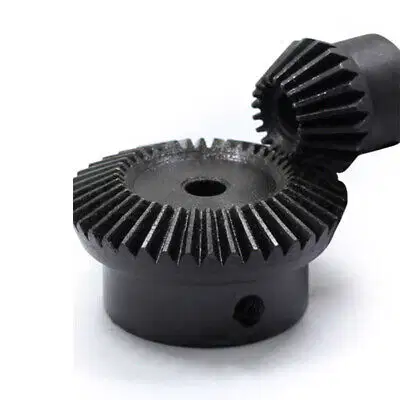
What is the primary function of a bevel gear in a mechanical system?
To convert linear motion to rotary motion
To increase the speed of rotation
To maintain constant torque
To change the direction of a shaft's rotation


The purpose of the universal joint is to
connect two axles together
allow two separate axles to rotate together over separate angles
allow 2 axles to bend
rotate 2 axles over 90 degrees
The universal joint
increases speed
increases torque
has constant speed and torque
Why is it important to handle the universal joint with care during testing?
It is made up of fragile components that can come loose
It is designed to break after repeated use
It cannot handle any rotational force
It only works if the shafts are kept at 0° angle

In what way does the universal joint benefit the movement of the rotating shafts?
It prevents the shafts from moving at all
It allows the shafts to rotate at higher speeds
It enables the shafts to rotate at angles
It forces the shafts to stay in a fixed, straight-line position
What is a key characteristic of a universal joint?
It only allows motion in a straight line
It limits the rotation of shafts to small angles
It restricts movement between connected shafts
It provides flexibility in connecting shafts at different angles
Why do designers and engineers create concept sketches?
To present final, detailed blueprints
To create a work of art to showcase to clients
To avoid labeling or describing their designs
To conceptualize and communicate their design ideas
How does concept sketching benefit communication?
It replaces verbal communication entirely.
It helps convey complex ideas more simply.
It allows for more precise measurements.
It focuses only on aesthetic (attractive) appeal.
Why are labels or descriptions important in a concept sketch?
They help explain the details of the design solution.
They make the sketch look more artistic.
They take away from the overall appearance of the sketch.
They are unnecessary if the picture is clear.
What should a concept sketch include in addition to drawings?
Precise scale and measurements
Final product specifications
3D renderings
Labels or descriptions
Which of the following is true about a good concept sketch?
It only needs to communicate the design ideas effectively
It must be a detailed and highly polished drawing
It should include precise measurements and scale
It is unnecessary to include any written descriptions
What is a key characteristic of a concept sketch?
It must be highly detailed and accurate
It should only include the drawing, not any labels
It is a freehand drawing that includes labels or descriptions
It should always be created using a ruler and compass

What is needed in the design sketch to improve it?
A __________ is a diagram that represents an algorithm, work flow, or process, and uses geometric symbols connected by arrows to show the direction of the flow of action.
Flowchart
Illustration
Data
Information

What does the Oval illustrate in a flowchart?
Beginning and end points
Actions
Yes/No or True/False questions
Connects symbols to show the direction of flow of action

What does the Rectangle illustrate in a flowchart?
Beginning and end points
Actions
Yes/No or True/False questions
Connects symbols to show the direction of flow of action

What does the Rhombus illustrate in a flowchart?
Beginning and end points
Actions
Yes/No or True/False questions
Connects symbols to show the direction of flow of action

Keep repeating a part of a flowchart with this construct
loop
algorithm
document
diamond

