Wayground logo

Free Printable Worksheets

Font size

S
M
L
XL
Worksheets

Water Cycle Review

Total questions: 20

Worksheet time: 30mins

Name
Class
Date
1.
Precipitation occurs because 
a)
the droplets evaporate in the air
b)
the droplets are too light for the air to hold
c)
the droplets are too heavy for the air to hold
2.
What part of the water cycle does this picture show?
a)
condensation
b)
precipitation
c)
evaporation
3.
This is a picture of what?
a)
Permeable rock
b)
Impermeable rock
c)
spring
d)
Artesian Well
4.
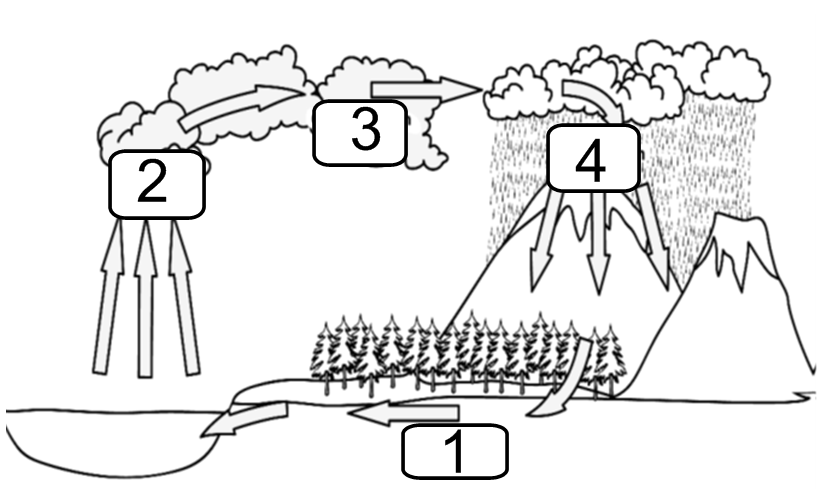
Which stage does the #3 show in the diagram?
a)
condensation
b)

evapotranspiration

c)
precipitation
d)
run off
5.
The ___________________ the grain size, the faster the water will move through the soil.
a)
more mixed
b)
smaller
c)
larger
6.
When water turns into a gas
a)
condensation 
b)
evaporation
c)
precipitation
7.
Groundwater feeds the river systems.  Groundwater and surface water are connected, not separate.  Consequently, water wells may remove or intercept groundwater that was on its way to springs that feed streams and rivers.  What can happen to water level if too many wells are placed together?
a)
they may cause the water table to rise
b)
they may draw down the water table
c)
the rivers will all run dry
d)
rainwater will stop falling
8.

How does groundwater occur?

a)

It doesn't occur

b)

Rain seeps into the ground until it is completely saturated

c)

it just happens at random

d)

When water runs off the surface due to maximum saturation

9.
Impermeable materials...
a)
have an abundance of pores.
b)
let water in.
c)
have little to no pores.
10.

What is a drawback to the extensive use of irrigation?

a)

crops don't receive sufficient water

b)

flooding increases

c)

groundwater levels decrease

d)

pollution increases

11.
Which stage does the #2 show in the diagram?
a)
condensation
b)
evaporation
c)
precipitation
d)
run off
12.
What variable is the same between all three containers?
a)
Porosity
b)
Permeability
c)
Capillarity
d)
Infiltration Rate
13.

As permeability increases

a)

Infiltration decreases and runoff decreases

b)

Infiltration increases and runoff decreases

c)

Infiltration decreases and runoff increases

d)

Infiltration increases and runoff increases

14.

__________________ is the process by which moisture is carried through plants from roots to small pores on the underside of leaves, where it changes to vapor and is released to the atmosphere. It is essentially evaporation of water from plant leaves.

a)

Transpiration

b)

Percolation

c)

Infiltration

d)

Plant Uptake

15.

This is the source of energy that heats up the water to start the  water cycle. 

a)

Sun

b)
moon
c)
Mars
16.
What is condensation?
a)
The part of the water cycle when the sun heats up water, turning it from a liquid into water vapor or steam. It rises from the ground into the air.
b)
The part of the water cycle when the water vapor in the air gets cold. The water turns back into a liquid and forms clouds.
c)
The part of the water cycle when clouds get heavy and can no longer hold the liquid water. This causes the water to fall from the sky to the earth as rain, snow, sleet, or hail.
17.

Water droplets forming on the outside of your glass

a)

Evaporation

b)

Condenstation

c)

Precipitation

18.
Water flows through permeable materials ____________________ than impermeable materials.
a)
slower
b)
faster
19.
What is evaporation?
a)
The part of the water cycle when the sun heats up water, turning it from a liquid into water vapor or steam. It rises from the ground into the air.
b)
The part of the water cycle when the water vapor in the air gets cold. The water turns back into a liquid and forms clouds.
c)
The part of the water cycle when clouds get heavy and can no longer hold the liquid water. This causes the water to fall from the sky to the earth as rain, snow, sleet, or hail.
20.
What is the water cycle?
a)
When water rides a bike. 
b)
The movement of water between Earth's surface and atmosphere. 
c)
How water is created. 
d)
How water is destroyed.