
Font size
 Worksheets
Force and Motion Review
Total questions: 20
Worksheet time: 40mins

A teacher pushes a bookshelf with a constant force across a classroom floor. How can the teacher increase the change in motion of the bookshelf?
add more books to the shelf
put all the books on the middle shelf
have more teachers push the bookshelf in the same direction
push the bookshelf with the same force in the opposite direction
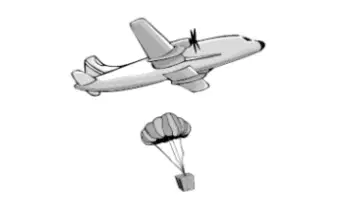
Emergency workers drop a box of supplies from a moving airplane. The package falls quickly through the air until the parachute opens. Then, the package falls at a slower rate. Which statement describes the force that slows the fall of the package?
The open parachute decreases the force of gravity.
The airplane forms currents near the airplane.
The air pushes up against the parachute.
The magnetic force from the airplane attracts the parachute.

The city of Toledo, Ohio is 200 miles north of Cincinnati, Ohio. The table shows the schedule for the train traveling between the two cities with no stops. Which departure time is the fastest train to Cincinnati?
8:30
9:15
3:55
7:00

Kevin and Max each push a wheelbarrow across a field. Kevin pushes Wheelbarrow A with a greater force than Max pushes Wheelbarrow B. Both wheelbarrows have equal mass. Which statement describes the position of the two wheelbarrows on the number line after five seconds?
Both wheelbarrows arrive at line 3 on the number line at the same time.
Wheelbarrow B travels faster along the number line than wheelbarrow A.
Both wheelbarrows travel at the same constant speed along the number line.
Wheelbarrow A travels a greater distance along the number line than Wheelbarrow B.

A squirrel runs 10 meters across a lawn, then 10 meters up a tree. The squirrel runs one meter every second. How many seconds does it take for the squirrel to run across the lawn and up the tree?
2 seconds
10 seconds
20 seconds
100 seconds
Which statement is true about objects that are at rest (not moving)?
Very heavy objects will not move even if a very strong force acts on them.
Very light objects begin to move without a force acting on them.
Objects at rest move unless a force holds them in place.
Objects at rest will not move unless a force acts on them.
Scientists measure the speed of lizards when running to catch prey and when running to escape predators. The scientists conclude the lizards run fast if they are running after prey, but they run even faster if they are running away from predators. Select the two variables the scientists could use to measure the relative speed of running lizards to support their conclusion.
color of the lizard's skin and length of the lizard's tail
number of prey a lizard catches and number of predators hunting the lizard
speed of the lizard running toward and away from its habitat
distance the lizard runs and time it takes the lizard to travel that distance
A student pushed a cart in a straight line for three trials. In the first trial she applied a small force to the cart. In the second trial she applied a medium force, and in the third trial she applied a large force. She observed the relationship between the force she applied and the change in speed of the cart. Which bar graph shows the relationship between the force applied to the cart and the change in speed in the student’s three trials?


Two identical wagons, A and B, are next to each other on a flat surface. The wagons are not moving and are not touching.
The student wants Wagon A to have a greater increase in its speed than Wagon B when an equal force is applied to both wagons.
What could the student do to one of the wagons to achieve this result?
Put a bag filled with books in Wagon A only.
Put a bag filled with books in Wagon B only.
Push Wagon A towards the right instead of straight.
Push Wagon A toward the left and push Wagon B toward the right.
A teacher is pushing a cart filled with books down a hallway with a wooden floor. Which change would help the teacher move the cart more easily?
putting fewer books in the cart
removing the wheels from the cart
carrying the cart instead of rolling it
laying carpet over the wooden floor
Students design toy cars and then race them against each other. They record the following measurements during the competition.
• Distance traveled
• Weight of car
• Time traveled
• Volume of car
What should students do to calculate the average speed of each toy car?
Divide the weight of each toy car by its volume.
Divide the volume of each toy car by its weight.
Divide the distance traveled by each toy car by the time traveled.
Divide the time traveled by each toy car by the distance traveled.

Four boxes are lifted straight up from the ground to a shelf. Each box has a different mass, as shown in the table. Which box requires the smallest force to lift it off the ground?
L
M
N
O
Scientists use electronic devices to collect data about birds during a migration.
These data are shared on the Internet for anyone to view. A student analyzes the
data and concludes that one bird flies at a speed of 20 meters per second during a portion of its migration.
What are two types of data the student needs to form this conclusion?
the bird's habitat and food main food source
direction of the wind and the bird's wing length
bird's locations and time between each data point
direction the bird flies and number of predators of the bird

An ant crawls up a table leg from point X to the top of the table to point Y. Then it crawls across the tabletop to point Z. The graph lines show that each square measures 50 cenimeters (cm) in length. It took the ant 2 minutes (min) to walk from point X all the way to point Z. What was the aveage speed of the ant?
4 cm/min
25 cm/min
100 cm/min
200 cm/min

In the picture, the dots show where a toy car is at certain times. What statement correctly describes the motion of the toy car?
It is sitting still.
It is speeding up.
It is slowing down.
It is moving at a constant speed.
A delivery truck makes a trip from Akron, Ohio to Columbus, Ohio. The truck departs from Akron at
4:00 pm and arrives in Columbus at 6:00 pm. The truck travels a distance of 120 miles. What is the average speed of the truck during the entire journey?
20 m/h
30 m/h
60 m/h
65 m/h

A student stacks books on a skateboard and pushes it down the hall. Click on each change the student could make that would result in the skateboard reaching the end of the hall faster.
Push the skateboard with less force.
Push the skateboard with greater force.
Remove some of the books.
Stand the books upright.
Replace the books with heavier objects.

A student applies a constant force to the pedals of a bicycle to travel at a constant speed on a calm day. Suddenly, a strong gust of wind blows straight toward the front of the student. Which statement describes the motion of the student on the bicycle immediately after the wind started to blow, if the student continues to apply the same constant force to the pedals?
The motion sped up.
The motion reversed.
The motion slowed down.
The motion remained constant.
A group of students places two identical carts on a flat surface. One cart is empty and the other is full of
blocks. The students push the carts across the surface. Each student pushes with the same force for the
same amount of time. Which cart will speed up the most?
the full cart pushed by one student
the full cart pushed by two students
the empty cart pushed by one student
the empty cart pushed by two students
Which list shows what can happen to the motion of an object when only one force is acting on the object?
the object speeds up, slows down, sits at rest
the object changes direction, speeds up, slows down
the object moves at constant speed, speeds up, slows down
the object moves at a constant speed, changes direction, speeds up

