
NEW
Font size
 Worksheets
Chemistry Quizs
Total questions: 17
Worksheet time: 9mins

Total number of neutrons for the following isotope
0
1
2
3
Complete the nuclear fission reaction: @@^{235}_{92}U + ^{1}_{0}n \rightarrow ^{142}_{56}Ba + ^{91}_{36}Kr + 3@@ What is missing after the 3 in the equation?
@@^{1}_{0}n@@
@@^{2}_{1}H@@
@@^{0}_{-1}e@@
@@^{4}_{2}He@@
Oxygen is in column 16.
It has 5 valence electrons
It has 6 valence electrons
It has 7 valence electrons
It has 8 valence electrons
Total number of protons in the nucleus of an atom with two electrons in its first shell and six electrons in its second shell.
6
7
8
9
Elements in Group 17 include Bromine, Chlorine, Fluorine, and Iodine. What happens to the valence electrons and energy shells as you go down the column?
Valence electrons increase and energy shells stay the same
Valence electrons stay the same (7) and the energy shells increase
Valence electrons decrease and energy shells increase
Valence electrons stay the same and energy shells decrease
The difference between oxygen-16 and oxygen-18
Oxygen-16 has 8 neutrons and oxygen-18 has 10 neutrons.
Oxygen-16 has 6 neutrons and oxygen-18 has 8 neutrons.
Oxygen-16 has 10 neutrons and oxygen-18 has 12 neutrons.
Oxygen-16 has 8 neutrons and oxygen-18 has 6 neutrons.
Mass number of every chlorine atom.
32
34
35
36
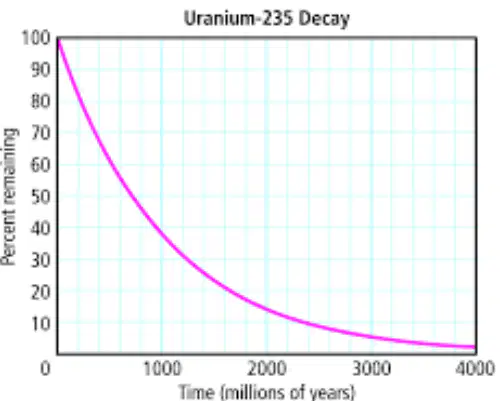
After 2000 million years, what percentage of uranium-235 remains?
5%
10%
15%
20%
The atomic radius of elements in a period (row) ______ as you move left to right.
increase
decrease
stay the same
fluctuate

Atomic number for the following isotope
1
2
3
4
Why is oxygen-16 neutral?
It has 8 protons and 8 electrons.
It has 7 protons and 9 electrons.
It has 8 protons and 7 electrons.
It has 9 protons and 8 electrons.
Benefits of nuclear fusion as a source of energy
Less nuclear waste as products
High levels of carbon emissions
Limited availability of hydrogen fuel
Increased risk of nuclear accidents
Mass number of an atom with 8 protons and 8 neutrons.
14
15
16
17
Elements in the same group (column) have similar chemical properties
They have the same number of protons
They have the same number of neutrons
They have the same number of valence electrons
They have the same atomic mass

Is this reaction fusion or fission?
Fusion because it starts with 2 smaller nuclei and makes 1 larger nucleus
Fission because it splits a larger nucleus into smaller nuclei
Fusion because it involves the release of energy from a single nucleus
Fission because it combines two smaller nuclei into one larger nucleus
Identify the mass of the isotope represented by 11H .
0
1
2
3
Comparison of atomic masses for the starting materials in fusion and fission.
Fusion uses heavier nuclides compared to fission.
Fusion uses lighter nuclides compared to fission.
Fusion and fission use nuclides of the same mass.
Fission uses lighter nuclides compared to fusion.

