
 Worksheets
Topic A1, A2, A3 Revision Quiz [20 marks]
Total questions: 20
Worksheet time: 40mins
A sky diver is falling at terminal speed when she opens her parachute. What are the direction of her velocity vector and the direction of her acceleration vector before she reaches the new terminal speed?
velocity - upwards, acceleration - upwards
velocity - upwards, acceleration -downwards
velocity - downwards, acceleration - upwards
velocity - downwards, acceleration -downwards
A stone is thrown downwards from the edge of a cliff with a speed of 5.0 m s⁻¹. It hits the ground 2.0 s later. What is the height of the cliff?
20 m
30 m
40 m
50 m
A ball is thrown upwards at an angle to the horizontal. Air resistance is negligible. Which statement about the motion of the ball is correct?
The acceleration of the ball changes during its flight.
The velocity of the ball changes during its flight.
The acceleration of the ball is zero at the highest point.
The velocity of the ball is zero at the highest point.
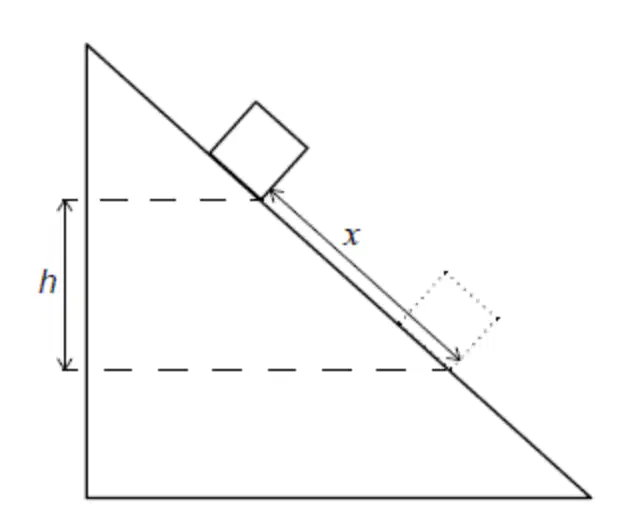
An object of mass m is sliding down a ramp at constant speed. During the motion it travels a distance x along the ramp and falls through a vertical distance h. The coefficient of dynamic friction between the ramp and the object is μ. What is the total energy transferred into thermal energy when the object travels distance x?
mgh
μmgh
μmgx
mgx
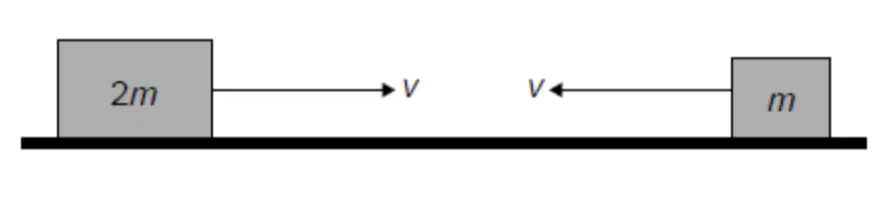
Two blocks of masses m and 2m are travelling directly towards each other. Both are moving at the same constant speed v. The blocks collide and stick together. What is the total momentum of the system before and after the collision?
momentum before = mv,
momentum after = mv
momentum before = mv,
momentum after = -mv
momentum before = 3mv,
momentum after = -3mv
momentum before = 3mv,
momentum after = 3mv
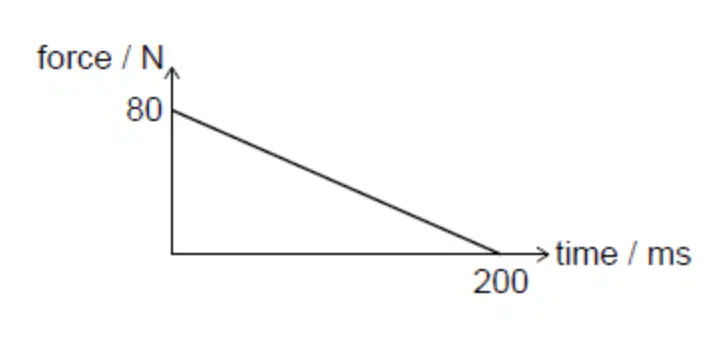
The graph shows the variation with time of the resultant net force acting on an object. The object has a mass of 1kg and is initially at rest.
What is the velocity of the object at a time of 200 ms?
8 m s–1
16 m s–1
8 km s–1
16 km s–1
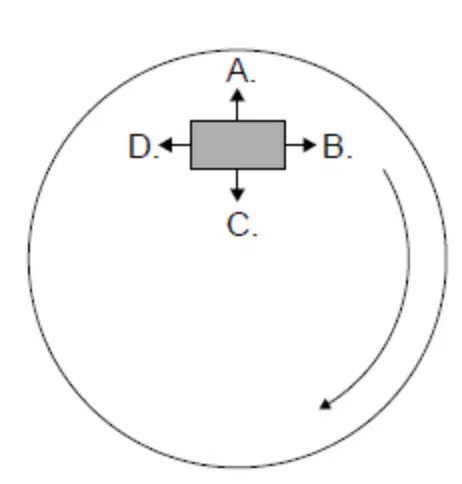
A block is on the surface of a horizontal rotating disk. The block is at rest relative to the disk. The disk is rotating at constant angular velocity. What is the correct arrow to represent the direction of the frictional force acting on the block at the instant shown?
A.
B.
C.
D.
A book is at rest on a table. What is a pair of action-reaction forces for this situation according to Newton’s third law of motion?
the force of the book on the table - the force of the book on the Earth
the force of the table on the Earth - the force of the book on the table
the force of the Earth on the book - the force of the book on the Earth
the force of the Earth on the book - the force of the table on the book
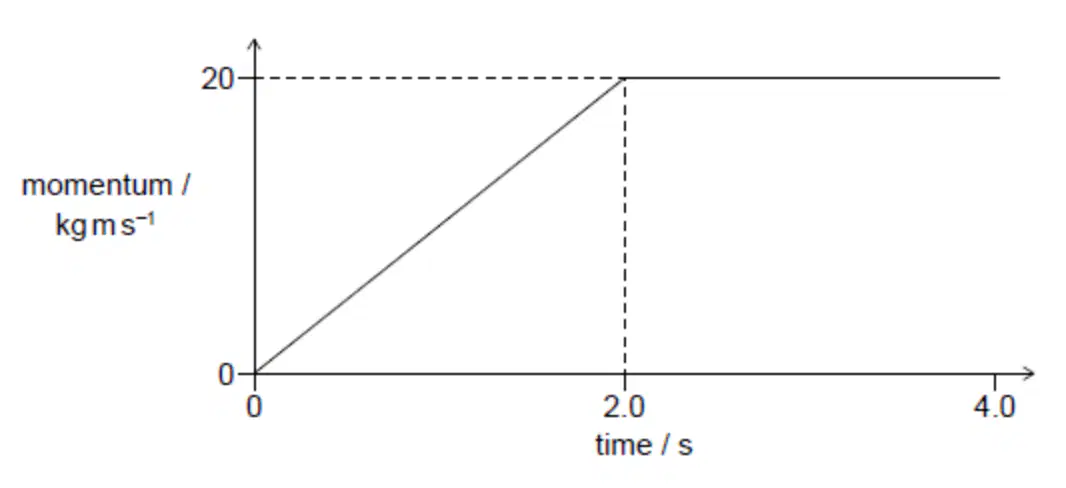
The graph shows the variation of momentum with time for an object.
What net force acts on the object for the first 2.0 s and for the second 2.0 s of the motion?
Force for first 2.0 s = 10N, Force for second 2.0 s = 0N
Force for first 2.0 s = 20N, Force for second 2.0 s = 40N
Force for first 2.0 s = 10N, Force for second 2.0 s = 40N
Force for first 2.0 s = 20N, Force for second 2.0 s = 0N
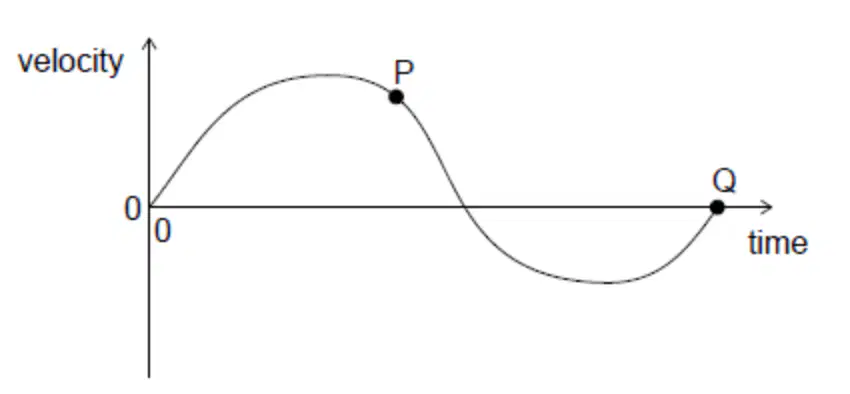
The graph shows the variation of velocity of a body with time along a straight line. What is correct for this graph?
The maximum acceleration is at P.
The average acceleration of the body is given by the area enclosed by the graph and time axis.
The maximum displacement is at Q.
The total displacement of the body is given by the area enclosed by the graph and time axis.
Two forces of magnitude 12 N and 24 N act at the same point. Which force cannot be the resultant of these forces?
10 N
16 N
19 N
36 N
A boat with an output engine power of 15 kW moves through water at a speed of 10 m s⁻¹. What is the resistive force acting on the boat?
0.15 kN
0.75 kN
1.5 kN
150 kN
A fuel has mass density ρ and energy density u. What mass of the fuel has to be burned to release thermal energy E?
uρE
ρuE
Eρu
ρuE
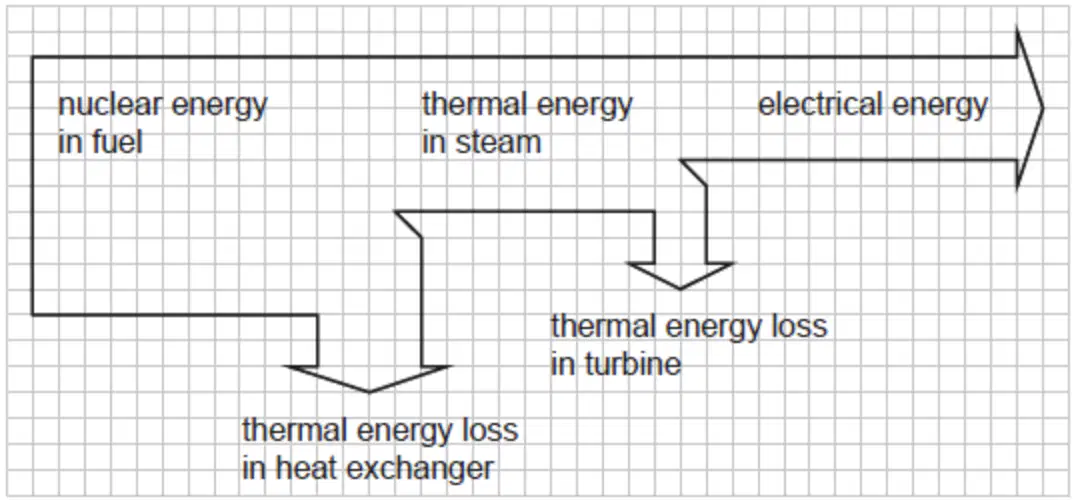
The Sankey diagram shows the energy transfers in a nuclear power station. Electrical power output of the power station is 1000 MW. What is the thermal power loss in the heat exchanger?
500 MW
1000 MW
1500 MW
2500 MW
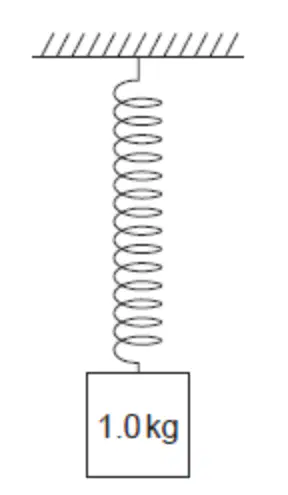
An object of mass 1.0 kg hangs at rest from a spring. The spring has a negligible mass and the spring constant k is 20 N m⁻¹. What is the elastic potential energy stored in the spring?
1.0 J
2.5 J
5.0 J
10 J
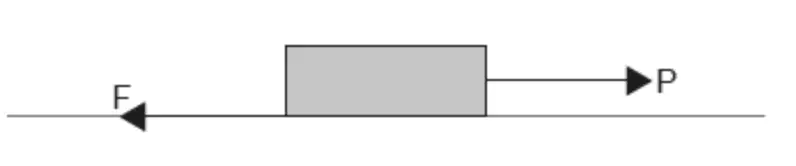
A block rests on a rough horizontal plane. A force P is applied to the block and the block moves to the right. There is a coefficient of friction μd giving rise to a frictional force F between the block and the plane. The force P is doubled. Will μd and F be unchanged or greater?
μd and F will be unchanged
μd will be unchanged, F will be greater
μd will be greater, F will be unchanged
μd and F will be greater
The input power of an electric motor is 200 W. It is used to raise a mass of 10 kg at constant speed. If the efficiency of the motor is 40%, through what height will the mass be raised in 1 second?
0.5 m
0.8 m
1.2 m
2.0 m
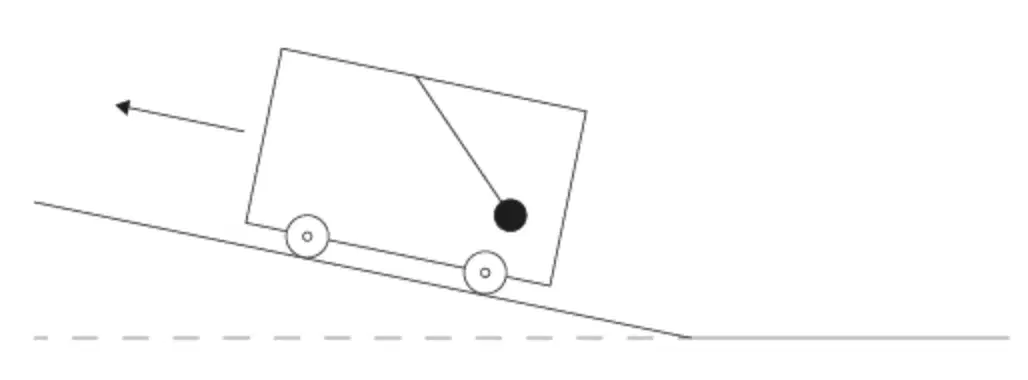
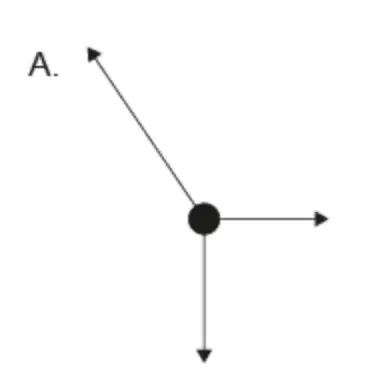
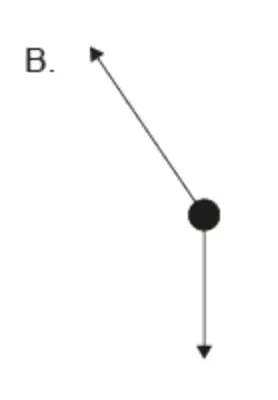
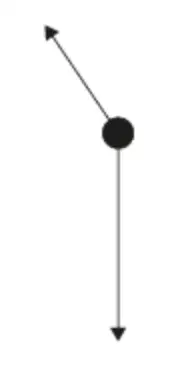
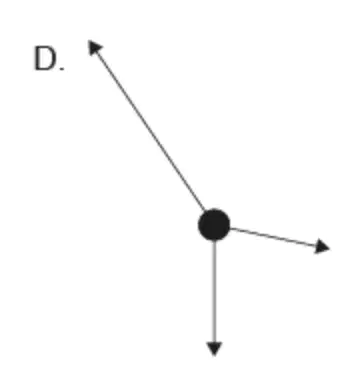
A mass is suspended by a light string from the roof of a car. The car is accelerating up an incline. What is the free-body diagram for the mass?
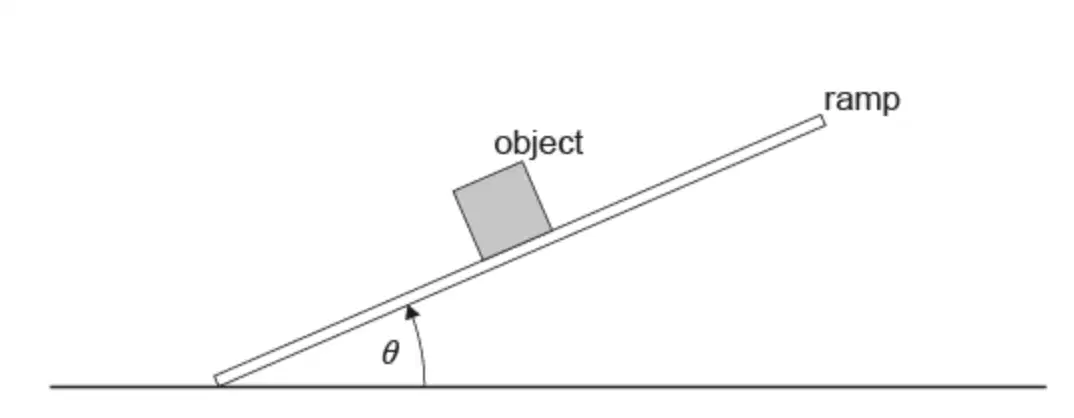
The angle θ between a ramp and a horizontal surface slowly increases from zero. An object on the ramp does not slide as θ increases. The frictional force on the object is
constant.
negligible.
proportional to cos θ.
proportional to sin θ.
An object is suspended from a spring balance. When the object is in air the spring balance reads 900 N. When the object is completely submerged in water the spring balance reads 400 N.
The density of water is 1000 kg m−3.
What is the volume of the object?
0.04 m3
0.05 m3
0.09 m3
0.5 m3

