
Font size
 Worksheets
Unit 3 AoS1 Deforestation revision
Total questions: 32
Worksheet time: 17mins
What is the main underlying driver of deforestation and forest degradation worldwide?
Wars and civil conflict
Economic growth
Corruption
Lack of regulation
What is the leading direct cause of deforestation worldwide?
Mining
Urban expansion
Agriculture
Construction of infrastructure
Which of the following is NOT an environmental impact of deforestation?
Increased biodiversity
Soil erosion
Increased greenhouse gas emissions
Loss of habitat for wildlife
What is the primary goal of the REDD+ program?
To promote economic development from forestry
To reduce emissions from deforestation and forest degradation
To encourage monoculture farming
To increase mining development
What is afforestation?
The conversion of forests into farmland
Planting trees in an area where there were no previous forests
The re-establishment of forests after logging
Where the train stops in the middle of the forest
Until the mid-1900s, the main location of deforestation was the temperate forests of the world (China, Europe, North America, Australia). Is this statement:
True
False
Since the mid 1900s the majority of deforestation has occured in tropical forests due to rampant deforestation in the developing world (S.E. Asia, Latin America, Africa). Is this statement:
True
False
Approximately what percentage of the Earth's land area is covered by forests?
11%
31%
51%
71%
What is the term for a forest that has never been logged or disturbed by humans?
Primary forest
Secondary forest
Plantation forest
Monoculture forest
What type of logging practice is the most destructive to forests?
Selective logging
Clearfelling
Shelterwood cutting
Seed tree retention
What is the biggest driver of deforestation in the Amazon rainforest?
Illegal mining
Infrastructure development
Cattle ranching
Urbanisation
How does deforestation impact local climates?
It decreases temperatures
It increases rainfall
It leads to higher temperatures and reduced rainfall
It has no impact on local climates
Which continent currently has the highest rate of deforestation?
Europe
North America
South America
Africa
Approximately what percentage of Cameroon’s land area is covered by forests?
10%
25%
40%
60%
What is the primary driver of deforestation in Cameroon?
Urbanisation
Agriculture, especially palm oil and rubber plantations
Industrialisation
Tourism development
What year was Cameroon’s Forestry Law introduced?
1984
1994
2004
2014
Which rainforest is found in Cameroon?
Amazon
Congo Basin
Boreal Forest
Daintree
What is one of the key aims of the REDD+ Mount Cameroon initiative?
Expanding industrial logging
Creating conservation areas and supporting local communities
Combating commercial mining
Developing palm oil industry
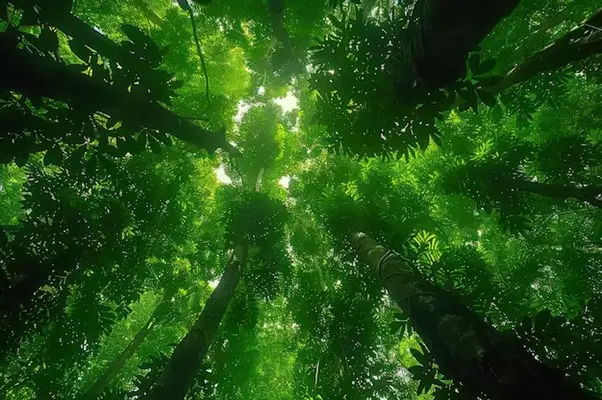
Is this image an example of:
closed forest (>80% canopy cover)
open forest (50-80% canopy cover)
woodland (<50% canopy cover)
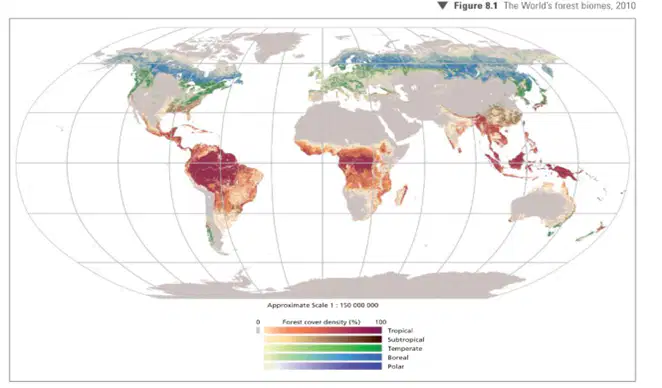
Which of the following statements about the distribution of forest types is incorrect?
Tropical forests are concentrated in the Amazon Basin, Central Africa, and Southeast Asia, close to the equator.
Boreal forests are found in the Northern Hemisphere, across Canada, Russia, and Scandinavia.
Areas of temperate forests are found in every continent
Subtropical forests are present in parts of China, the southeastern United States, and South America.
Which is not a natural process causing deforestation worldwide?
Insects, pests and diseases
Wildfires
Natural climate change on a long term timescale
Woodfuel collection
While human activities are the primary direct cause of deforestation, these also influence natural processes that make the deforestation worse, creating a feedback loop. Therefore, there is an (a) between natural processes and human activities in causing deforestation.
Studies have shown that the economic benefits that come from logging or conversion to farmland are higher than the total economic value of maintaining intact forest systems. Is this statement:
True
False
Forests are the most significant carbon ‘sink’. They store 54% of terrestrial carbon, more than the atmosphere. Deforestation is estimated to contribute approximately this much to global greenhouse gas emissions.
5%
10-25%
40-50%
80-90%
Challenges to using remote sensing to assess and manage deforestation include:
Cloud cover or moisture over forests
The high cost of advanced technology and high res imagery
The need to verify the data collected by ‘ground truthing’
All of the above
What is one thing that geospatial technology cannot be used for:
Locating appropriate areas for logging operations
Assessing the nature of forest change over time
Taking political action to reduce deforestation
Evaluating the success of management strategies
Which is not one of the goals of the UNFF Strategic plan for forests 2017-2030?
Reverse the loss of forest cover worldwide through sustainable forest management, protection, afforestation and restoration
Enhance forest based economic, social and environmental benefits, including improving the livelihoods of forest dependent people
Increase the amount of protected forest globally
Increase economic development in forestry and agricultural sectors in developing countries
Without the maintenance of very large blocks of interconnected forest, there is a risk that hundreds of species could become extinct. Large mammals such as gorillas and elephants are particularly affected because of the vast areas they require to survive. The process of breaking up large, continuous forested areas into smaller, isolated patches, due to human activities is called:
Reforestation
Forest fragmentation
Deforestation
Afforestation
Illegal logging is difficult to accurately assess, but in Cameroon it is estimated to be what % of total timber production?
10-20%
30-40%
50-60%
60-90%
What is not a positive economic impact of palm oil production in Cameroon?
Contributes to rural development and infrastructure improvements
Estimated 11,000 jobs in CDC’s palm oil sector
Employs 5,000 workers in large company Socapalm
Displacement of Indigenous communities
The forests of Cameroon are home to approximately 4 million forest dependent people, including 50,000 Indigenous people who rely on hunting and gathering of non-timber forest products.
True
False
Which is NOT a measure of Cameroon’s 1994 Forestry Law?
Appointing government observers to oversee logging concessions
Creation of community forests
Ensuring logging revenues benefit communities
Creation of permanent Forests

