
 Worksheets
Moral Values
Total questions: 167
Worksheet time: 2hrs 47mins
What is the significance of value education in personal development?
Value education focuses solely on academic success.
Value education is significant in personal development as it cultivates ethical values, critical thinking, and emotional intelligence.
Value education promotes competition over collaboration.
Value education is irrelevant to emotional well-being.
How do core values in UHV contribute to individual growth?
Core values in UHV are irrelevant to individual growth.
Core values in UHV discourage self-reflection and personal development.
Core values in UHV focus solely on academic achievements.
Core values in UHV contribute to individual growth by promoting self-reflection, accountability, and interpersonal skills.
In what ways does value education influence ethical decision-making?
Value education discourages ethical decision-making.
Value education influences ethical decision-making by providing a moral framework, promoting critical thinking, and fostering empathy.
Value education has no impact on personal values.
Value education only focuses on academic success.
What role do values play in shaping societal norms and behaviors?
Values only affect personal preferences, not society.
Values have no impact on societal norms.
Values are irrelevant to individual behavior.
Values shape societal norms and behaviors by establishing the principles that define acceptable conduct and influence individual actions.
How can individuals integrate values into their daily routines?
Focus solely on financial goals
Ignore personal beliefs
Identify core values, set aligned goals, practice mindfulness, and reflect on choices.
Avoid self-reflection
Why is it important to teach value education in schools?
Value education is important in schools to instill moral values and social responsibility in students.
Value education is only necessary for high school students.
Teaching value education distracts from academic subjects.
Value education is not relevant in today's digital world.
What are some examples of core values emphasized in UHV?
integrity, respect, excellence
honesty
teamwork
kindness
How does understanding ethics relate to value education?
Understanding ethics is only important for legal studies, not for value education.
Ethics is unrelated to value education and has no impact on decision-making.
Understanding ethics is fundamental to value education as it guides individuals in making morally sound decisions and developing positive values.
Value education focuses solely on academic performance without ethical considerations.
In what ways can values impact community relationships?
Values impact community relationships by fostering trust, cooperation, and understanding, or by causing division and conflict.
Values have no effect on community relationships.
Values are irrelevant to trust and cooperation in communities.
Values only impact individual behavior, not communities.
What strategies can be used to promote values in everyday life?
Focus solely on individual success
Avoid discussing values with others
Ignore personal values
Model behavior, engage in community service, practice gratitude, encourage open discussions.
what is the meaning of moral values?
Moral values are ideas that society considers important. They are at play when a person interacts with the wider world or has to make a decision that will have a consequence on others.
moral values don't care about their feelings.
moral values is only when they don't care who are not responsible about it.
moral values thinks bad cares about or only who are not independent too.
moral values care people and making their decision on their own?
true
false
other option
none of them
define moral values.
morals are the rules which people use to guide their behavior and thinking.
moral thinks bad values.
or just only making funny people.
just not guide vacs pace vets only to make their funniest life for ever.
moral thinks good.
(a)
moral values are the way they thinks us only?
yes
no
add option
all of them
What does sympathy mean?
Why people don't have patience in their life?
People don't have patience because they are conditioned to expect instant gratification.
.People lack patience because they have too much free time.
Integrity relates to _______,_______,_______.
(a)
Empathy means writing and waste time. true or false?
Why values are important in life?

what should you do when a stranger comes? and also is here when you and your family are sleeping?
do not do anything and sleep
call police and make some plan to catch the thief
welcome the thief and serve him food and water
sleep and mind your own biseness
do nothing
what is the meaning of discipline and hardwork?
sleep ,not study rest and be lasy for a long timeand not have a own time table in mind
play and a thing that means rest, rest and rest.
discipline means a thing that helps the man for his own life and also being a good resposible person for his needs.and .Hardworking could make ourselves different and good.
being a bad person.
what shoud you do when your friend is in trouble?
say a strict no.
beat him and say "never willl help you".
laugh and say that the friend is a fool.
help him from trouble and say " i am always here to help you friend".
All your friends think it’s funny to call a classmate by a horrible name that the child hates. Do you:
tell the child that ‘it’s just a joke’ and call the child by the name too to make your friends laugh
tell your friends that you feel it is mean to use put-downs and it is against your school’s values?
You find the answers to the class test you are having on Friday. Do you:
return the answers to the teacher without looking at them,
study the answers to get a good score on the test?
Gerald was a (a) king.
Hans saved the life of :-
England
Holland
France
India
What is the moral value we learn from the chapter :-Who will be the emperor?
Kindness
Truthness
Honesty
Bravery
Finish this sentence :-
Honesty is the ________.
Best
Bad
Best policy
None of the above
Which of them is not included in six pillars of good character?
Trustworthiness
Fairness
Cooperation
Helpfulness
Which human value is associated with trustworthiness?
Openness
Non-violence
Respect
Reliability
What is a positive feeling of esteem or deference for a person known as?
Respect
Loyalty
Responsibility
Justice
What is the responsibility of good citizen?
Do your share
Respecting authority and law
Voting and reporting wrong doing
All
Which is not correct about character?
Character is solid foundation on which a person's entire life is based.
Character can be build in very short period of time.
Character is the magic ingredient of life.
Character is a potpourri of many qualities.
What is the most important asset that human should have?
Money
Building
Popularity
Character
Hans saved the life of :-
England
Holland
France
India
Gerald was a (a) king.
taj mahal is located at-
agra
delhi
mumbai
uttarakhand
Which principle emphasizes considering the child's growth and development stages, interests, abilities, and needs in curriculum construction?
Which principle advocates for the inclusion of hands-on activities and practical learning in the curriculum?
What is the significance of community involvement in curriculum construction?
Which principle highlights the importance of catering to local conditions and individual needs in the curriculum?
Principle of Variety
Which principle emphasizes coordinating and correlating subjects in the curriculum?
Principle of Correlation
What is the purpose of an integrated approach in curriculum construction?
To ensure better assimilation of knowledge and values.
which principle emphasizes the inclusion of values such as socialism, democracy, and fraternity in the curriculum?
Principle of Values
Which principle emphasizes the inclusion of content directly related to real-life situations in the curriculum?
Principle of Life Situations
Which principle focuses on developing creative and constructive abilities through the curriculum?
Principle of Principle of utilizing creative and constructive ability
Which principle highlights the importance of including content and activities that promote cultural development and civilized knowledge?
The Principle of knowledge of culture and civilizations
Which principle emphasizes the need to include content that promotes health and good behavior patterns in the curriculum?
The Principle of health and conduct behavior pattern
What is the purpose of involving all life activities in the curriculum?
To develop physical, social, moral, emotional, intellectual, and political activities
Which principle emphasizes the inclusion of content and activities that develop interests and encourage leisure time activities?
Principle of training leisure time activities
What is the significance of considering individual needs, local contexts, and societal changes in curriculum construction?
It It fosters holistic development and relevance in education.
What is the overall objective of the principles of curriculum construction discussed?
To foster holistic development in students
Define Business Ethics
Who out of these is not a famous whistleblower?
Edward Snowden
M.S.Dhoni
V.P.SIngh
Manjunath
State of confusion about what is ethically right or wrong.
(a)
Do you think business units can be profitable along with being ethical?
Yes
No
Maybe
Which out of these are benefits of ethics in business?
High employee morale
Good public image
High employee turnover
Low market reputation

Identify this personality who has been a pioneer in the field of Corporate Social Responsibility
(a)
Listen to the audio and identify which product advertisement does this audio belong to?
Pepsi
KFC
Cadbury Silk
Adidas
Full form of CSR?
(a)
Ethics is derived from the ____________ word ‘ethos’.
Greek
Latin
Spanish
Japanese
Which of the following is not among the 3 R’s of business Ethics?
Respect
Results
Reliability
Responsibility
___________ is the oldest source of ethical inspiration.
Culture
Religion
Philosophy
Legal system
______________ Ethics is the rules and principles decided by upper management.
Societal
Managerial
Professional
Individual
___________ management is neither immoral nor moral.
Marketing
Business
Amoral
Finance
___________ is the duty or path of righteousness.
Dharma
Artha
Kama
Moksha
According to _________, ethics is the study of what is right or good in human conduct.
Robert Solomon
Churchill
William Shaw
Mackenzie
The 3 C's of business ethics were given by ________.
Churchill
Josephson Institute
Robert Solomon
William Shaw
There are ________ rules associated with the 3 C's of business ethics.
9
8
6
7
The basic justification of ethics is to ________________.
Maximize profitability
Behave according to agreed rules
Build a commercial reputation
All of the above
Shared values, norms, and artifacts that influence employees and determine behavior?
Cultural Audit
Organizational Culture
Ethics
Compliance
What is the United States federal law that mandates certain practices in financial record keeping and reporting for corporations?
Sarbanes-Oxley 404 Act of 2002
Sarbaines-Oxlei 404 Act of 2002
Sarbaines-Oxely 404 Act of 2002
Sardines-Oxlley 404 Act of 2002
These are significant factors in ethical decision-making
Ethics and Corporate Culture
Branding and Marketing
Education and Age
Rewards and Recognition
Match the words with their definition.
Business ethics
It is a set of guidelines for dealing with various procedures ethically.
Corporate responsibility
self-regulation instituted by companies by means of a formal integration into a respect.
Corruption
dishonest or illegal behavior especially by powerful people
Concern
anxiety; worry.
Stakeholder
individual or group that has an interest in any decision or activity of an organization.
Match the world with their definition.
Corporate environment
duty of a company to operate in a way that protects the environment.
Corporate ethics
a set of theories, principles, and values that govern business practices.
Integrity
the quality of being honest and having strong moral principles.
Accountable
responsibility


What is Ethics to do with?
Business
The wider community
Right and wrong
Nothing
A (n) ________ is a problem, situation, or opportunity requiring an individual, group, or organization to choose among several actions that must be evaluated as right or wrong.
Crisis
Ethical Issue
Indictment
Fraud
State of confusion about what is ethically right or wrong.
(a)
Do you think you are ethical?
Yes
No
Maybe
Not sure
Write one Ethical characteristics you have

Ethics is about doing the ______________ thing.
Profit
Right
Good
Newcastle Utd
Being ethical can bring benefits to businesses...
Higher costs to pay higher wages to workers and providing a safe working environment
Workers trust their employer, increasing motivation, productivity and retention which reduces costs.
"A standard of values that involve a concept of right and wrong and guide the way a business behave."
This statement explains about:
Laws
Ethics
Moral principles
Business ethics

How do ethical people face failure?
They try until they succeed
They try something else
They ask for advice
They complain and give up
Which moral problem is solved by Utilitarianism?
What makes actions morally right or morally wrong?
What is the best way of doing things?
What is the best economic choice?
How is it possibile to produce a good without wasting resources?
What does utilitarianism focus on?
Having fun
Being useful
The consequences of actions
The motivations for actions
How should actions be measured according to Utilitarianism
By how hard you try to do the right thing
By what your intentions were
By which rules you followed
By how much happiness or pleasure they produce
What do utilitarians believe should drive morality?
Being happy
Being sensible
External rules
Fear of God
Who does utilitarianism try to get the best outcome for?
the individual
the boss
the greatest number of people
the poor
Ethics is something related to a state of mind, a way of looking at things, which may develop into a pattern of behaviour, or way of life and social conduct.
True
False
It is the act consistent with the moral standards or codes of conduct established by society .
(a)
It is very often used, as a synonym for terms like values, norms, standards and morality, etc.
(a)
Give at least two unethical behaviors found in the workplace and how they affect the development of a company?
What is shareholder?
Own part of a public company because they have sold shares of the company
Own all part of a public company because they have bought shares of the company
Own part of a public company because they have bought shares of the company
Own all part of a public company because they have sold shares of the company
All stakeholders are shareholders, but not all shareholders are stakeholders
YES
NO
____________ have an interest in the performance of a company for reasons other than stock performance.
Shareholders
Stakeholders
Which are the three (3) components that associated with moral?
Values, customs and belief
Norms, customs and belief
Custom, values and belief
Norms, values and belief
Which one is the right one about sources of moral?
Business
Company
Ethics
Education
__________ principles that contain behavioural codes to determine what is right or wrong.
Customs
Moral
Ethics
Business Ethics
Business Ethics refers to _______ and ______ that define acceptable business conduct.
Principles and standards
Behavioural and principles
Behavioural and standards
Confidence and principles
Which one are the benefits of being ethical in business ethics?
i) Ethics contribute to employee commitment
ii) Ethics contribute to investor loyalty
iii) Ethics contributes to customer satisfaction
iv) Ethics contribute to profits
i), ii) & iii)
ii), iii) & iv)
i), ii), iii) & iv)
i), ii) & iv)
The reality in the human life process known as _______
Golden Rule of Transcendent
The Reality of Golden Rule
The Golden Rule of Life
Transcendent Reality
Does to others what you want others to do to you is known as ________
The Golden Rule of Life
Transcendent Reality
The Reality of Golden Rule
Transcendent of Golden Rule
How many pillars of Islam?
2
3
4
5
How many pillars of Iman?
6
5
4
3
Which are the pillars of Islam?
i) Concern for an almsgiving to the needy
ii) Belief in the commissioned Messengers
iii) Self-purification through fasting
iv) Belief in the resurrection and the events of Qiyamah
ii) & iv)
i) & iii)
i) & iv)
ii) & iii)
As a Muslim, we should know what is right and what is wrong as part of ________
Sabr
Taqwa
Itqan
Istiqomah
This religion of ethics focus on love, grace, mercy and forgiveness. What is that religion?
Christian
Islam
Budha
Sikh
The difference between east and west culture of ethics is west culture support on liberal and east culture support on secularism.
YES
NO
Human rights, freedom of thought and rational thinking is the ideology of West culture.
YES
NO
Please list down the professional values in Islamic Management
List down all Noble Path of Buddhist Ethics

Integrity means-
A. Doing what is popular, even if it's wrong
B. Being honest and doing the right thing, even when no one is watching
C. Following orders without question
D. Avoiding difficult situations

Identify the action that demonstrates empathy.
A. Ignoring someone who is upset
B. Criticizing someone for their feelings
C. Trying to understand how someone else feels
D. Giving advice without listening

If you take responsibility for your actions, what are you doing?
A. Blaming others for your mistakes
B. Denying your involvement in a situation
C. Accepting the consequences of what you did
D. Ignoring the outcomes of your decisions

What is an example of respect in a conversation?
A. Interrupting someone to share your opinion
B. Listening carefully when someone else is speaking
C. Talking over someone who disagrees with you
D. Ignoring someone’s feedback

Why is self-discipline important?
A. It allows you to avoid all responsibilities.
B. It helps you achieve goals by staying focused.
C. It means letting others control your decisions.
D. It only matters for school or work.

Which of the following best represents gratitude?
A. Acknowledging and appreciating the good things in life
B. Complaining about what you don’t have
C. Taking things for granted
D. Expecting others to do things for you

A person shows humility when they:
A. Brag about their accomplishments
B. Act superior to others
C. Refuse to acknowledge anyone else’s success
D. Admit when they are wrong and accept feedback

What does accountability mean?
A. Taking credit for someone else’s work
B. Avoiding difficult responsibilities
C. Owning up to your actions and their outcomes
D. Ignoring rules and expectations

What does it mean to act with courage?
A. Avoiding challenges and conflicts
B. Taking risks only when there is no danger
C. Standing up for what you believe in, even if it’s difficult
D. Waiting for others to solve problems

Which of the following is an example of fairness?
A. Treating everyone equally regardless of their background
B. Favoring one group over another without reason
C. Making decisions that benefit only yourself
D. Ignoring someone’s concerns
Values can be defined as ….
Principles or standards people live by
The strong urges of a person
A person's intuition
The things a person seeks to achieve
We are stronger when we work together. This describes which Core Value?
Impact
Discovery
Teamwork
Inclusion
Which of the following is/are related to HONESTY?
I am accountable for my actions.
I am open with my strengths and weaknesses.
I am truthful and transparent.
All of the above

What is Personal branding?
The ability to communicate effectively with superiors, colleagues, and staff
The process of how to brand yourself, who you are and what you stand for
A marketing practice in which a company creates a name, symbol, or design that is easily identifiable as belonging to the company
Refers to activities a company undertakes to promote the buying or selling of a product or service
What is the significance of 'compassion' in personal values?
Compassion promotes empathy, kindness, and understanding towards others, fostering stronger relationships and contributing positively to society.
Compassion is only important in professional settings
Compassion has no impact on personal values
Compassion leads to selfish behavior and should be avoided
Describe 'generosity' as a personal value.
Generosity is about receiving more than giving.
Generosity means expecting something in return for your actions.
Generosity involves only giving to those who can benefit you.
Generosity as a personal value means giving without expecting anything in return.
What are values?
Money.
A big house.
Holidays.
Fast car.
Thoughts, ideas, and actions that are important to you.
Define Character.
A letter, number, or other mark or sign used in writing or printing.
A person in a novel, play, or movie.
The mental and moral qualities distinctive to an individual.
Strong __________________ means you have a high sense of moral and ethical behavior that earns the respect of others.
Cooperation
Confidence
Attitude
Character
Identify the category of the following value:
those you take for yourself and which constitute a critical part of your values and are apparent in attitudes, beliefs, and actions
religious values
personal values
social values
Your Top 2 values post assessment
What does the study of ethics involve?
The systematic analysis of societal norms.
Evaluating personal beliefs and values.
Examining and evaluating moral principles, values, and standards that guide behavior.
Studying legal regulations within society.

What is the role of ethical considerations in decision-making?
They provide a framework for avoiding decisions.
They guide individuals in making morally sound decisions.
They dictate specific choices without considering values.
They have no impact on the decision-making process.

How does ethical behaviour contribute to personal and professional relationships?
By promoting dishonesty and deception.
By fostering integrity, honesty, and responsibility.
By encouraging actions that disregard the well-being of others.
By creating conflicts and disputes in relationships.
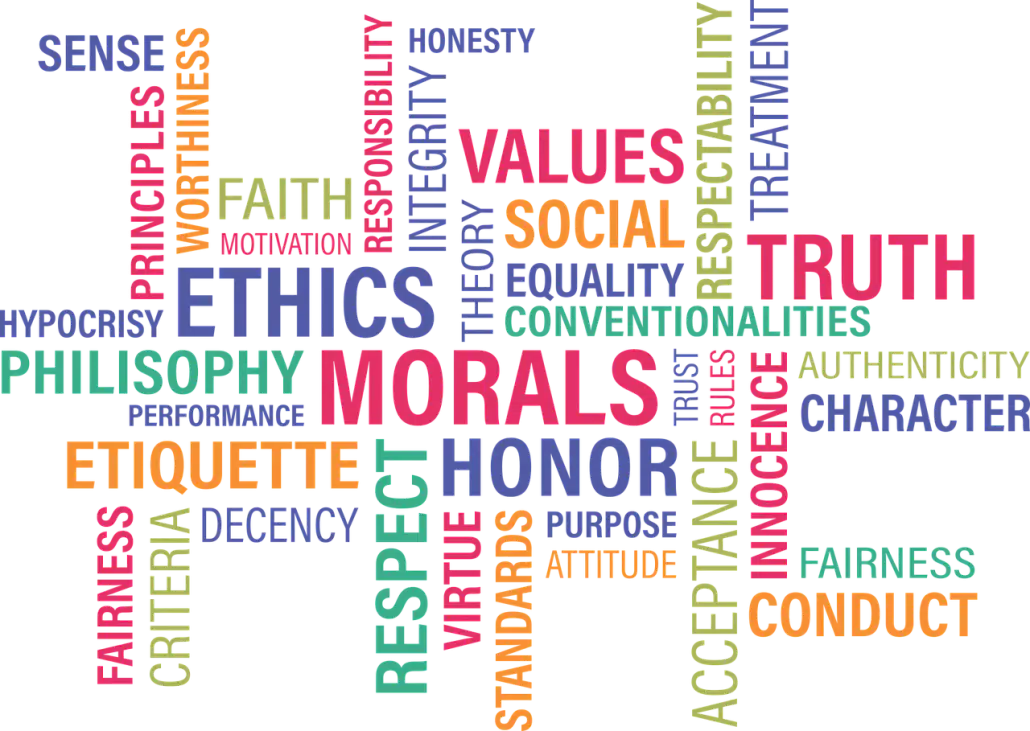
What characterizes a value?
It is imposed on individuals without their consent.
It arises from arbitrary and unintentional choices.
It is chosen willingly and independently, reflecting a deliberate choice.
It is influenced solely by cultural norms.

Which of the following influences an individual's values?
Media and religious affiliations.
Synderesis and moral identity.
Personal contemplation and cognitive processes.
Accumulation of wealth and status.
How do morals differ from morality?
Morality is personal beliefs, while morals are collective principles.
Morality involves the distinction between right and wrong, while morals refer to cultural norms.
Morality is situational, while morals are enduring and persistent.
Morals are individual beliefs, while morality is a broader concept encompassing shared principles.

According to Aristotle, what did he propose as essential for promoting the 'GOOD LIFE'? (Virtue Ethics)
Pursuit of wealth and status.
Engaging in noble actions and cultivating good habits.
Disregard of common interests.
Adherence to specific cultural norms.

What did C.S. Lewis believe about moral behaviour?
Moral behaviour is divinely inspired.
Moral behaviour involves prioritizing selfish needs.
Moral behaviour can be broken down into ensuring 'fair play', cultivating good people, and maintaining a positive relationship with the creator.
Moral behaviour is shaped solely by individual experiences.

In a scenario where a military force is considering engaging in war, which ethical framework is most likely to be used for justification, according to the information provided?
Virtue Ethics
Utilitarianism
Ethic of Care
Deontology
What does Deontology emphasize in moral actions?
The consequences of actions.
Moral character development.
The intentions behind actions.
The variability of virtues.
Suppose an individual consistently demonstrates qualities such as honesty, generosity, and justice through daily actions. According to which ethical theory is this person likely building up virtue?
Utilitarianism.
Deontology.
Virtue Ethics.
Agent-based normative theory.

Imagine a situation where an individual faces a moral dilemma and Virtue Ethics is applied. What aspect would be the focus when determining the ethical rightness of the decision?
The consequences of the decision.
The moral character of the decision-maker.
The adherence to a set of universal laws.
The overall happiness produced.
Which of the following is a characteristic of morality as described in the information?
Binary - either legal or illegal.
Grey areas with different perspectives.
Objective enforcement by government actors.
Formal regulation by the police.
What does the study of ethics involve?
The systematic analysis of societal norms.
Evaluating personal beliefs and values.
Examining and evaluating moral principles, values, and standards that guide behavior.
Studying legal regulations within society.
What is the role of ethical considerations in decision-making?
They provide a framework for avoiding decisions.
They guide individuals in making morally sound decisions.
They dictate specific choices without considering values.
They have no impact on the decision-making process.
How does ethical behaviour contribute to personal and professional relationships?
By promoting dishonesty and deception.
By fostering integrity, honesty, and responsibility.
By encouraging actions that disregard the well-being of others.
By creating conflicts and disputes in relationships.
What characterizes a value?
It is imposed on individuals without their consent.
It arises from arbitrary and unintentional choices.
It is chosen willingly and independently, reflecting a deliberate choice.
It is influenced solely by cultural norms.
Which of the following influences an individual's values?
Media and religious affiliations.
Synderesis and moral identity.
Personal contemplation and cognitive processes.
Accumulation of wealth and status.
How do morals differ from morality?
Morality is personal beliefs, while morals are collective principles.
Morality involves the distinction between right and wrong, while morals refer to cultural norms.
Morality is situational, while morals are enduring and persistent.
Morals are individual beliefs, while morality is a broader concept encompassing shared principles.
According to Aristotle, what did he propose as essential for promoting the 'GOOD LIFE'? (Virtue Ethics)
Pursuit of wealth and status.
Engaging in noble actions and cultivating good habits.
Disregard of common interests.
Adherence to specific cultural norms.
What did C.S. Lewis believe about moral behaviour?
Moral behaviour is divinely inspired.
Moral behaviour involves prioritizing selfish needs.
Moral behaviour can be broken down into ensuring 'fair play', cultivating good people, and maintaining a positive relationship with the creator.
Moral behaviour is shaped solely by individual experiences.
In a scenario where a military force is considering engaging in war, which ethical framework is most likely to be used for justification, according to the information provided?
Virtue Ethics
Utilitarianism
Ethic of Care
Deontology
What does Deontology emphasize in moral actions?
The consequences of actions.
Moral character development.
The intentions behind actions.
The variability of virtues.
Suppose an individual consistently demonstrates qualities such as honesty, generosity, and justice through daily actions. According to which ethical theory is this person likely building up virtue?
Utilitarianism.
Deontology.
Virtue Ethics.
Agent-based normative theory.
Imagine a situation where an individual faces a moral dilemma and Virtue Ethics is applied. What aspect would be the focus when determining the ethical rightness of the decision?
The consequences of the decision.
The moral character of the decision-maker.
The adherence to a set of universal laws.
The overall happiness produced.
Which of the following is a characteristic of morality as described in the information?
Binary - either legal or illegal.
Grey areas with different perspectives.
Objective enforcement by government actors.
Formal regulation by the police.

