

wayground logo

Free Printable Worksheets

Font size

S
M
L
XL
Worksheets

Enlightenment Quiz

Total questions: 21

Worksheet time: 11mins
Name
Class
Date
1.
3. Which of the following would most likely agree with the form of government supported by Louis XIV?
a)
A. Thomas Hobbes
b)
B. John Locke
c)
C. Jean-Jacques Rousseau
d)
D. Baron de Montesquieu
2.
4. How did Cesare Beccaria view the role of government in people’s lives?
a)
A. Governments should treat prisoners fairly and with respect.
b)
B. Governments should create laws advocating capital punishment.
c)
C. Governments should create laws that allow torture for political prisoners.
d)
D. Governments should allow political prisoners who have committed treason to go free.
3.
5. Which of the following were causes championed by Enlightenment thinkers? Choose the three correct answers.
a)
B. abolition of serfdom
b)
D. social equality of the classes
c)
E. separation of church and state
d)
A. divine right of kings
e)
C. censorship of the press
4.
6. Which of the following grievances are cited in the Declaration of Independence? Choose the three correct answers.
a)
A. King George III ruled like a tyrant.
b)
B. King George III violated the colonists’ natural rights.
c)
F. King George III and Parliament ruled without the colonists’ consent.
d)
C. King George III had no right to appoint royal governors.
e)
D. King George III was not a legitimate ruler of the British nation.
5.
10. Which of the following characteristics of American government reflects the enlightened thought of Voltaire?
a)
A. Federalism
b)
B. Bill of Rights
c)
C. Republicanism
d)
D. checks and balances
6.
11. Which portion of the U.S. Bill of Rights was inspired by the writings of Cesare Beccaria?
a)
A. “. . . nor cruel and unusual punishment inflicted”
b)
B. “Congress shall make no law . . . [denying] the freedom of speech”
c)
C. “Congress shall make no law respecting an establishment of religion . . .”
d)
D. “The rights of the people . . . against unreasonable searches and seizures”
7.
12. According to John Locke, people form governments to protect their _________:
a)
A. social contracts
b)
B. loyalties
c)
C.natural rights
d)
D. philosophes
8.
13. Which of the following was NOT a result of the Enlightenment:
a)
A. Stimulation of religious tolerance
b)
B. Monarchies were given longer terms
c)
C. Inspired democratic revolutions around the world
d)
D. Applied reason to the human world
9.
14. Enlightenment ideas helped cause the:
a)
A. American Revolution
b)
B. Industrial Revolution
c)
C. Neolithic Revolution
d)
D. Scientific Revolution
10.
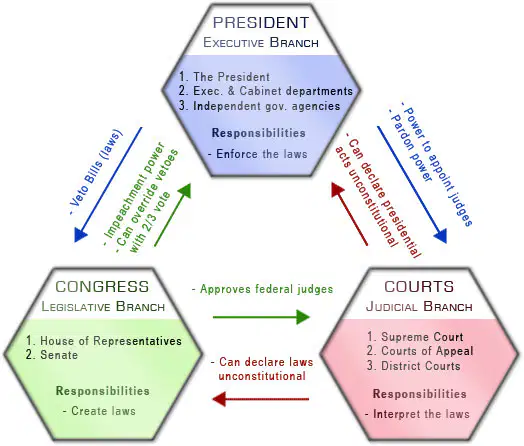
15. This graphic demonstrates what Enlightenment principle, developed by whom?
a)
The supremacy of legislature; Locke
b)
The supremacy of the legislature; Hobbes
c)
The separation of powers; Voltaire
d)
The separation of powers; Montesquieu
11.
16. “I think that people can't be trusted. They need to be controlled in order for society to work well."This statement expresses the views of:
a)
A. Hobbes
b)
B. Locke
c)
C. Voltaire
d)
D. Rousseau
12.
17. “I may not agree with a word you have to say but I will fight to my death for your right to say it.”The quote above illustrates which of the following concepts:
a)
A. Freedom of Religion
b)
B. Freedom of Assembly
c)
C. Freedom of Petition
d)
D. Freedom of Speech
13.
18.“Man is born free and everywhere he is in chains."The statement above illustrating the Social Contract was stated by:
a)
A. Jean-Jacques Rousseau
b)
B Rene Descartes
c)
C Voltaire
d)
D Mary Wollstonecraft
14.
19. Voltaire was a philosophe who defended
a)
A. The practice of slavery
b)
B. The Nobility
c)
C Freedom of Speech
d)
D The Free Market
15.
20. What did John Locke and Thomas Jefferson believe the people should do if their government did not protect their natural rights?
a)
A. Appeal to the national religion to protect their natural rights
b)
B. Peacefully protest to a higher authority
c)
C Overthrow their government
d)
D Change their natural rights
16.

Which Enlightenment thinker is known for advocating the idea of a 'social contract' where individuals consent to form a government?

a)

D. Voltaire

b)

A. John Locke

c)

B. Thomas Hobbes

d)

C. Jean-Jacques Rousseau

17.

Which Enlightenment philosopher's ideas greatly influenced the American Declaration of Independence?

a)

C. Voltaire

b)

D. Rousseau

c)

B. John Locke

d)

A. Montesquieu

18.

What was a key belief of Enlightenment thinkers regarding the role of reason in society?

a)

A. Reason should be subordinate to religious doctrine

b)

B. Reason is the primary source of authority and legitimacy

c)

C. Reason is irrelevant in political matters

d)

D. Reason should be used only in scientific inquiry

19.

21. Which Enlightenment thinker is known for his advocacy of the separation of church and state?

a)

A. John Locke

b)

B. Voltaire

c)

D. Jean-Jacques Rousseau

d)

C. Thomas Hobbes

20.

22. What was a major impact of the Enlightenment on the political landscape of Europe?

a)

D. Decline of scientific inquiry

b)

A. Strengthening of absolute monarchies

c)

B. Rise of democratic ideals

d)

C. Increased power of the church

21.

23. Which Enlightenment philosopher argued that the best form of government is one that has a system of checks and balances?

a)

D. Locke

b)

C. Rousseau

c)

B. Montesquieu

d)

A. Voltaire
