

wayground logo

Free Printable Worksheets

Font size

S
M
L
XL
Worksheets

Newton's/Kepler's Laws

Total questions: 20

Worksheet time: 41mins
Name
Class
Date
1.
Kepler's 2nd Law deals with 
a)
the shape of the planets' orbits
b)
the speed/area the planet travels 
c)
the length of time it takes the planet to orbit the sun
2.
The farther away a planet is from the sun, the _______ it takes it to orbit the sun once. 
a)
longer
b)
shorter
3.
What are the two factors that influence gravity the most?
a)
Mass and weight
b)
Weight and gravity
c)
Mass and distance
d)
Weight and distance
4.
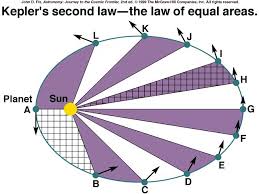
Where is the planet moving faster
a)
Position A to B
b)
Position B to C
c)
Position H to I
d)
Position I to J
5.
What is true about the area between points A, B and the Sun, and the area between points H, I and the Sun?
a)
The area between A, B and the Sun is the largest.
b)
The area between H, I and the Sun is the largest
c)
Both areas are equal in size
d)
There is not enough information to determine the areas
6.
Who created the Universal Law of Gravitation?
a)
Copernicus
b)
Newton
c)
Kepler
d)
Galileo
7.
Double the product of the masses of two objects
a)
4 times stronger gravity force
b)
4 times weaker gravity force
c)
2 times weaker gravity force
d)
2 times stronger gravity force
8.
Double the distance between two objects
a)
4 times greater gravity attraction
b)
4 times weaker gravity attraction
c)
2 times weaker gravity
d)
2 times greater gravity
9.

Which planet will take the most amount of time to revolve around the Sun?

a)

Mercury

b)

Venus

c)

Earth

d)

Mars

10.

Which statement best describes Kepler’s 2nd Law of Planetary Motion?​

a)

Planets revolve around the sun over equal areas in equal time intervals.

b)

Planetary orbits are in the shape of an ellipse.

c)

A planet’s orbital period is proportionate to its distance from the sun.

11.

When a planet or moon travels once fully in its orbit around a largest celestial body, it is a(n):

a)

Rotation

b)

Revolution

12.

A way of measuring distances in space. Equivalent to the distance from Earth to the Sun.

a)

Elipse

b)

Eccentricity

c)

Astronomical Unit

d)

Period

13.

The diagram is about....

a)

Kepler's First Law

b)

Kepler's Second Law

c)

Kepler's Third Law

14.

When Kepler compared the cube of the mean orbital radius to the square of the period, what did he discover which led him to discover his 3rd law?

a)

R^3 is always double the size of T^2

b)

R^3 is always smaller than T^2

c)

R^3 is always bigger than T^2

d)

R^3 and T^2 are identical

15.

An ellipse is drawn around two points called:

a)
aphelion
b)
perihelion
c)
foci
d)
axis
16.

SOLVE USING Kepler’s 3rd Law: (T2=D3)

A planet orbits the Sun (or any star) in 4.4 Earth years. What is its distance from the Sun (star) in AU?

a)

2.1 AU

b)

2.7 AU

c)

3.2 AU

d)

3.9 AU

17.

SOLVE USING Kepler’s 3rd Law: (T2=D3) *Same problem as prior...

A planet orbits the Sun (or any star) in 4.4 Earth years. What is its distance from the Sun (star) in MILES?

a)

1.9 x 10⁸ miles

b)

2.2 x 10⁸ miles

c)

2.5 x 10⁸ miles

d)

2.9 x 10⁸ miles

18.

SOLVE USING Kepler’s 3rd Law: (T2=D3) *Same problem as prior...

A planet orbits the Sun at a distance of 7.8 AU. What is its orbital period (time) in Earth YEARS?

a)

21.8 Earth Years

b)

20.2 Earth Years

c)

18.8 Earth Years

d)

11.4 Earth Years

19.
Predict the magnitude of the gravitational force a 66.5 kg person would experience while standing on the surface of Mars:
Mass 6.42 × 10^23 kg
Radius 3.40 × 10^6 m

a)
246 N
b)
38.5 N
c)
651 N
d)
0.692 N
20.
Luke Skywalker has a mass of 13 kg and weight of 127.4 N on earth. Find his weight on the Endor moon. Acceleration due to gravity of 2 m/s/s.
a)
254.8 N
b)
13 kg
c)
26 N
d)
127.4 kg