
 Worksheets
Year 6 History
Total questions: 30
Worksheet time: 32mins

An artifact, document, diary, manuscript, or other source of information created at the time of study is a ....
Primary Source
Secondary Source

A photograph is an example of a
Primary Source
Secondary Source

Your parents describing how your great grandfather came to Australia.
Primary Sources
Secondary Sources

Secondhand information is an example of a secondary source
True
False

Which of these is NOT an example of a primary source?
Original uniforms worn by soldiers
Diaries written at the time of an event
video of a historical event
A poem about a famous person from your classmate

Which of these is NOT an example of a secondary source?
Newspaper articles
Diary entry
Encyclopedia
Textbook

I am writing an essay on Albert Namatjira for my Australian history project. I used articles from Wikipedia and websites. What am I using?
Primary Source
Secondary Source
When was Federation
1991
1901
2001
2030

The main reason why the colonies decided to become one country was (a)
Which of the following were positive reasons for federation?
A larger range of foods
A National railway line
Australia would have stronger national defence
It would be cheaper to live in Australia
Before the federation, what were the six colonies of Australia?
Western Australia, South Australia, Victoria, New South Wales, Queensland, Tasmania
Northern Territories, Australian Capital Territory, Western Australia, South Australia, Queensland, Tasmania
Perth, Adelaide, Melbourne, Sydney, Brisbane, Hobart
Tasmania, South Australia, Victoria, Queensland, Northern Territories, Australian Capital Territory
Which of the following was a reason FOR Federation?
Rich colonies did not want to share their wealth with the poorer colonies.
Australia could be put on the world map.
It was too hard and too many important decisions would need to be made.
There would be one army, one postal service and one rail gauge.
What was the primary purpose of the Australian Federation?
To establish a monarchy in Australia
To unify the six colonies under a single federal government
To declare independence from the British Empire
To create a new currency
How did the federation impact the Indigenous peoples of Australia?
It immediately granted them the right to vote.
It led to the creation of policies that further dispossessed them.
It had no significant impact on their status or rights.
It provided them with equal rights under the new constitution.
What was the significance of the 'Yes' vote in the referendums for the Australian Federation?
It led to the immediate establishment of a federal army.
It was purely symbolic and had no legal standing.
It indicated public support for federation, leading to the creation of the Commonwealth of Australia.
It resulted in the immediate independence of Australia from British rule.
What did the colonies of Australia become after Federation?
Territories
A.C.T.
States
Areas

Locate Sir Henry Parkes in the photo?
Seated bottom right
Centre of the picture- man with a beard
Seated in the middle with a top hat
The pale suit on the left
Organize these options into the right categories
Loss of Colonial Power
Exclusion of Indigenous Peoples
Economic Inequality
Cost and Complexity
Unified Defence
Common Economic Policies
National Identity
Standardized Laws
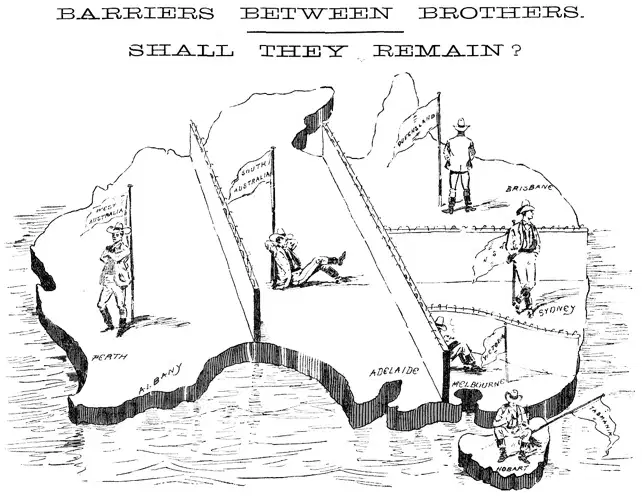
Why do you think this picture was created?
If you had the chance to vote in the referendum about whether Australia should federate or shouldn't federate - what would you vote and why??

