
 Worksheets
Driving Theory (HGV) - Practice Test #3 of 19
Total questions: 55
Worksheet time: 28mins
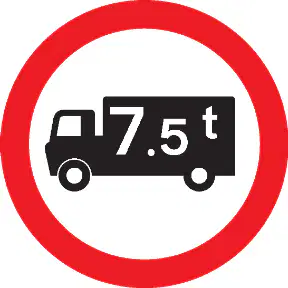
What does this road sign mean?
No goods vehicles under 7.5 tonnes maximum authorised mass
No goods vehicles under 7.5 metres overall height
No goods vehicles over 7.5 metres overall height
No goods vehicles over 7.5 tonnes maximum authorised mass
Which axle configuration is most effective at preventing petrol tankers from rolling over?
Tandem axles with double wheels
Tri-axles with double wheels
Tri-axles with single wheels
Tandem axles with air suspension
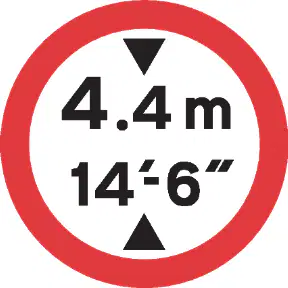
What does this sign mean?
No vehicles over 14 feet 6 inches (4.4 m) wide
No vehicles over 14 feet 6 inches (4.4 m) high
Road humps 14 feet 6 inches (4.4 m) apart
No vehicles over 14 feet 6 inches (4.4 m) long

What does this sign mean?
Trailer length must not exceed 6 feet 6 inches (2 metres)
The width of the road is 6 feet 6 inches (2 metres)
No vehicles over 6 feet 6 inches (2 metres) wide
No vehicles over 6 feet 6 inches (2 metres) high
Where can you park large vehicles at night without needing to use parking lights?
In most lay-bys
On a road with a 20 mph speed limit
In an off-road parking area
At least 10 metres (32 feet) away from any junction
Where should you park your trailer if you have to leave it unattended?
In a quiet residential area
On the public highway
On secure premises
In a public car park
The analogue tachograph on your vehicle becomes faulty. How long do you have before you must have it repaired?
Three days
Two weeks
One week
One day
How long is a digital tachograph driver card valid?
One year
Ten years
Five years
Three years
Your vehicle breaks down during a journey. You continue by driving in another vehicle with the same type of tachograph. What must you do with your tachograph chart?
Telephone the testing authority for permission to drive without a chart
Take it with you, and use it in the new vehicle
Take it with you for security, but use a new chart in the new vehicle
Leave it in the broken-down vehicle
In frosty weather, what precaution could a lorry driver take to prevent moisture from freezing in the air-brake system?
Drain the air tanks daily
Pump the brakes
Keep the engine at high revs when starting
Cover the air tanks with a blanket
Your vehicle is fitted with an air-assisted hydraulic braking system. What would warn you that the air compressor is not working?
The brake pedal feels spongy when pressed
The brake pedal has little resistance
The brake pedal feels hard when pressed
The brake pedal travels a long way
What should you do when an air-pressure warning device activates?
Pump the brake pedal repeatedly
Continue to drive the vehicle
Drain the air tanks
Stop and have the fault put right
What should you avoid when using an independent endurance brake (retarder) on slippery roads?
The drive wheels locking
The front wheels spinning
Anti-skid road surfaces
Brake-pad wear
What should you do at a zebra crossing?
Always leave the crossing clear in traffic queues
Rev your engine to encourage pedestrians to cross quickly
Park only on the zigzag lines on the left
Wave pedestrians to cross if you intend to wait for them
What should you do if you're driving along a motorway and become tired?
Leave the motorway at the next exit and take a rest
Close your windows and set the heating to warm
Close your windows and turn up the radio volume
Stop on the hard shoulder at a safe place to rest
What should you do if you're feeling tired but there's nowhere to stop safely?
Increase your speed to find a stopping place more quickly
Ensure a supply of fresh air
Gently tap the steering wheel
Keep changing speed to improve your concentration
Your vehicle breaks down on the hard shoulder of a motorway. What should you do if you decide to use your mobile phone to call for help?
Set the tachograph to 'Other work' before making the call
Stand at the rear of the vehicle while making the call
Use the speed-dial function to save time
Check your location from the marker posts on the left
How should you answer a mobile phone call while you're driving?
Keep one hand on the steering wheel
Reduce your speed wherever you are
Stop safely before answering
Slow down and allow others to overtake
What may result from a poor diet?
Lung disease
Deafness
Epilepsy
Heart disease
What should you do when you want to join a motorway where traffic is flowing freely?
Keep to a low speed until you see a gap on the motorway
Use the hard shoulder, if necessary, to build up speed
Stop at the start of the slip road and move off when you see a gap
Build up your speed on the slip road before joining the motorway
What ground conditions are suitable for a tipper lorry to tip its load?
Soft and level
Solid and level
Solid and uphill
Soft and downhill
What should you do when you park your vehicle on a two-way road at night?
Use the parking lights
Park underneath a street lamp
Put a traffic cone behind your vehicle
Switch off all lights
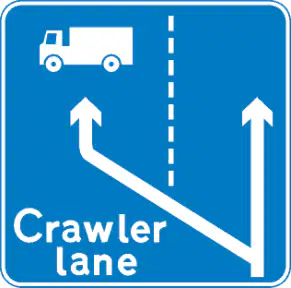
What does this motorway sign mean?
You're approaching a service area
You're approaching a long downhill slope
You're approaching a long uphill slope
You're approaching a 'lorries only' lane
In fast traffic, when should you leave a two-second gap between your vehicle and the one in front?
When the roads are dry
When you're driving in fog
When it's raining and the roads are wet
When the roads are icy
The entrances to roundabouts are often slippery when they're wet. How should you deal with this hazard?
Stay in the left-hand lane
Brake in good time
Use the handbrake
Stop before emerging
You're waiting for the emergency services to arrive at the scene of an incident. A pedestrian's leg is bleeding heavily, but there's nothing embedded in the wound. What could you do to help?
Wrap an ice pack near the wound
Apply firm pressure to the wound
Dab the wound to stop the bleeding
Put the casualty into the recovery position
While driving through a tunnel, your vehicle catches fire. What's the first thing you should do if the vehicle can't be driven out of the tunnel?
Wait for the police; tunnels are regularly patrolled
Don't put out the fire; wait for the emergency services
Stop at the side of the road and switch off the engine
Stay with your vehicle; you'll be seen by the CCTV cameras
You're at the scene of an incident. What would suggest someone is suffering from shock?
A. A flushed complexion
B. Being very hungry
C. Rapid shallow breathing
D. Being alert
Before starting a journey, you want to check your brake-system warning lights. What can you do when these aren't operated by the ignition switch?
Look for a check switch on the dashboard
Get someone behind to check your brake lights
Check them at the end of your journey
Pump the brake pedal a number of times
What could happen if you overfill your engine with oil?
Some gaskets might be damaged
The handling may improve
You could wait longer before the next service
Exhaust emissions could be reduced
What could happen if you overfill your engine with oil?
Longer service intervals
Lower emissions
Better handling
Loss of power
What's the best way to lift a heavy object?
Lift the load as quickly as possible
Twist your back while lifting
Have a stable position
Hold the load at arm's length
How should you load a vehicle?
Spread the load evenly
Load it towards the rear
Load it towards the front
Arrange the load to make it easy for unloading
34. You're covering a load using more than one sheet. Why should you start with the rearmost sheet, then work forwards?
A. To stop wind and rain from getting under the sheets
B. To make it easier to carry longer loads
C. To make it much easier to fold up the sheets
D. To stop you tripping when walking on the load
In what circumstances will short-wheelbase vehicles bounce more noticeably than long-wheelbase vehicles?
When turning
When laden
When empty
When travelling slowly
You're carrying another vehicle piggyback on your lorry. Chocks should be used to secure the wheels. What else should you use to secure the load?
Axle stands
A scaffolding bar
Restraining straps
Baffle plates
What additional training do you need before transporting frozen foods?
Packaging procedures
Weight-distribution procedures
Waste-handling procedures
Hygiene procedures
You're driving a lorry with a sleeper cab. When would a quick sideways glance be helpful?
When traffic is merging from the right or left
When driving round sharp bends
After driving over a pedestrian crossing
Before climbing a steep hill
What should you check just before you turn left?
The interior mirror
The left-hand mirror
The right-hand mirror
The overtaking mirror
You hold a full category C licence. What does this entitle you to tow?
A curtain-sided trailer
A trailer of any weight
A trailer with more than one axle
A trailer up to 750 kg
What will cause a noticeable increase in your vehicle's fuel consumption?
Using the endurance brake
Using electric windows
Using a manual sunroof
Using air conditioning
Why should you check for motorcyclists just before turning right into a side road?
They might be overtaking on your right
They might be overtaking on your left
They might be following you closely
They might be emerging from the side road
Why are motorcyclists advised to wear bright clothing?
They must do so by law
The colours are popular
To help other road users to see them
It helps to keep them cool in summer
You're about to overtake a motorcyclist when they look around over their right shoulder. What's the most likely reason for them doing this?
Something has fallen from the machine
The rider intends to move to the right
The drive chain is slack
The rear tyre is flat
You're following a motorcyclist along a potholed road. How should you adjust your driving to take account of this situation?
Drive alongside them
Stay close behind them
Try to pass them
Give them extra room
You're driving past parked cars. What should you do if you notice a bicycle wheel sticking out between them?
Accelerate past quickly and sound your horn
Slow down and be prepared to stop for a cyclist
Brake sharply and flash your headlights
Slow down and wave the cyclist across

At a junction, you see this sign partly covered by snow. What does it mean?
Give way
Stop
Turn right
Crossroads
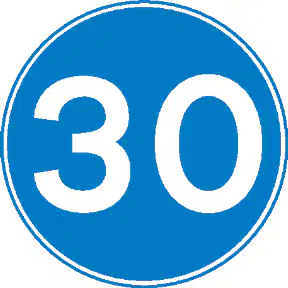
What does this sign mean?
Maximum speed 30 mph
Lay-by 30 miles ahead
Service area 30 miles ahead
Minimum speed 30 mph
What's a 'Red Route'?
An area where part-time traffic lights operate
An area where special waiting restrictions apply
An area where drivers have to pay a toll
An area where night-time and weekend weight limits apply
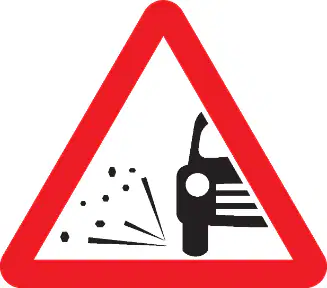
Why should you slow down when you see this sign?
To prevent grit from blocking your air filter
To avoid splashing others with water
To avoid throwing up loose chippings
To reduce the risk of a blow-out
What is the maximum authorised mass for goods vehicles?
5 tonnes
6.5 tonnes
7 tonnes
7.5 tonnes
What type of suspension is most stable for semi-trailers?
Dual-axles with double wheels
Single-axles with single wheels
Tri-axles with single wheels
Quad-axles with double wheels
What is the height restriction for vehicles?
12 feet 6 inches
14 feet 6 inches
16 feet 6 inches
18 feet 6 inches
What is the width restriction for vehicles?
4 feet 6 inches
5 feet 6 inches
6 feet 6 inches
7 feet 6 inches
Where should you park your vehicle to ensure safety?
On a public road
In a lay-by
In an off-road parking area
On a narrow road

