
 Worksheets
Self reflection and growth PPD1 WEEK 11 part 2
Total questions: 73
Worksheet time: 42mins

Self-assessment is a process by which individuals evaluate their own ________.
performance and skills
financial status
health condition
social relationships
Which of the following are key components of self-assessment?
A) Reflection
B) Evaluation
C) Goal-setting
D) All of the above.
One benefit of self-assessment according to Panadero et al., 2017 is:
Improved academic performance
Increased stress levels
Decreased motivation
Reduced learning outcomes
The benefit of active engagement in learning is:
Improved retention and understanding
Increased stress and anxiety
Decreased motivation
Reduced participation
Critical thinking benefits problem-solving skills by:
enhancing creativity and innovation
limiting the scope of solutions
focusing only on logical reasoning
ignoring emotional aspects
Independence plays a crucial role in lifelong learning by:
allowing individuals to make their own learning decisions.
restricting access to diverse learning resources.
limiting the ability to adapt to new information.
preventing collaboration with others.
How does self-assessment improve performance according to Brown and Harris (2013)?
By providing external feedback
By encouraging self-reflection and goal setting
By increasing competition among peers
By offering rewards for performance
Reflective Journaling is a technique used in self-assessment to:
record personal thoughts and experiences
evaluate others' performance
create a daily schedule
memorize information
What is Self-Grading in self-assessment techniques?
A method where students grade their own work
A technique for teachers to grade students
A system for peer evaluation
A tool for automated grading
What is Peer Feedback in self-assessment techniques?
A method where students assess their own work.
A method where students give feedback to each other.
A method where teachers assess students' work.
A method where students assess teachers' performance.
What is Goal-Setting in self-assessment techniques?
A method to identify personal objectives and create a plan to achieve them.
A technique to evaluate others' performance.
A strategy for financial planning.
A way to avoid setting any objectives.
Medical students use self-assessment to recognize areas needing improvement.
To identify strengths
To recognize areas needing improvement
To evaluate peers
To prepare for exams
Continuous self-evaluation enhances patient care capabilities by:
improving communication skills
identifying areas for improvement
increasing patient satisfaction
all of the above
The Mini-Clinical Evaluation Exercise (Mini-CEX) is a tool used for:
assessing clinical skills in a structured manner
providing feedback on research papers
evaluating theoretical knowledge
conducting large-scale surveys
What is the first step in the self-assessment practice activity?
Identifying learning goals
Reviewing feedback
Setting a timeline
Reflecting on progress

During the personal reflection step of the self-assessment practice activity, students should:
write a summary of what they learned
discuss with peers
take a break
ignore the activity

The purpose of the partner discussion in the self-assessment practice activity is to:
share personal experiences
evaluate each other's understanding
provide feedback
all of the above

Who developed the concept of Growth Mindset?
Albert Bandura
Carol Dweck
Sigmund Freud
B.F. Skinner

Growth Mindset contrasts with which other mindset?
Fixed Mindset
Open Mindset
Creative Mindset
Analytical Mindset

The core belief of Growth Mindset is that abilities develop through ________ and learning.
effort
luck
genetics
talent
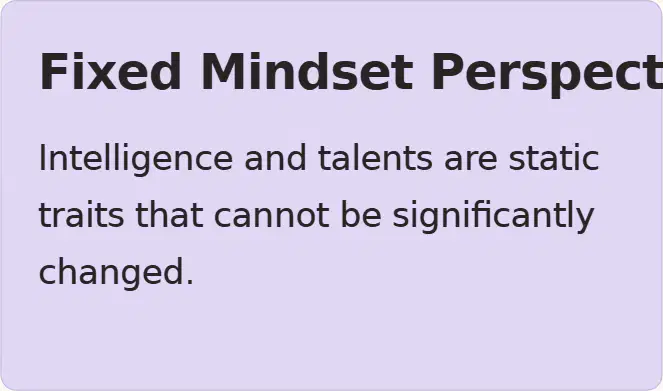
What is the perspective of a fixed mindset?
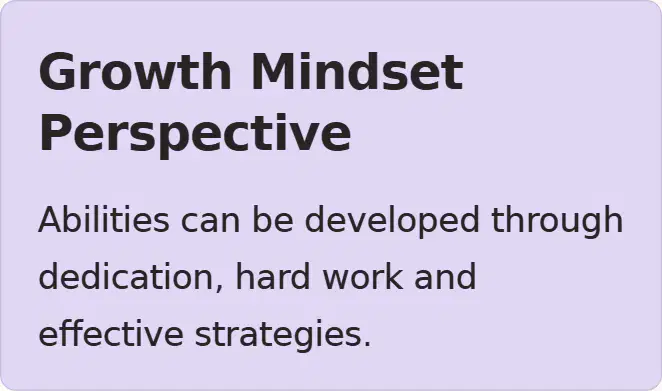
What is the perspective of a growth mindset?
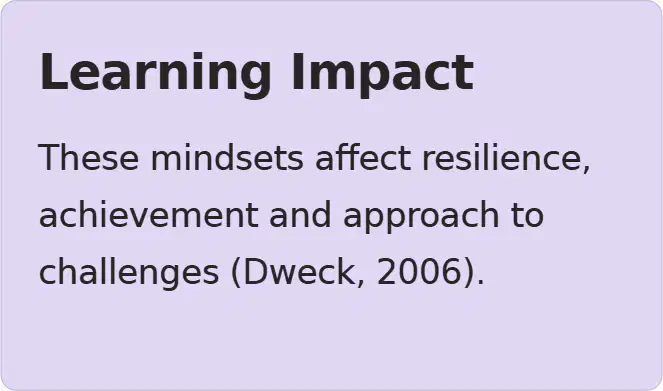
How do these mindsets affect learning impact?
They enhance learning by fostering a growth mindset.
They have no effect on learning.
They hinder learning by promoting a fixed mindset.
They only affect learning in specific subjects.

Embracing challenges in the context of a growth mindset means:
avoiding difficult tasks to prevent failure.
welcoming difficult tasks as opportunities to learn and grow.
focusing only on tasks that guarantee success.
ignoring challenges and focusing on strengths.

Persisting through setbacks contributes to a growth mindset by:
demonstrating resilience and adaptability
showing a fixed mindset
avoiding challenges
focusing on immediate success

Valuing effort is important in developing a growth mindset because:
it leads to fixed mindset.
it encourages learning and resilience.
it discourages trying new things.
it makes people complacent.

In what ways can learning from criticism enhance a growth mindset?
By fostering resilience and adaptability
By promoting fixed mindset traits
By discouraging feedback
By avoiding challenges

Being inspired by others' success can foster a growth mindset by:
Encouraging imitation of successful behaviors
Creating jealousy and competition
Promoting a fixed mindset
Discouraging personal growth
What is brain plasticity and how does it affect our brains throughout life?
Brain plasticity is the ability of the brain to change and adapt throughout life, affecting learning and memory.
Brain plasticity is a fixed trait that does not change after childhood.
Brain plasticity only affects the brain during early development and has no impact in adulthood.
Brain plasticity is a myth and does not have any scientific basis.
Learning activities influence neural connections in the brain by:
strengthening existing connections
weakening existing connections
creating new connections
all of the above
Effort and practice play a role in strengthening neural connections over time.
They weaken neural connections.
They have no effect on neural connections.
They strengthen neural connections.
They disrupt neural connections.

Scenario Recognition: How can students identify fixed vs growth mindset responses in common situations?
By observing the language used in responses
By analyzing the tone of voice
By considering the context of the situation
By evaluating the emotional response

Group Discussion: What are some different mindset approaches that teams can debate when faced with challenges?
Growth mindset vs. fixed mindset
Optimistic vs. pessimistic
Collaborative vs. competitive
All of the above

Reframing Practice: How can fixed mindset statements be transformed into growth-oriented perspectives?
By ignoring them
By accepting them as they are
By reframing them into growth-oriented perspectives
By avoiding any change

What does 'Recognise Fixed Thinking' mean in the context of developing a growth mindset?
It means identifying and challenging limiting beliefs.
It refers to accepting all thoughts as they are.
It involves ignoring negative thoughts.
It is about maintaining a positive attitude always.

How can 'Embrace Challenges' contribute to developing a growth mindset?
By avoiding difficult situations
By fostering resilience and learning
By maintaining a fixed mindset
By ignoring feedback

Why is it important to 'Focus on Process' when developing a growth mindset?
It helps in achieving goals faster.
It encourages learning and improvement.
It guarantees success.
It eliminates the need for effort.

What does 'Cultivate Learning Passion' involve in the context of a growth mindset?
Developing a love for learning and embracing challenges
Avoiding difficult tasks to prevent failure
Focusing solely on achieving high grades
Relying on innate talent rather than effort

What is the fixed statement mentioned in 'The Power of Yet'?
The statement that intelligence is static.
The statement that effort leads to mastery.
The statement that challenges are opportunities.
The statement that learning is a lifelong process.

What is the growth transformation statement in 'The Power of Yet'?
The Power of Yet is about embracing challenges.
The Power of Yet is about fixed mindset.
The Power of Yet is about giving up.
The Power of Yet is about immediate success.

What perspective shift is described in 'The Power of Yet'?
A shift from fixed mindset to growth mindset
A shift from pessimism to optimism
A shift from individualism to collectivism
A shift from traditional learning to experiential learning

What is the outcome of applying 'The Power of Yet'?
Improved mindset
No change
Negative impact
Immediate success

The focus of educational settings that embrace a growth mindset is:
achieving high test scores
developing fixed intelligence
fostering continuous learning and improvement
maintaining traditional teaching methods

How do growth mindset educational settings create supportive learning cultures?
By fostering a fixed mindset among students
By encouraging competition over collaboration
By promoting a culture of continuous learning and resilience
By focusing solely on academic achievements

What role does effort praise play in a growth mindset educational setting?
Effort praise encourages a fixed mindset by focusing on innate abilities.
Effort praise fosters a growth mindset by emphasizing the importance of effort and perseverance.
Effort praise has no impact on a student's mindset.
Effort praise discourages students from trying new things.

Normalizing productive failure is important in growth mindset education because:
it encourages students to embrace challenges and learn from mistakes.
it prevents students from making any mistakes.
it ensures that students always succeed without effort.
it discourages students from taking risks.
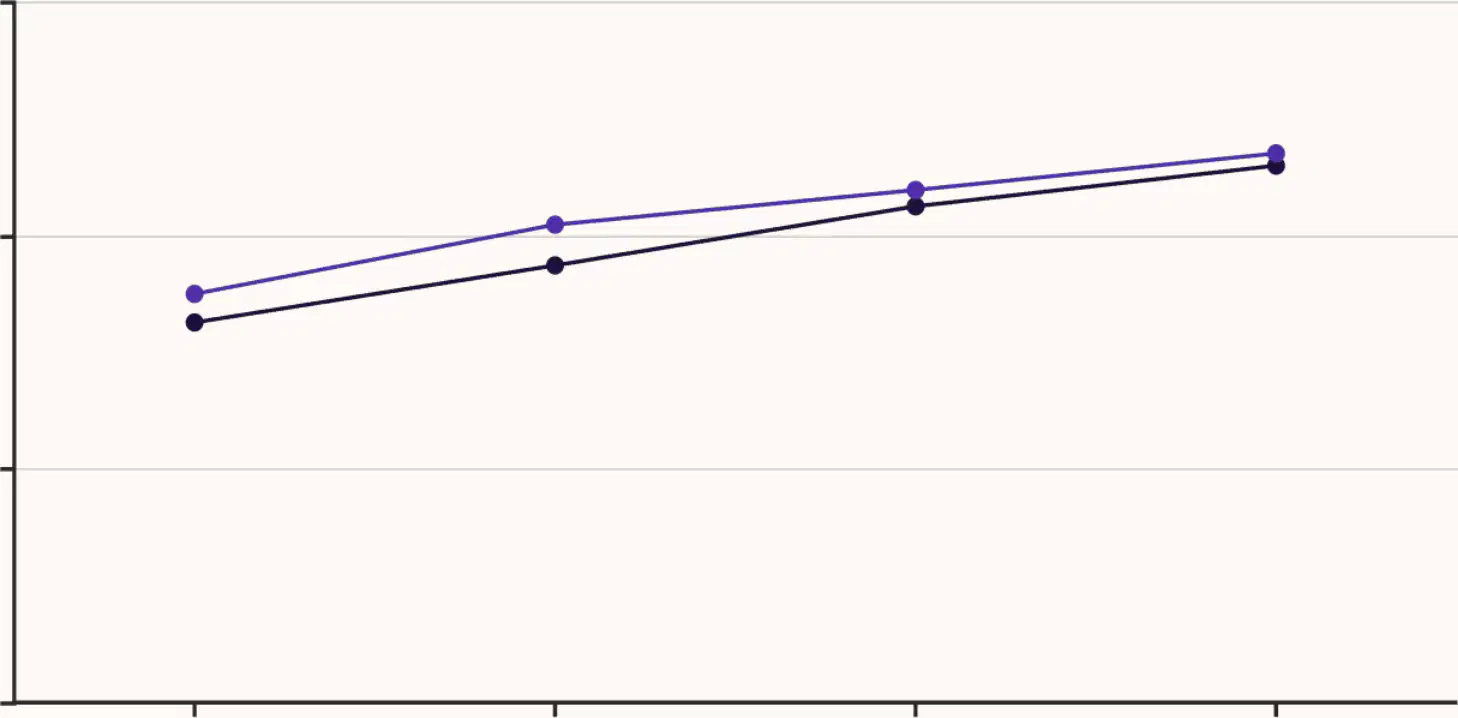
Based on the graph, which year shows the highest level of Employee Engagement?
2014
2016
2018
2020
How did CEO Satya Nadella transform Microsoft's culture according to the caption?
By implementing a growth mindset
By focusing on product innovation
By reducing workforce
By increasing profits
What is the first step in the Personal Growth Plan?
Identify your goals
Create an action plan
Evaluate your progress
Seek feedback
Setting SMART Goals in the Personal Growth Plan involves:
Specific, Measurable, Achievable, Relevant, Time-bound objectives
General, Vague, Unattainable, Irrelevant, Timeless goals
Random, Unstructured, Unclear, Unrelated, Unlimited targets
Broad, Undefined, Impossible, Insignificant, Infinite aims
Developing strategies in the Personal Growth Plan involves:
Setting clear goals and objectives
Ignoring feedback and reflection
Avoiding time management
Focusing solely on weaknesses
What methods can be used to track progress in the Personal Growth Plan?
Using a journal
Setting specific goals
Regular self-assessment
All of the above

Explain the role of a Self-Assessment Tool in recognizing growth opportunities.
A Self-Assessment Tool helps identify strengths and weaknesses.
A Self-Assessment Tool is used for financial planning.
A Self-Assessment Tool is primarily for entertainment purposes.
A Self-Assessment Tool is a marketing strategy.

How does Challenge Embracing contribute to persistence?
By fostering resilience and adaptability
By increasing stress and anxiety
By promoting avoidance behavior
By reducing motivation and effort

What is the importance of Strength Identification in tackling challenges?
It helps in recognizing personal abilities to overcome obstacles.
It is not relevant to overcoming challenges.
It makes challenges more difficult to tackle.
It has no impact on tackling challenges.

Improvement Areas are considered opportunities rather than judgments because:
they focus on potential growth and development.
they are a form of criticism.
they are used to evaluate performance.
they are mandatory requirements.

How does Goal Setting enhance motivation from a growth perspective?
By providing clear direction and focus
By increasing stress and pressure
By limiting personal growth
By discouraging effort and persistence

The importance of addressing bias in self-assessment is:
It ensures accurate self-evaluation and personal growth.
It helps in maintaining a biased perspective.
It is not necessary for self-improvement.
It complicates the self-assessment process.

External validation can improve self-assessment by:
Providing objective feedback
Increasing self-doubt
Reducing confidence
Encouraging complacency

Why is self-awareness development crucial for accurate self-assessment?
It helps in recognizing personal strengths and weaknesses.
It allows for better time management.
It improves physical health.
It enhances social media presence.

What role does continuous improvement play in self-assessment?
It helps identify areas for growth and development.
It serves as a final evaluation method.
It replaces the need for external feedback.
It is unrelated to self-assessment.
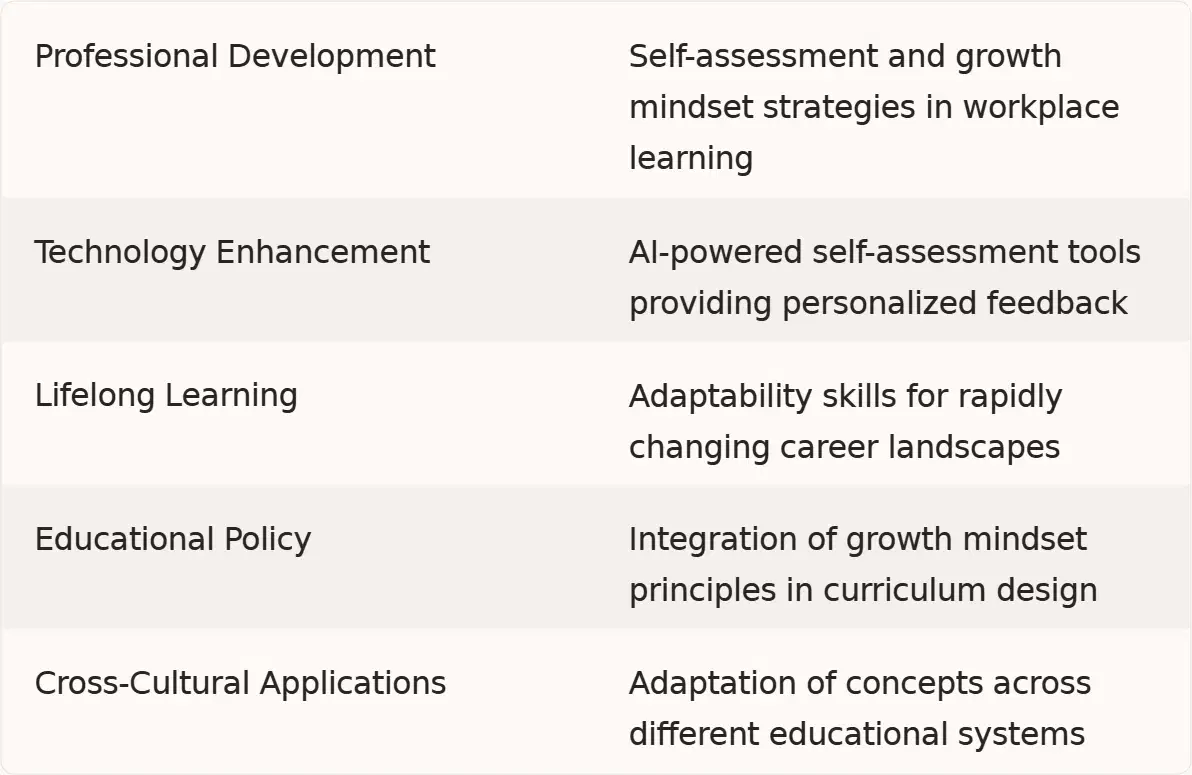
What are the future directions and applications for Professional Development?
Future directions include personalized learning paths and applications in various industries.
Professional development will remain static with no new applications.
There are no future directions for professional development.
Professional development will only focus on traditional methods.
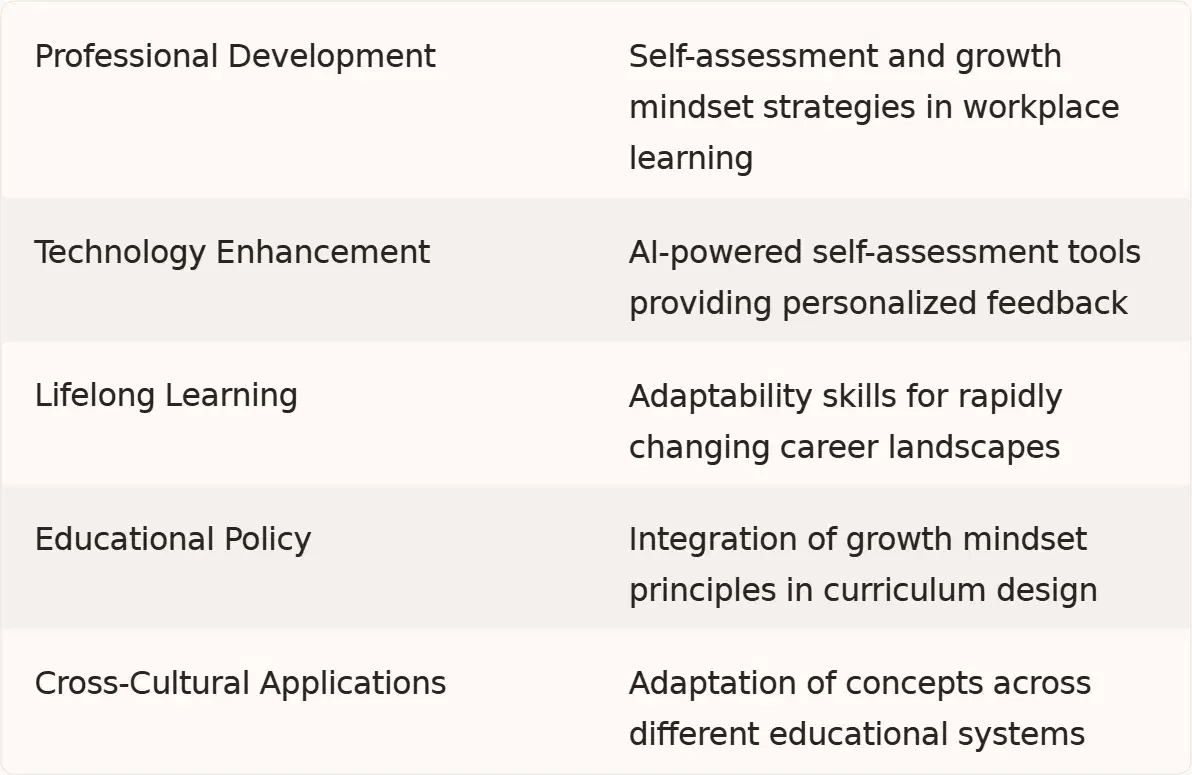
What are the future directions and applications for Technology Enhancement?
Artificial Intelligence and Machine Learning
Blockchain and Cryptocurrency
Quantum Computing
All of the above
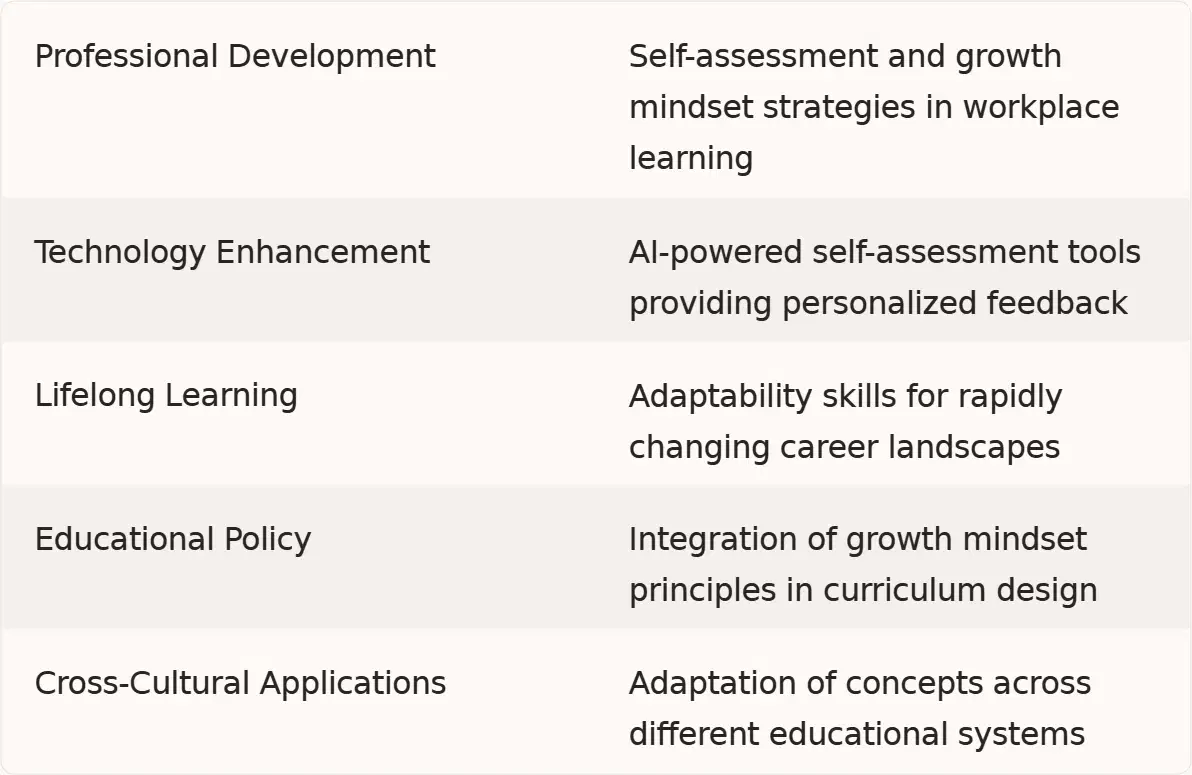
What are the future directions and applications for Lifelong Learning?
Continuous professional development and skill enhancement
Immediate job placement
Short-term project completion
Temporary knowledge acquisition
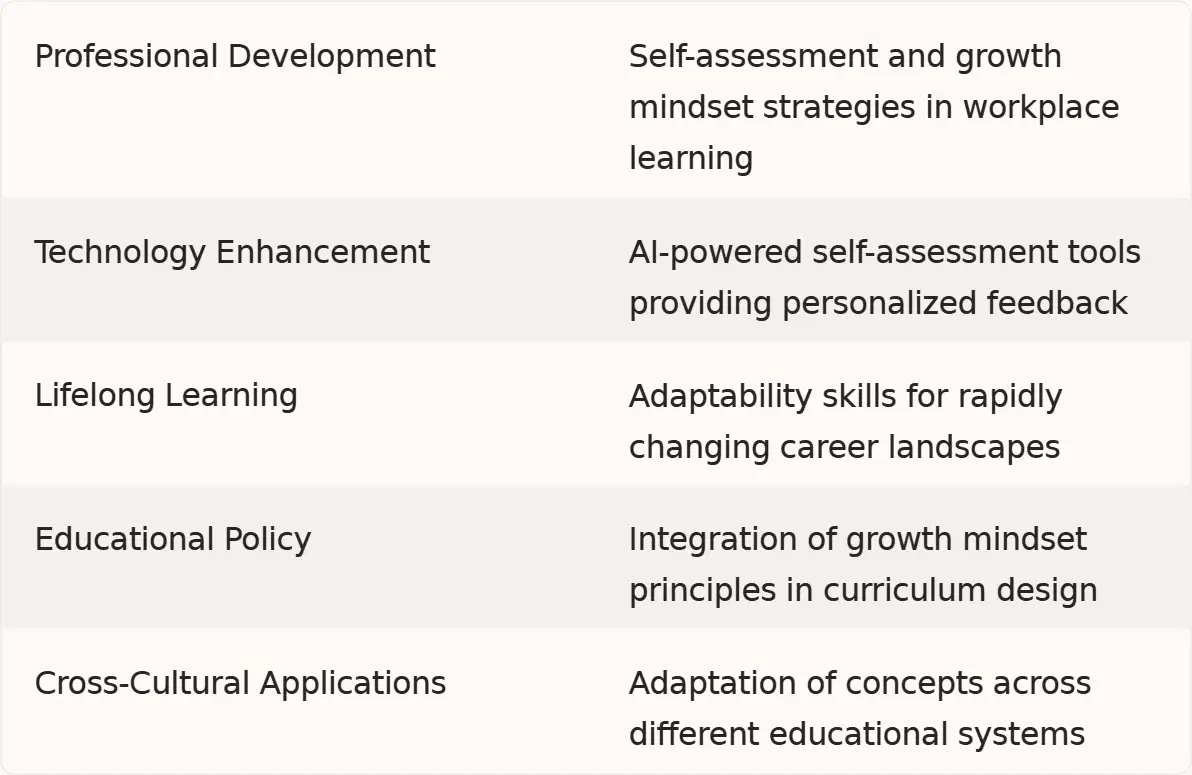
What are the future directions and applications for Educational Policy?
Incorporating technology in classrooms
Focusing on traditional teaching methods
Reducing the number of schools
Eliminating standardized testing
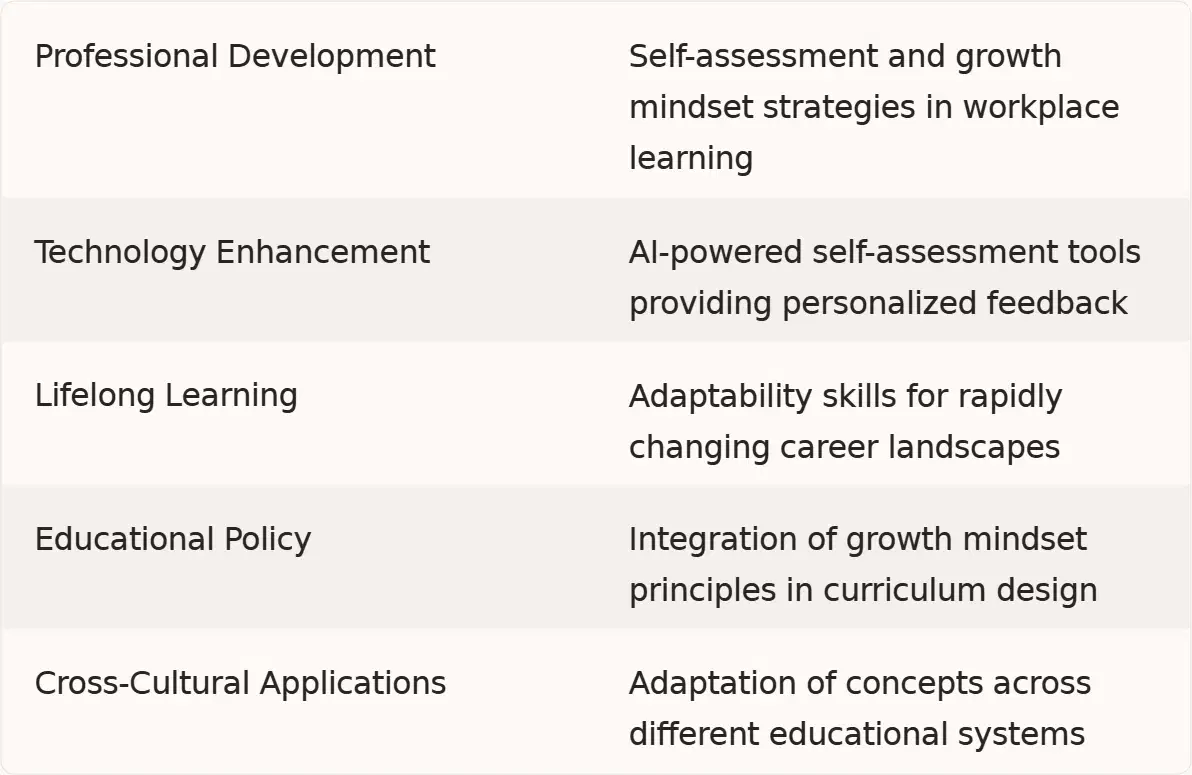
What are the future directions and applications for Cross-Cultural Applications?
Exploring new cultural dimensions
Improving existing cultural models
Integrating technology with cultural studies
All of the above
Who are the authors of the 2013 article in the International Journal of Educational Research?
John Doe and Jane Smith
Alice Johnson and Bob Brown
Michael White and Sarah Green
Emily Davis and David Wilson
The title of C.S. Dweck's 2006 book is:
Mindset: The New Psychology of Success
The Growth Mindset
Success and Mindset
The Psychology of Achievement
C.S. Dweck's 2014 article was published in which journal?
Journal of Personality and Social Psychology
Psychological Science
Science
Nature
Who co-authored the 2016 article in the Harvard Business Review with C. Dweck?
A. Angela Duckworth
B. Daniel Kahneman
C. Richard Thaler
D. Peter Senge
What is the volume and issue number of the 2018 article by B. Ng in the Educational Psychology Review?
Volume 30, Issue 1
Volume 29, Issue 2
Volume 28, Issue 3
Volume 27, Issue 4
In which journal was the 2003 article by J.J. Norcini et al. published?
Journal of Medical Education
Academic Medicine
The New England Journal of Medicine
Medical Teacher
Who are the authors of the 2017 article in the Educational Research Review?
John Doe and Jane Smith
Alice Johnson and Bob Brown
Michael White and Sarah Green
Emily Davis and David Wilson

