wayground logo

Free Printable Worksheets

Font size

S
M
L
XL
Worksheets

Unit 9: Transformations Review

Total questions: 105

Worksheet time: 15hrs 40mins

Name
Class
Date
1.
State the line of reflection.
a)
Reflection across y-axis
b)
Reflection across x-axis
c)
Reflection across x = 1
d)
Reflection across y = 1
2.
Find K' if the figure is reflected across the x-axis
a)
(4, 1))
b)
(-1, -4)
c)
(1, -4)
d)
(1, 4)
3.
Reflect the point (2, -4) over the y-axis.
a)
(-4, 2)
b)
(-2, 4)
c)
(-2, -4)
d)
(2, 4)
4.
Reflect (6, -3) over the line x-axis.
a)
(6, 3)
b)
(-6, -3)
c)
(-3, 6)
d)
(3, -6)
5.
Which answer shows a reflection across the x-axis?
a)
d
b)
c
c)
b
d)
a
6.
B(-2, -4)
Reflect over the line y = x
a)
(2, -4)
b)
(-4, 2)
c)
(-4, -2)
d)
(4, 2)
7.
You want to reflect a figure over the horizontal line shown. 
What directions would you give? 
Reflect over the line: ________
a)
x = -4
b)
y = -4
c)
x - y = 4
d)
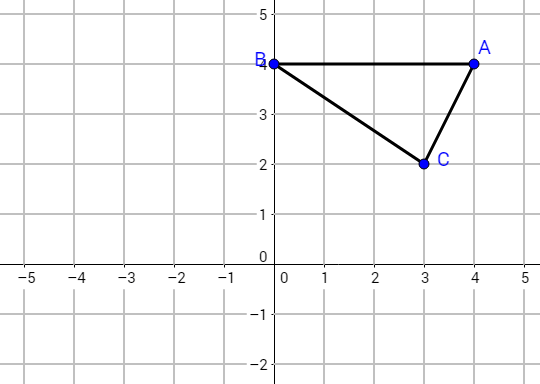
None of these
8.
The point ( -2,5) is reflected over the line x = 1.  Find its image.
a)
(  4,  5)
b)
( -2  , -5)
c)
( 2  ,  5)
d)
(2   , -5)
9.
∆QRS contains the points: Q(4, 2) R(5, 1) S(3,7). If the triangle is reflected across the y-axis, what will S' be?
a)
S'(3, 7)
b)
S'(-3, 7)
c)
S'(-3, -7)
d)
S'(3, 7)
10.
The reflection of J (-1,11) is J' (-1, -11).  what is the reflection of D (5, -5) when reflected over the same axis of reflection? 
a)
(-5,5)
b)
(5,5)
c)
(5,-5)
d)
(-5, -5)
11.
How many degrees was the figure rotated?
a)
90 degrees counterclockwise 
b)
180 degrees
c)
90 degrees clockwise
12.
If you were to rotate ABCD 180°  about the origin, what would the coordinate of A' be?
a)
(-5, 5)
b)
(-3, -5)
c)
(-5, 3)
d)
(-3, 3)
13.
If you were to rotate ABCD 90° counterclockwise about the origin, what would the coordinate of A' be?
a)
(-5, 5)
b)
(-3, 5)
c)
(-5, 3)
d)
(-3, 3)
14.
If you were to rotate ABCD 180° about the origin, what would the coordinates of B' be?
a)
(0, 0)
b)
(-6, -5)
c)
(-1, 3)
d)
(-6, 2)
15.
What is the angle of rotation for this counterclockwise rotation about the origin?
a)
90°
b)
180°
c)
270°
d)
360°
16.
Rotate the point (-3,-4) around the origin 180 degrees. State the image of the point.
a)
(-4,-3)
b)
(-4,3)
c)
(4,-3)
d)
(3,4)
17.
What is this picture an example of? 
a)
An angle
b)
A cat vertex 
c)
Rotation 
d)
Dilation
18.
The image A'B'C' is a rotation of ABC.
a)
True
b)
False
19.
What is a transformation that turns a figure about a fixed point for a given angle?
a)
Point of Rotation 
b)
Vertex 
c)
Rotations
d)
Image 
20.
How many degrees was the figure rotated?
a)
90 degrees counterclockwise 
b)
180 degrees
c)
90 degrees clockwise
21.
The original figure prior to a transformation.
a)
Pre-image
b)
Image
22.
The result of a transformation.
a)
Pre-image
b)
Image
23.
How is trapezoid ABCD translated to trapezoid A'B'C'D'?
a)
Translated 5 units down and 5 units to the right
b)
Translated 5 units down and 1 to the right
c)
Translated 8 units down and 5 units to the right
d)
Translated 5 units down and 4 units to the right
24.
Determine how to translate triangle A'B'C' to triangle ABC.
a)
right two, down five
b)
right two, down 9
c)
left two, down 9
d)
left two, down 5
25.
How is triangle ABC being translated to triangle A'B'C'?
a)
up 3, left 8
b)
up 9, left 4
c)
down 3, right 8
d)
down 9, right 4
26.
.
a)
A
b)
B
c)
C
d)
D
27.
How is Quadrilateral EFGH translated to E'F'G'H'?
a)
6 down
b)
6 down, 1 right
c)
6 down, 3 left
d)
8 down, 1 right
28.
Determine how to translate triangle A'B'C' to triangle ABC.
a)
(x+2, y-5)
b)
(x+2, y-9)
c)
(x-2, y-9)
29.
Determine where X' would be if you translated X 3 units to the left and 9 units down.
a)
(-4, 4)
b)
(-10, 2)
c)
(-4, -5)
d)
(-1, 5)
30.
Determine where T' would be if you translated T 3 units to the right and 6 units up.
a)
(5, 1)
b)
(2, -5)
c)
(-1, 1)
d)
(8, -2)
31.
How is trapezoid ABCD translated to trapezoid A'B'C'D'?
a)
Translated 5 units down and 5 units to the right
b)
Translated 5 units down and 1 to the right
c)
Translated 8 units down and 5 units to the right
d)
Translated 5 units down and 4 units to the right
32.
How would you translate point P to P'?
a)
Translate 2 units to the right and  8 units down
b)
Translate 3 units down and 2 units to the right
c)
Translate 4 units down and 4 units to the left
d)
Translate 8 units to the right and 2 units down
33.
How is triangle ABC being translated to triangle A'B'C'?
a)
up 3, left 8
b)
up 9, left 4
c)
down 3, right 8
d)
down 9, right 4
34.
How is Quadrilateral EFGH translated to E'F'G'H'?
a)
6 down
b)
6 down, 1 right
c)
6 down, 3 left
d)
8 down, 1 right
35.
What transformation is happening?
(x, y) ----> (x + 2, y - 3) 
a)
slide up 2, left 3
b)
slide right 2, up 3
c)
slide right 2, down 3
d)
slide left 3, right 2
36.
Write the rule for this translation:
Slide 3 up and 2 right
a)
(x, y)---->(x + 3, y + 2)
b)
(x, y)-----> (x+2, y + 3)
c)
(x, y)----> (x - 2, y + 3)
37.
A transformation in which a graph or geometric figure is picked up and moved to another  location without any change in size or orientation.
a)
Translation
b)
Rotation
c)
Reflection
d)
Dilation
38.
A dilation produces a similar figure
a)
True
b)
False
39.
A dilation produces a congruent figure
a)
True
b)
False
c)
D
40.
When a dilation has a scale factor greater than one, the dilation is an enlargement.
a)
True
b)
False
41.
When the scale factor of a dilation is less than one, the dilation is a reduction.
a)
True
b)
False
42.
How do you write the algebraic notation when the scale factor is 3?
a)
(x, y) goes to (1/3x, 1/3y)
b)
(x, y) goes to (-3x, -3y)
c)
(x, y) goes to (x + 3, y + 3)
d)
(x, y) goes to (3x, 3y)
43.
How do you write the algebraic notation when the scale factor is 1/2?
a)
(x, y) goes to (2x, 2y)
b)
(x, y) goes to (1/2x, 1/2y)
c)
(x, y) goes to (-2x, -2y)
d)
(x, y) goes to (2x, 1/2y)
44.
Choose the correct scale factor:
a)
2
b)
3
c)
1/3
d)
1/2
45.
Dilate Point B by a scale factor of 3:
a)
(12,0)
b)
(12,12)
c)
(4,3)
d)
(0,12)
46.
Does the image show a dilation?
a)
Yes
b)
No
47.
A dilation is which of the following: 
a)
only an enlargement
b)
only a reduction
c)
Either an enlargement or a reduction
d)
Neither an enlargement or a reduction
48.
Which of the following is the algebraic representation for a dilation?
a)
(x, y) → (x, 3y)
b)
(x, y) → (3x, 3y)
c)
(x, y) → (x, y - 3)
d)
(x, y) → (.5x, .4y)
49.
Does the image show a Dilation?
a)
Yes
b)
No
50.
In a dilation what mathematical operation is used with the scale factor?
a)
addition 
b)
subtraction 
c)
multiplication 
d)
division 
51.

Which type of symmetry can the figure be mapped onto itself by turning the figure upside down or 180 degrees?

a)

Rotational Symmetry

b)

Point Symmetry

c)

Line Symmetry

52.

Which type of symmetry can the figure be mapped onto itself by any turn?

a)

Rotational Symmetry

b)

Point Symmetry

c)

Line Symmetry

53.

Which type of symmetry can the figure be mapped onto itself by a reflection in a line?

a)

Rotational Symmetry

b)

Point Symmetry

c)

Line Symmetry

54.

Rotation:

90o Clockwise and 270o Counterclockwise

(x, y) -------->

a)

(y, -x)

b)

(y, x)

c)

(x, y)

55.

Which transformation does this rule apply to?

Multiply each x-coordinate and y-coordinate by the scale factor

a)

Translation

b)

Reflection

c)

Rotation

d)

Dilation

56.

Rotation:

180o Turn in either direction

(x, y) -------->

a)

(y, -x)

b)

(-x, -y)

c)

(x, -y)

57.

Rotation:

90o Counterclockwise and 270o Clockwise

(x, y) -------->

a)

(y, -x)

b)

(-y, x)

c)

(x, y)

58.

The triangle was reflected across the y-axis.  Which algebraic representation best describes this transformation?

a)

(x,y)(y,x)\left(x,y\right)\rightarrow\left(y,-x\right)

b)

(x,y)(x,y)\left(x,y\right)\rightarrow\left(x,-y\right)

c)

(x,y)(x,y)\left(x,y\right)\rightarrow\left(-x,-y\right)

d)

(x,y)(x,y)\left(x,y\right)\rightarrow\left(-x,y\right)

59.

The triangle was reflected across the x-axis. Which algebraic representation best describes this transformation?

a)

(x,y)(y,x)\left(x,y\right)\rightarrow\left(y,-x\right)

b)

(x,y)(x,y)\left(x,y\right)\rightarrow\left(x,-y\right)

c)

(x,y)(x,y)\left(x,y\right)\rightarrow\left(-x,-y\right)

d)

(x,y)(x,y)\left(x,y\right)\rightarrow\left(-x,y\right)

60.
The original figure that a transformation is applied to.
a)
Postimage
b)
Starting Figure
c)
Preimage
d)
Transformed Figure
61.
This represents the figure after a specific transformation.
a)
Preimage
b)
Image
c)
Postimage
d)
Transformed image
62.
Translation Coordinate Rules
a)
(x,y) ->(y, x)
b)
(x,y) ->(x+h, y+k)
c)
(x,y) -> (-x, -y)
d)
(x, y) -> (-y, -x)
63.
Coordinate Rule:
Reflect around y=x
a)
(x,y) -> (-x, y)
b)
(x,y) -> (-y, -x)
c)
(x,y) -> (y,x)
d)
(x,y) -> (x, -y)
64.
Coordinate Rule:
Reflect around y=-x
a)
(x,y) -> (-x, y)
b)
(x,y) -> (-y, -x)
c)
(x,y) -> (y,x)
d)
(x,y) -> (x, -y)
65.
Coordinate Rule:
90 degree Rotation (counterclockwise)
a)
(x,y) -> (x, -y)
b)
(x,y) -> (-y,x)
c)
(x,y) -> (-x, -y)
d)
(x,y) -> (y,-x)
66.

A figure is translated 5 units down and 3 units to the right. Which algebraic representation best describes this transformation?

a)

(x,y)(x5,y+3)\left(x,y\right)\rightarrow\left(x-5,y+3\right)

b)

(x,y)(x5,y3)\left(x,y\right)\rightarrow\left(x-5,y-3\right)

c)

(x,y)(x+3, y5)\left(x,y\right)\rightarrow\left(x+3,\ y-5\right)

d)

(x,y)(x3,y5)\left(x,y\right)\rightarrow\left(x-3,y-5\right)

67.

Triangle ABC was transformed to create triangle A'B'C'.  Which algebraic representation best describes this transformation?

a)

(x,y)(x5,y+3)\left(x,y\right)\rightarrow\left(x-5,y+3\right)

b)

(x,y)(x5,y3)\left(x,y\right)\rightarrow\left(x-5,y-3\right)

c)

(x,y)(x+3, y5)\left(x,y\right)\rightarrow\left(x+3,\ y-5\right)

d)

(x,y)(x3,y5)\left(x,y\right)\rightarrow\left(x-3,y-5\right)

68.
Identify the transformation.
a)
Reflection across y axis
b)
Reflection across x-axis
c)
180 Rotation
d)
Translation 2 units down
69.
Which of the following are congruence transformations?
a)
Rotations
b)
Translations
c)
Reflections
d)
All Three
70.

A translation _____

a)

moves left, right, up, down

b)

flips

c)

changes angle & direction

d)

changes shape and size

71.

Congruence means you keep the ......?

a)

Same size & shape

b)

Same direction/angle

72.

Which label is correct for a transformed point

a)

A

b)

B

c)

C'

d)

D

73.

How do I read this label: B'

a)

B prime

b)

B dash

c)

B 2

d)

B new

74.

A reflection ____

a)

flips

b)

moves left, right, up, down

c)

changes shape & size

d)

changes angle and direction

75.

What does dilation mean?

a)

a transformation that enlarges or reduces a figure

b)

a transformation that flips a figure

c)

a transformation that turns a figure

d)

a transformation that slides a figure

76.

Having the same size and shape; ≅.

a)

Congruent

b)

Similar

c)

Image

d)

Preimage

77.

What kind of transformation is this?

a)

Reflection

b)

Translation

c)

Rotation

78.

What kind of transformation is this?

a)

Rotation

b)

Reflection

c)

Translation

79.

What kind of transformation is this?

a)

Translation

b)

Reflection

c)

Rotation

80.
A transformation that “turns” a figure about a fixed point at a given angle and a given direction.
a)
rotation
b)
translation
c)
reflection
d)
dilation
81.
Which transformation is not a rigid transformation?
a)
Translation
b)
Reflection
c)
Rotation
d)
Dilation
82.
If the quadrilateral is translated 4 units to the left and 5 units down what is the coordinates for Point A'?
a)
(4,0)
b)
(0,4)
c)
(-1,5)
d)
(5,-1)
83.
Write a rule for the translation.
a)
 (x -1, y  + 2)
b)
 (x -2, y  + 1)
c)
 (x +2, y  - 1)
d)
(x +1, y  -  2)
84.

Find the coordinates of each point after the given transformation.

a)

U' (-3, 2)

b)

U' (-2, -3)

c)

U' (-2, 3)

d)

U' (3, -2)

85.

Find the coordinates of each point after the given transformation.

a)

V' (0, -3)

b)

V' (-1, -1)

c)

V' (1, -1)

d)

V' (-1, 1)

86.

Find the coordinates of each point after the given transformation.

a)

V' (1, -3)

b)

V' (-5, 3)

c)

V' (-1, 3)

d)

V' (-3, -1)

87.
What is the image for the point (5, 5) and the rule (x + 2, y-3)?
(X, Y)
a)
(7, 2)
b)
(7, -4)
c)
(3, 2)
88.
Dilate point A by a scale factor of 3. What are the coordinates of A'?
A(3,3) 
a)
A'(9,9) 
b)
A'(6,6) 
c)
A'(0,0) 
d)
(1,1)
89.
Write a rule for the translation.
a)
 (x -1, y  + 2)
b)
 (x -2, y  + 1)
c)
 (x +2, y  - 1)
d)
(x +1, y  -  2)
90.
Reflect Point C over the y-axis:
a)
(-3, 2)
b)
(3,2)
c)
(-2,3)
d)
(3,0)
91.
Find K'.
a)
(4, 1))
b)
(-1, -4)
c)
(1, -4)
d)
(1, 4)
92.
State the coordinate of the image of the given point B (-10,-6) under a dilation with center at the origin with the given scale factor k = 1/2.
a)
(5,3)
b)
(20,12)
c)
(-20,-12)
d)
(-5,-3)
93.
A scale factor of less than one means
a)
that the prime image will be larger than the pre-image.
b)
That the prime image will be the same as the preimage.
c)
That you need to subtract that amount off  of each side.
d)
That the prime image will be a reduction of the preimage.
94.
Dilate Point A by a scale factor of 1/2
a)
(-4,-4)
b)
(-1,-4)
c)
(-1,-1)
d)
(-2,-2)
95.
If you were to rotate ABCD 180°  about the origin, what would the coordinate of A' be?
a)
(-5, 5)
b)
(-3, -5)
c)
(-5, 3)
d)
(-3, 3)
96.
Rotate the point (-3,-4) around the origin 180 degrees. State the image of the point.
a)
(-4,-3)
b)
(-4,3)
c)
(4,-3)
d)
(3,4)
97.
Enlargement or reduction?  Find the scale factor!
a)
It's a reduction; the scale factor is 2.
b)
It's an enlargement; the scale factor is 2.
c)
It's an enlargement; the scale factor is 1/2.
d)
It's a reduction; the scale factor is 1/2.
98.
Enlargement or reduction?  Find the scale factor!
a)
It's an enlargement; the scale factor is 1/2.
b)
It's an enlargement; the scale factor is 2.
c)
It's a reduction; the scale factor is 1/2.
d)
It's a reduction; the scale factor is 2.
99.

The point A (8, 12) was dilated to become point A' (2, 3). What was the scale factor?

a)

½

b)

¼

c)

4

d)

2

100.

What is going to be the coordinate of point Q?, if you rotate 90º clockwise about (-1,-2)

a)

Q' (-3, -5)

b)

Q' (3, -5)

c)

Q' (-5, 3)

d)

Q' (-2, -4)

101.

What is going to be the coordinate of point H?, if you rotate 180º about (-1,-1)

a)

L' (1, -5)

b)

L' (-5, 2)

c)

L' (0, -2)

d)

L' (0, -5)

102.

Which sequence of transformations is used to transform the original image to the final image? Original: ABCD Final: A" B" C"D"

a)

Reflect over the x-axis and then rotate clockwise 90 around the origin.

b)

Rotate counterclockwise 90 around the origin and then translate 8 units left.

c)

Reflect over the y-axis and then rotate counterclockwise 90 around the origin.

d)

Rotate clockwise 90 around the origin and then translate 8 units left.

103.

Two triangles are shown on the coordinate grid. Which sequence of transformations shows that

ΔABCΔDEF\Delta ABC\cong\Delta DEF  

a)

Reflect △ABC across the x-axis, then translate it down 1

b)

Reflect △ABC across the x-axis, then translate it up 1

c)

Reflect △ABC across the y-axis, then translate it down 1

d)

Reflect △ABC across the y-axis, then translate it up 1

104.

If QR is rotated 270 degrees counterclockwise about the origin and then translated 2 units down and 3 units to the left, what are the endpoints of the resulting image?

a)

Q' (-2, -3) R'(-4, 0)

b)

Q' (-1, -4) R'(-3, -1)

c)

Q' (1, 1) R'(-2, 1)

d)

Q' (1, -1) R'(-1, 2)

105.

If QR is rotated 90 degrees clockwise about the origin and then translated 2 units to the left and 3 units up, what are the endpoints of the resulting image?

a)

Q'(1, 2) R'(-4, 4)

b)

Q'(-1, -3) R'(1, 2)

c)

Q'(-3, 1) R'(2, -1)

d)

Q'(-5, 4) R'(0, 2)