
 Worksheets
Solutions Mini-Test Review
Total questions: 32
Worksheet time: 24mins
By stirring a solid solute in a solvent, do you increase or decrease the speed of dissolving?
increase
decrease
stays the same
unknown
What does it mean to increase the surface area of a solute?
to increase the size of the solution
to increase the size of the solvent
to make the size of the solute bigger
to increase the amount of area the solute interacts with the solvent
You are about to add sugar into water at room temperature. Which is NOT a way to speed up the rate of dissolving?
increase the temperature of the water
stir the solution once the sugar is in the water
make sure the sugar is crushed into smaller pieces
lower the temperature of the water
Which Alka-Seltzer will dissolve faster?


What is the solute?
The substance being dissolved
The substance doing the dissolving
The combined mixture of solution
Which is NOT a factor that affects the rate a solid dissolves in water?
stirring/agitation
temperature
surface area
color
Supersaturated
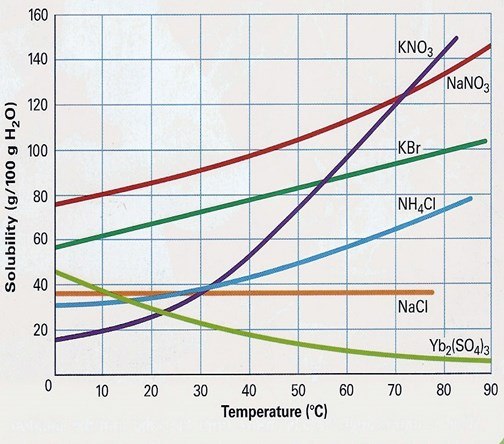
Identify if the following solution would be saturated, unsaturated, or supersaturated: 100 g KBr at 70 degrees Celsius.
Unsaturated
Saturated
Supersaturated
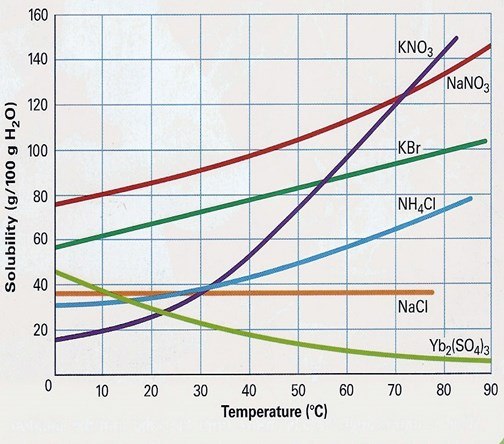
At 80 degrees Celsius, KBr's solubility is:
100 g/100g H2O
90 g/100g H2O
80 g/100g H2O
0 g/100g H2O
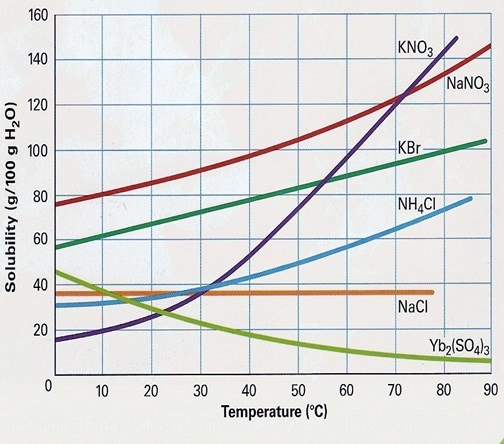
Identify how many grams of KNO3 is required to make a saturated solution at 40 degrees Celsius.
50 g
45 g
60 g
33 g
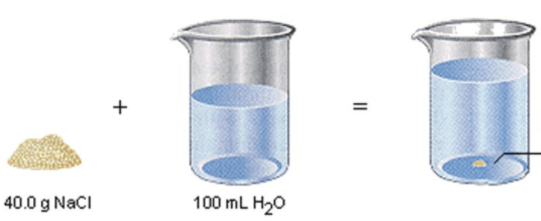
Identify the saturation associated with the product of this experiment.
Unsaturated
Saturated
Supersaturated
A solution with less than the maximum amount of solute completely dissolved.
Saturated solution
Unsaturated solution
Supersaturated solution
A solution with more than the maximum amount of solute completely dissolved.
Saturated solution
Unsaturated solution
Supersaturated solution
What happens when a supersaturated solution is disturbed?
Nothing
Solute crystallizes (crystals are formed)
The solution can dissolve more solute
Solute falls to the bottom of the container
Mg(NO3)2
Soluble
Insoluble
CaCl2
Soluble
Insoluble
Al2S3
Soluble
Insoluble
Ag2SO4
Soluble
insoluble
BeS
Soluble
Insoluble
Mg(OH)2
Soluble
Insoluble
Ba(OH)2
Soluble
Insoluble
Which product(s), if any, form a precipitate?
CuCl2 (aq) + NaOH (aq) → Cu(OH)2 (?) + NaCl (?)
Cu(OH)2
NaCl
Both
Neither
Which product(s), if any, form a precipitate?
Pb(NO3)2 (aq) + 2KI (aq) → PbI2 (?) + 2KNO3 (?)
PbI2
KNO3
Both
Neither
Oil is made of nonpolar compounds. Will it dissolve in water?
Yes
No
Water is
Polar
Nonpolar
Which way would a water molecule orient itself when dissolving a positive ion?
Oxygens pointing towards the positive ion
Oxygens pointing away from the positive ion
The water molecules will orient themselves randomly
Polar solvents dissolve...
Nonpolar solutes
Both polar and nonpolar solutes
Polar solutes

