
 Worksheets
Mathematical Modeling
Total questions: 30
Worksheet time: 45mins
Which of the following is not a component in mathematical modeling?
Constructing and identifying the problems
Making assumptions and identifying the variables
Applying mathematics to solve problems
Reporting the findings
A train moves from town A to town B for a distance of 200 km within 1 hour and 30 minutes. If the train takes 40 minutes to move from town B to town C, what is the distance between town B and town C?
Based on the problem above, what assumption should be made in the mathematical modeling?
The operating cost of the train is fixed.
The type of fuel used by the train is fixed.
The speed of the train is fixed.
The driver of the train is the same person.

State the variable in the problem.
Person who makes the fixed deposit.
Number of years to save the money in the fixed deposit account.
Location of bank.
The date that Rafidah starts to deposit the money in the fixed deposit account.
Which of the following is a step to refine a mathematical model?
Check the answers from the solution obtained.
Determine the variables used in the mathematical model.
Determine whether the assumptions made are true or false.
Replace with a new mathematical model if the model applied is not appropriate.
A ___________ is a representation involving real world problem into mathematical problem.
mathematical function
mathematical modeling
derivative function
abstraction
Which of the following components can be achieved through mathematical modeling?
I Refining the mathematical modeling
II Making estimation and identifying hypothesis
III Identifying and defining the problem
IV Report the findings
I, II, III
I, II, IV
I, III, IV
II, III, IV
The iCycle Club is organizing a recycling campaign in a neighbourhood. They setup one-stop recycling collection centre around the neighbourhood and would like to study their usage rate. Which of the following is a valid assumption about how many people would make use of the one- stop centre?
It is assumed that 100% of the people near the one-stop center would use it.
It is assumed that none of the people near the one-stop center would use it.
It is assumed that 20% of the people near the one-stop center would use it based on a previous research study.
It is assumed that 90% of the people near the one-stop center would use it as their house is within 0.5 km from the one-stop centers.
Which of the following is the importance of model assessment?
It helps to analyse the accuracy of the results predicted by the model.
It helps to analyse the accuracy of the results predicted by the model.
It helps to identify the strengths and weaknesses of the built model and understand at a deeper level the behaviour of the model.
It helps to define the proper variables to be used in developing the model.
It is given that the temperature of town A is –5 °C in July. The temperature decreases for –2 °C per month for 6 consecutive months. What is the temperature of town A in October?
-7
-9
-11
-13

Linear model
Cubic model
Quadratic model
Exponential model
Which of the following statements is not related to the processes involved in mathematical modeling?
Identifying and defining the problems
Making assumptions and identifying the variables
Solving problems by guessing
Verifying and interpreting solutions in the context of the problem
What is the last step in mathematical modeling?
Reporting findings
Refining the mathematical model
Applying mathematics to solve problems
Verifying and interpreting solutions in the context of the problem

What is the assumption needed to be made for the problem above?
The price of the smartphone increases when Shuhada has raised RM1500
The interest rate does not change throughout the period of saving
Shuhada withdraws money after a month
Shuhada adds RM500 to her savings

The diagram shows the data collected for the number of customers, y , who visit a restaurant after x days.
Which of the following is the most appropriate model used to represent the above data?
Linear model
Cubic model
Quadratic model
Exponential model
the length and width of a room is 6m and 5m respectively. A worker wants to cover room with square tiles with a side length of 30cm. How many tiles does he need?
340
320
300
280
Joanne wants to go to a shopping mall for leisure. However, she does not have transportation like car that can send her to go to the shopping mall from her house. Thus, she wants to get a taxi service that will charge RM14.00 for a journey of 7 km. Before Joanne booking the taxi service from a taxi driver, she receives a phone call from her friend who wishes to meet her in a library to discuss school assignments. The distance between Joanne’s house and the library is 15 km. She wants to book the taxi service from the same taxi driver to move from her house to the library. How much is the taxi fare charged by the taxi driver when sending Joanne from her house until arriving at the library?
Which of the following is the process of making assumptions and identifying the variables?
Determine taxi fare charged by the taxi driver while he sends Joanne from the house until arriving at the library.
Assume that the taxi fare charged for a journey of 1 km is the same. Let x represents the distance of journey and y represents the taxi fare charged by the taxi driver.
The model of linear function y = 2x obtained may not be used for every kilometer travelled.
Substitute y = 14 and x = 7 into y = kx.

What is the possible function for this model?
y=ax2+bx+c
y=ax+b
y=ex
y=xa

What is the possible function for this model?
y=ax2+bx+c
y=mx+c
y=ax
y=xa


A student invests $500 for x years in a savings account that earns 4% interest per year. No further deposits or withdrawals are made during this time. Write an function f(x) to represent the amount of money earned after x years.
f(x) = 500 (.60)x
f(x) = 500 (.96)x
f(x) = 500 (1.04)x
f(x) = 500 (1.4)x

The diagram above shows part of the mathematical modeling. Process P is
A. reporting the findings
B. verifying and interpreting solutions in the context of the problem
C. making assumptions and identifying the variables
D. refining the mathematical model
This function gives the depth D (in inches) of water in a 5-gallon jug that starts off full and is drained through a spigot for t minutes:
D(t)=0.265t2−4.055t+15.5
Calculate D(2) . Round your final answer to 2 decimal places.
7.92
24.67
8.45
12.51
This function gives the depth D (in inches) of water in a 5-gallon jug that starts off full and is drained through a spigot for t minutes:
D(t)=0.265t2−4.055t+15.5
D(2)=8.45 : what does this MEAN in this situation?
After 8.45 minutes, there were 2 gallons of water left in the jug.
After 2 minutes, there were 8.45 gallons of water left in the jug.
After 8.45 minutes, the depth of the water was 2 inches.
After 2 minutes, the depth of the water was 8.45 inches.
This function gives the depth D (in inches) of water in a 5-gallon jug that starts off full and is drained through a spigot for t minutes:
D(t)=0.265t2−4.055t+15.5
What was the inital depth of the water in this jug?
5 inches
15.5 inches
7.436 inches
7.866 inches

What is the bus doing between points A and B?
The bus is speeding up.
The bus's speed is remaining constant.
The bus is stopped.
The bus is beginning to slow down.
What is the bus doing between points C and D?
The bus is speeding up.
The bus's speed is remaining constant.
The bus is stopped.
The bus is beginning to slow down.
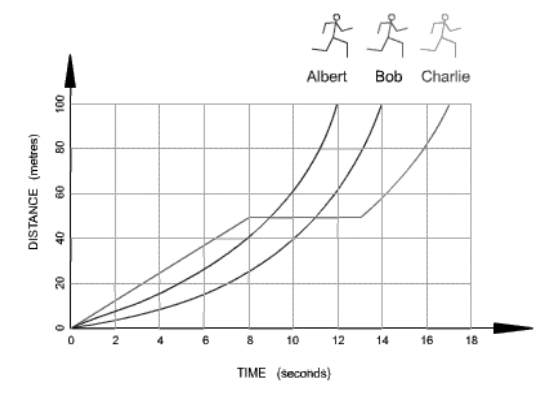
Which runner stopped for a rest?
Albert
Bob
Charlie
No one stopped for a rest.
Which stage in the marking Criterion has the highest number of marks allocated?
Formulate
Solve
Evaluate and Verify
Communicate
What is an assumption in the context of solving a mathematical problem?
A fact that is known to be true
A belief that is taken to be true in order to solve a given task
Data or information required to solve a problem
A mathematical model

