
 Worksheets
China Test
Total questions: 15
Worksheet time: 8mins
The Tiananmen Square massacre in China was a reaction to
Deng Xiaoping's plan to revive the Cultural Revolution
student demands for greater individual rights and freedom of expression
China's decision to seek Western investors
Great Britain's decision to return Hong Kong to China
The goal of Mao Zedong's policy known as the Great Leap Forward was to
develop foreign export industries in China's coastal urban centers
eliminate state-owned industries in rural China
modernize China's economic system by dividing China into communes
introduce capitalism to the Chinese economy
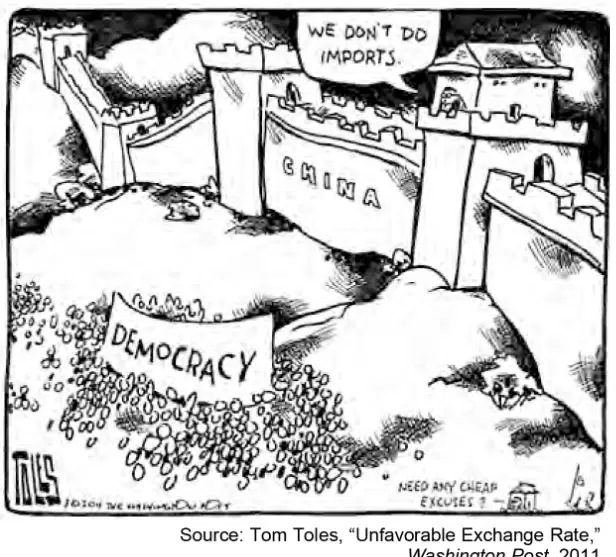
What point of view is depicted in this cartoon?
China is not participating in the global trade market at this time
China has attempted to prevent democratic ideas from entering the country.
China viewed democracy as an attractive import.
China was looking for excuses to strengthen the wall.
In Cambodia, Pol Pot and the Khmer Rouge modeled their agrarian society on
Mao Zedong's Great Leap Forward in China
Leonid Brezhnev's doctrine of détente
Mohandas Gandhi's Quit India program
Lech Walesa's Solidarity movement in Poland
A comparison of the five-year plans of Joseph Stalin and of the Great Leap Forward of Mao Zedong would show that both leaders
encouraged individual rights and freedoms
implemented some aspects of capitalism
supported the involvement of wealthy entrepreneurs in the economy
focused on increasing industrial and agricultural output
One reason Mao Zedong, Ho Chi Minh, and Fidel Castro rose to power was that these leaders
promoted capitalism and democracy
gained the support of the peasants
represented the interests of rich landowners
wanted their countries to stress religious values
What was an immediate result of the Great Leap Forward (1958)?
independence of Kenya from Great Britain
the breakup of the Soviet Union
the relocation of Bosnian refugees
increased famine in China
One similarity between Stalin’s five-year plans and Mao Zedong’s Great Leap Forward was that both programs attempted to
increase industrial production
privatize the ownership of land
correct environmental pollution
strengthen international trade
In China the terms "Long March," "Little Red Book," and "Great Leap Forward" are most closely associated with the
economic policies of the Kuomintang
expulsion of foreigners during the Boxer Rebellion
foreign policy under Deng Xiaoping
leadership of Mao Zedong
The Great Leap Forward in China was an attempt to
introduce democratic principles of government
reduce the power of the military
increase agricultural and industrial output
remove restrictions on emigration
The Cultural Revolution in China was Mao Zedong's attempt to
renew the ideas and enthusiasm of the Communist revolution
increase the industrial output of China
promote artistic exchanges with the United States
encourage foreign investment in China
In the 1980s, China's economic growth and reentry into the world economy was most directly the result of the
restoration of dynastic rule
adoption of Deng Xiaoping's Four Modernizations
reestablishment of a regional self-sufficiency plan
implementation of Mao Zedong's Cultural Revolution
One way in which Soviet leader Mikhail Gorbachev and Chinese leader Deng Xiaoping are similar is that both
granted autonomy to satellite countries
promoted a multiparty political system
encouraged religious dissenters to seek freedom
incorporated capitalist ideas into communist societies
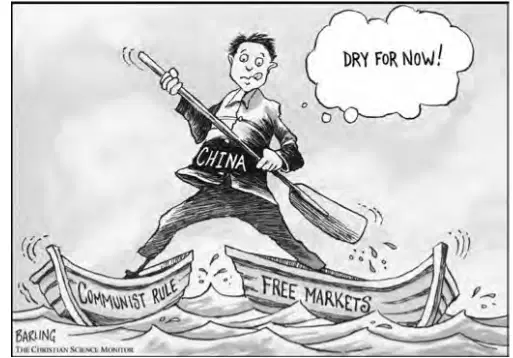
The policies of which 20th-century leader helped to create the situation shown in this 2006 cartoon?
Deng Xiaoping
Kim Jong II
Aung San Suu Kyi
Ho Chi Minh
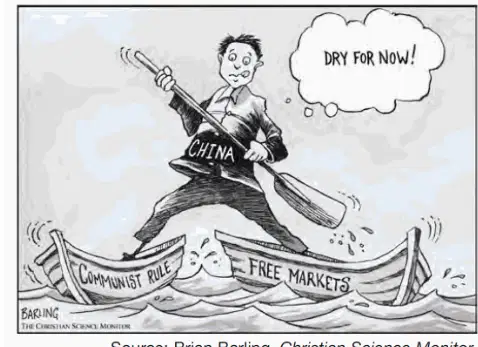
Which claim is best supported by this cartoon?
Economic reforms in China have not led to political reforms.
China is in danger of experiencing a drought.
Communist economic policies have led to increased industrialization in China.
China should increase the size of its navy and increase trade with other nations.

