
 Worksheets
Natural Selection, Adaptation, and Evolution
Total questions: 20
Worksheet time: 10mins
Name
Class
Date
1.
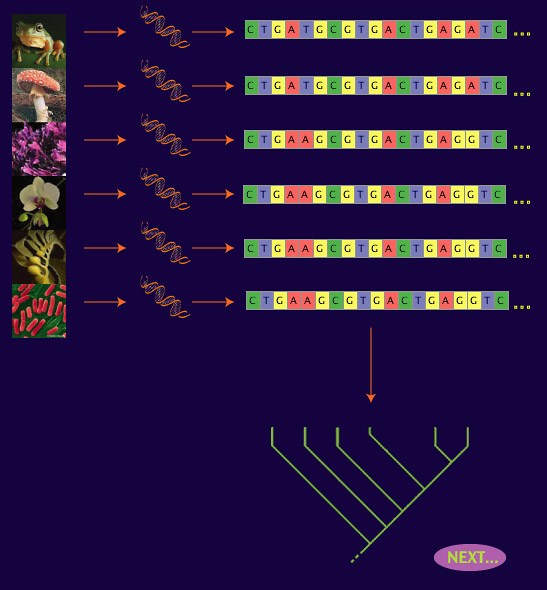
Two organisms that are closely related would have
a)
very similar DNA sequence
b)
exactly the same DNA sequences
c)
no proteins in common
d)
completely different DNA sequence
2.
The differences among a species, like different bird beaks, are called
a)
genes.
b)
variations.
c)
traits.
d)
theories.
3.

Darwin wrote that organisms with traits that are best suited to the environment will ________________
a)
increase in number
b)
become extinct
4.

The diagram shows fossils in different rock layers. Which of these statements about the age of these fossils is most likely correct?
a)
Fossil A and C are the same age
b)
Fossil B is older than fossil C
c)
Fossils A is older than fossil B
d)
Fossil D is older than fossil C
5.
In your lab, how would your describe multiple birds feeding from the same food source at the same time?
a)
competition
b)
evolution
c)
natural selection
d)
variation
6.
In your lab, what did the different kitchen utensils represent?
a)
variations in bird beaks
b)
food sources
c)
evolution
d)
pickles
7.
A remnant or trace of an organism from the past is called a _______.
a)
Ancestor
b)
Skeleton
c)
Fossil
d)
Imprints
8.
Why are advantageous traits more likely to be passed onto offspring?
a)
Because they are more likely to survive and reproduce.
b)
Because they come from dominant alleles.
c)
Because they come from recessive alleles.
d)
Because the trait is an acquired phenotype.
9.
What is an organism that has similar characteristics and can reproduce?
a)
species
b)
organism
c)
embryology
d)
vestigial
10.
Which term refers to the process by which individuals that are better suited to the environment survive and reproduce therefore passing down their genes to their offspring?
a)
Evolution
b)
Variation
c)
Adaptation
d)
Natural Selection
11.
Inherited trait that helps an organism survive is a(n) __________.
a)
Fossil
b)
Adaptation
c)
Ancestor
d)
Natural selection
12.
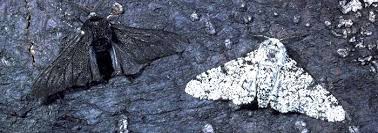
Predict which moth would increase in population
a)
light
b)
dark
13.
In your lab, why were some "birds" more adapted to their environment than others?
a)
their bird beak allowed them to eat more food, and most likely live to produce more offspring
b)
the birds could change their beak to suit the available food sources
14.

Which layer is the oldest?
a)
1
b)
2
c)
3
d)
4
15.
What is another name for natural selection?
a)
survival of the smartest
b)
survival of the fastest
c)
survival of the biggest
d)
survival of the fittest
16.
This scientist developed the theory of evolution as he studied the finches.
a)
Charles Darwin
b)
Isaac Newton
c)
Albert Einstein
d)
Marie Curie
17.

What is this an example of?
a)
diversity of species
b)
variation
c)
vestigial structures
d)
DNA studies
18.
What is a change in an organism that allows for it to survive in its environment?
a)
homologous
b)
vestigial
c)
variation
d)
adaptation
19.
When all of the organisms of a species have died it is called
a)
evolution
b)
extinction
c)
adaptation
d)
natural selection
20.
Which of the following traits is not inherited?
a)
Fur color
b)
Feathers
c)
Hair color
d)
A suntan
100 %

