
 Worksheets
Biology and Microscopy Quiz
Total questions: 20
Worksheet time: 13mins
William is studying different types of fungi for his biology project. He learns that one type of fungi is parasitic and often infects grains. Which type of fungi is it?
sac fungi
bracket fungi
smuts
molds
Nora and Henry are observing the physical appearance of plants in their garden. The physical appearance that results from the alleles an organism inherited for a particular trait is the ______.
phenotype
genotype
chromosome
gene
You are participating in a science scavenger hunt. The first clue reads, "I am an alga that resembles a mass of green thread; under a microscope, my cells are easily recognizable by their spiraling chloroplasts." What type of algae are you looking for?
volvox
spirogyra
Irish moss
kelp
Evelyn was observing microorganisms under a microscope in her biology class. She noticed some organisms that were distinguished by their slipper shape and cilia. These organisms are ___?
Sarcodines
Ciliates
Paramecia
Flagellates
During a biology class, Mason was fascinated by the study of organisms like mushrooms and molds. What is the study of the structure, characteristics, and environment of fungi called?
(a)
Anika is using a microscope in her biology class. On what part of the microscope does she place the slide?
objective
eyepiece
diaphragm
stage
During a biology class, Anika observed a cell under the microscope and noticed it had an organized nucleus. She concluded that the organism is a ______.
eukaryote
prokaryote
virus
bacterium
In a biology class, Nora asked, "What are the smallest living units of all living things called?"
(a)
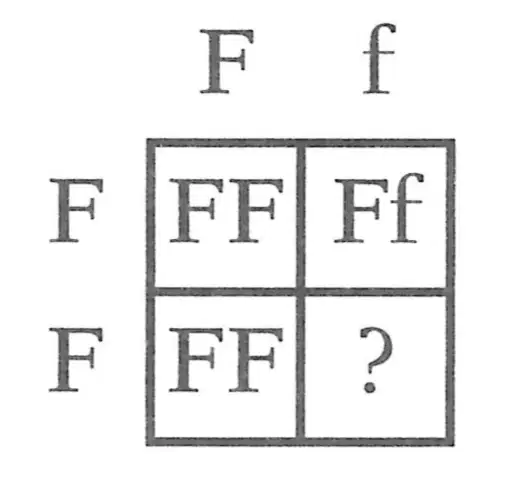
Mia is studying genetics and is using a Punnett square to predict the traits of offspring. In the following Punnett square, what should be in the indicated box?
FF
ff
Ff
Nothing
In a biology class, Avery is curious about how traits are passed from parents to offspring. What is the scientific study of heredity that Avery should explore?
(a)
During a science class, Benjamin was examining a piece of cork under a microscope. His teacher asked him if he knew which English scientist first discovered cork cells. What was Benjamin's answer?
Robert Hooke
Albert Einstein
Charles Darwin
Isaac Newton
What surrounds and protects the other parts of the cell?
Cell membrane
Cell wall
Cytoplasm
Nucleus
During a biology class, Benjamin was using a microscope to observe a slide. What is the name of the lens of the microscope through which Benjamin viewed the image?
objective
eyepiece
diaphragm
stage
Ethan is using a microscope to examine a plant cell. Which structure of the microscope should he adjust to change the amount of light passing through the slide?
objective
eyepiece
diaphragm
stage
Noah is studying his family's genetic history and creates a chart to track a specific trait. This type of chart is known as a(n) (a) chart?
During a biology class, Priya was curious about the structure in the cells of green plants where photosynthesis occurs. Can you help her identify it?
Mitochondria
Nucleus
Chloroplast
Ribosome
In a biology class, Olivia was asked to identify the jelly-like substance that makes up the largest portion of the cell. What is it?
Cell membrane
Cell wall
Cytoplasm
Nucleus
In a biology class, Benjamin asked, "What substance stores the information that determines the genetic traits of an organism?"
(a)
Liam is studying different types of algae in his biology class. He learned about volvox and wants to know which group of algae it belongs to. Can you help him?
red algae
yellow algae
green algae
brown algae
Grace was walking in the park and noticed an organism that could be seen by the unaided eye. This organism is considered ___?
subatomic
invisible
microscopic
macroscopic

