
 Worksheets
Unit 8.4 End of Unit Test Review
Total questions: 32
Worksheet time: 32mins
Name
Class
Date
1.
1. Which of the following BEST defines "force"?
a)
a) The speed of an object.
b)
b) The mass of an object.
c)
c) A push or a pull on an object.
d)
d) The temperature of an object.
2.

2. Based on Figure 1, which of the following BEST describes the process of solar system formation depicted in the image?
a)
a) Gas and dust particles are randomly scattered and remain unchanged over time.
b)
b) Gas and dust particles are forced together by an outside force and begin to clump together due to gravity.
c)
c) Gas and dust particles are ejected from a central point and move outwards in a straight line.
d)
d) Gas and dust particles are heated and transformed into a solid disk.
3.
3. Which of the following BEST describes an asteroid?
a)
a) A gaseous planet orbiting the Sun.
b)
b) A rocky body orbiting the Sun, primarily located between Mars and Jupiter.
c)
c) A frozen comet with a visible tail.
d)
d) A star that emits its own light.
4.
4. Which direction does a force need to be pointing to cause circular motion in an object?
a)
With the motion of the object
b)
Opposite of the motion of the object
c)
In towards the center of the circle
d)
Out away from the center of the circle
5.
5. Choose the TWO statements that are most correct.
a)
More massive objects produce more gravity than less massive objects.
b)
Less massive objects produce no gravity. Only more massive objects produce gravity.
c)
More massive objects always orbit around less massive objects.
d)
Less massive objects always orbit around more massive objects.
6.
7. Which of the following BEST describes the key difference between comets and asteroids?
a)
a) Comets are made of rock, and asteroids are made of ice.
b)
b) Comets orbit planets, and asteroids orbit the Sun.
c)
c) Comets are icy with a potential tail, and asteroids are rocky bodies primarily between Mars and Jupiter.
d)
d) Comets are larger than asteroids.
7.
8. A student is building a model of the solar system. They decide to use a basketball to represent the Sun. If they want to accurately represent the scale of the distances between the planets, which of the following is the MOST important consideration?
a)
a) The color of the materials used to represent the planets.
b)
b) The relative sizes of the planets compared to the basketball (Sun).
c)
c) The actual distance between the basketball (Sun) and the location of the model planets.
d)
d) The order in which the planets are placed in the model, regardless of distance.
8.
9. A soccer ball is sitting still on the grass. Why will the ball stay still unless someone kicks it?
a)
a) Because gravity is holding it down.
b)
b) Because of inertia, the ball resists any change in its motion.
c)
c) Because the grass is too rough.
d)
d) Because the ball is too light.
9.
10. A student is building a model of the solar system. They use a basketball for the Sun and a tennis ball for each planet and place them out on the football field at specific distances. What would this model be best for most accurately showing?
a)
Scale
b)
Position
c)
Motion
10.
11. Which of the following BEST defines a meteoroid?
a)
a) A large, gaseous planet.
b)
b) A small piece of rock in the solar system.
c)
c) A star that emits light.
d)
d) A large, icy body with a tail.
11.
12. Why do planets orbit the Sun in a curved path rather than a straight line?
a)
a) Because planets have their own light sources.
b)
b) Because of the Sun's gravitational pull.
c)
c) Because planets are perfectly round.
d)
d) Because planets are pushed by solar winds.
12.
13. Select the answer that best describes which objects can be found in a galaxy.
a)
All of the above
b)
Solar Systems
c)
Stars
d)
Gas
e)
Dust
13.

14. Figure 4 shows the movement of a space probe over four minutes as it travels towards a space station. Based on the image, which of the following statements is MOST accurate?
a)
a) The probe is accelerating as it moves towards the space station.
b)
b) The probe is moving at a constant speed away from the space station.
c)
c) The probe is decelerating as it moves towards the space station.
d)
d) The probe is changing direction as it moves towards the space station.
14.
15. Which of the following factors has the GREATEST impact on the strength of gravity between two objects? (Select all that apply)
a)
The color of the objects
b)
The temperature of the objects
c)
The mass of the objects
d)
The distance between the objects
e)
The shape of the objects
15.
16. Which of the following BEST defines gravity?
a)
a) The force that pushes objects away from each other.
b)
b) The force that attracts objects to the center of Earth or any object with mass.
c)
c) The force that causes objects to float.
d)
d) The force that only affects liquids and gases.
16.
17. Which of the following would INCREASE the amount of friction between two surfaces?
a)
a) Adding a lubricant like oil.
b)
b) Making the surfaces smoother.
c)
c) Increasing the force pressing the surfaces together.
d)
d) Reducing the speed of the moving object.
17.
18. Which free body diagram, or force diagram best show horizontal forces acting on the puck while at rest.
a)
a
b)
b
c)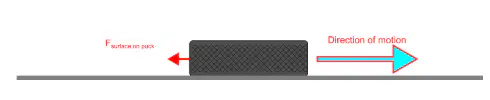
c
d)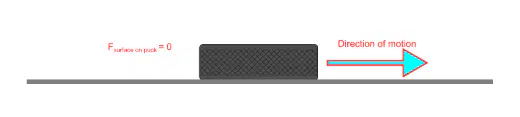
d
18.
19. Which of the following BEST explains how gravitational forces help us understand the orbital motion of planets and satellites in our solar system?
a)
a) Gravitational forces push planets and satellites away from the Sun and Earth, respectively, causing them to move in a straight line.
b)
b) Gravitational forces create friction between planets and satellites, causing them to slow down and eventually stop orbiting.
c)
c) Gravitational forces pull planets and satellites towards the Sun and Earth, respectively, causing them to move in a curved path or orbit.
d)
d) Gravitational forces have no effect on orbital motion; planets and satellites move due to their initial velocity.
19.
20. Which of the following BEST describes friction?
a)
a) The force that pulls objects towards the Earth.
b)
b) The force that pushes objects away from each other.
c)
c) The forces caused by one surface or object rubbing against another as they move past each other.
d)
d) The force that causes objects to float.
20.
21. A skydiver jumps out of an airplane. Which of the following forces are acting against the skydiver's motion as they fall?
a)
a) Gravity only.
b)
b) Friction with the ground only.
c)
c) Gravity and air resistance.
d)
d) Air resistance and friction with the ground.
21.
22. Why is air resistance NOT a factor for spacecraft traveling in outer space?
a)
a) Because gravity is stronger in space.
b)
b) Because there is very little to no air in space.
c)
c) Because spacecraft are made of special materials that repel air.
22.
23. Which of the following is a direct consequence of space being a vacuum?
a)
a) Sound can travel great distances.
b)
b) Objects experience significant air resistance.
c)
c) Objects moving in space will not experience any friction.
d)
d) Weather patterns are common.
23.
24. Which of the following statements about gravitational forces is TRUE?
a)
a) Gravitational forces only act over short distances.
b)
b) Gravitational forces are weaker between objects with larger masses.
c)
c) Gravitational forces are stronger between objects that are closer together.
d)
d) Gravitational forces are not affected by the distance between objects.
24.
25. Which force is primarily responsible for maintaining the orbital motion of planets?
a)
a) Friction
b)
b) Air resistance
c)
c) Gravity
d)
d) Electromagnetic force
25.
26. If the Sun were to disappear from our solar system the planets would...
a)
Continue moving in a circular orbit.
b)
Fall in towards where the Sun used to be.
c)
Stop moving.
d)
Continue moving in a straight line out into space.
26.
27. Fill in the blanks. Objects with _____ mass always orbit around objects with _____.
a)
less, more
b)
more, less
c)
no, some
d)
some, no
27.
28. Which free body diagram, or force diagram best show horizontal forces acting on the puck while in motion on ice.
a)
a
b)
b
c)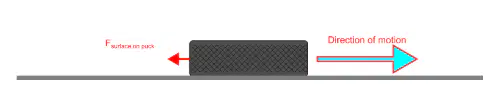
c
d)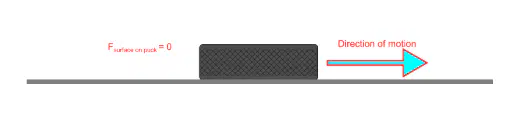
d
28.
29. Which of the following BEST explains how the patterns we see in our solar system help us understand other parts of the universe?
a)
a) Our solar system is special and unlike any other place.
b)
b) The same rules of gravity and motion we see here probably work the same way in other star systems.
c)
c) Life on Earth shows that our solar system is the only place with planets.
d)
d) Everything in the universe is spread out randomly, so there are no patterns.
29.

30. Using the charts above identify what you believe this mystery object could be.
a)
a. Planet
b)
b. Moon
c)
c. Dwarf Planet
d)
d. Sun
30.

31. Using the charts above identify what you believe this mystery object is.
a)
a. Asteroid
b)
b. Moon
c)
c. Dwarf Planet
d)
d. Comet
31.
32. A comet is a small __________ object that orbits the Sun and may display a tail when close to the Sun.
a)
icy
b)
gaseous
c)
feiry
d)
rocky
32.
33. Which of the following BEST describes a nebula?
a)
a) A solid, rocky planet.
b)
b) A very spread-out collection of cloud, gas, and dust in outer space.
c)
c) A small, icy object orbiting the Sun.
d)
d) A star that emits its own light.
100 %

