
Font size
 Worksheets
LV04 Chassis 40Q Mock Exam
Total questions: 40
Worksheet time: 21mins
In relation to steering geometry the purpose of the 'Castor' angle is to: Select one:
Compensate for over steer
Provide a degree of self-centering
make the wheels toe-out when cornering
Provide centre point steering
A relief valve is fitted to a hydraulic power steering system to:
limit the maximum pressure and prevent under steer
limit the minimum pressure and prevent over steer
limit the maximum pressure and prevent system damage
limit the minimum pressure and prevent system damage
A seized (not operating) front brake calliper piston on the offside may cause:
the vehicle to pull to the left when braking
the vehicle to pull to the right when accelerating
the vehicle to pull to the right when braking
the vehicle to pull to the left when accelerating
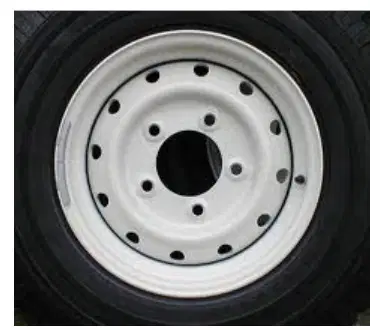
Identify the type of wheel shown.
wire wheels
pressed steel
flat-edge
light alloy
The minimum tread depth for a tyre is:
16.00mm
0.16mm
160.00mm
1.60mm
What happens when a tyre is overinflated? Select one:
Wear on the edges of the tread
Increased fuel efficiency
Wear on the centre part of the tread
Overheat with prolonged usage.
In vehicle suspension, the term roll refers to the:
Lateral tilting of the vehicle body during cornering
Vertical movement of the vehicle body
Longitudinal tilting of the vehicle body
Rotation of the wheels
Which of the following best describes the term "body roll"?
Lowering of the front during braking
Dipping and rising of the vehicle on uneven road surfaces
Lifting of the front during acceleration
Leaning movement of the body when turning
'Feathering' of the front wheel tyre tread is usually caused by:
Incorrect wheel balance
Incorrect castor angle
Buckled wheels
Incorrect wheel alignment
Excessively high temperature at the braking surfaces may cause:
Better braking
Brake grab
Brake pulling
Brake fade
What should be checked if the wheels are buckled?
that the load is evenly distributed
Uneven tyre pressures
if the wheels are buckled ✓
The track rod ends are correctly screwed in place
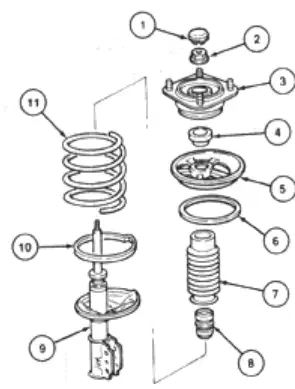
Identify the component marked no. 3.
Bump Stopper
Upper Spring Seat
Dust Boot
Strut Top Mounting
In relation vehicle behaviour during cornering understeer is when the:
vehicle slip angles of the rear tyres are larger than the slip angles of the front tyres
rear wheels of a vehicle are carrying much less load than the front wheels of the
slip angles of the front tyres are the same as the slip angles of the rear tyres
slip angles of the front tyres are larger than the slip angles of the rear tyres
The steering angle which provides a self-centering force to the road wheels is:
The swivel pin inclination angle
The camber angle
The Ackermann angle
The castor angle
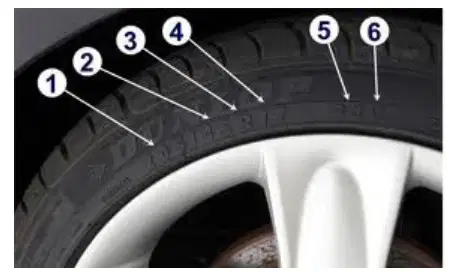
A car tyre is marked 205/45/R17, what does the "45" figure mean?
Tyre Aspect Ratio
Tyre width
Construction Type
Speed Rating
The wheel speed in an anti-lock braking system (ABS) is measured with:
a. a temperature sensor
b. a pressure sensor
c. a magnetic sensor
d. a friction sensor.
The outward or inward tilt of the front wheels when viewed from the front or rear of the vehicle is called:
Camber angle
Castor angle
steering angle
Toe Out or Toe In
Out of balance front wheels are likely to cause:
The steering to feel light
The steering wheel to Shimmy
The steering to feel heavy
The steering wheel to pull to one side
What is Negative Offset in relation to steering angle?
A condition where the steering axis intersects the wheel centerline behind the wheel center.
A condition where the steering axis intersects the wheel centerline ahead of the wheel center.
A condition where the steering axis is parallel to the wheel centerline.
A condition where the steering axis is perpendicular to the wheel centerline.
The Ackermann angle is:
is when there is an off-set angle in the longitudinal plane of the steering which is added to reduce steering feed back
is when centre line through the swivel pin intersects the centre line of the wheel above ground level
is when the centre line through the swivel pin intersects the centre line of the wheel below ground level
is when a negative Ackermann angle value is used in the steering system of a large car with power steering
The Ackermann steering angle is designed to give:
toe out / true rolling motion on corners
under steer of the front wheels during cornering
driver feed back on corners
over steer of the front wheels during cornering
The brake pedal will feel spongy’ and have an excessive amount of travel if:
the brake pads are worn
there is air in the brake system
the vacuum servo is faulty
the hand brake needs adjustment
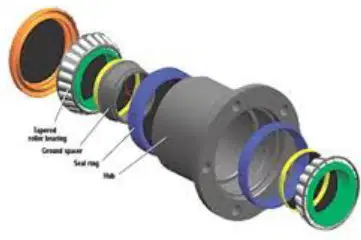
What type of bearing is being used?
Deep Groove Ball
taper roller
needle
roller
Which component in a vehicle's braking system is responsible for converting hydraulic pressure into mechanical force?
Master cylinder
Brake pad
Brake rotor
Brake caliper
In a vehicle's suspension system, what is the purpose of a coil spring?
To enhance steering precision
To improve aerodynamics
To increase engine power
To absorb shock and maintain ride height
where is the brake light switch mounted?
remotely from the brake pedal
directly to the brake pedal
on the front panel
on the front panel

What is shown in this image?
positive camber
negative camber
Toe-in
Toe-out
you find that a vehicles brake fluid is contaminated, what must you do to rectify this?
replace the brake fluid
fit all new brake hoses
fit new brake pads
fit new brake discs
When braking you feel a pulsing of the brake pedal, what checks would you perform on the brake system?
Check thickness with a micrometer
Check the wear on the disc by feel
Measure the disc with a caliper and rule
Check disc run out with a Dial Test Indicator
what tool would be used to check the run out of a brake disc?
a micrometer
a feeler gauge
a dial gauge
Ackerman steering results in:
the inner wheel turns through a greater angle than the outer
the outer wheel turns through a greater angle than the inner
both wheels turn the same amount
what is meant by the 82 in the following tyre size 185/65/R15 82 H
the speed rating
the load index
the nominal width
the aspect ratio
what is the most common spring type used on the front axle of light vehicles?
torsion bar springs
coil springs
leaf springs
what should you do after fitting new brake pads to a customers vehicle?
pump the brake pedal to take up the free play
take the vehicle for a test drive
check the hand brake travel
Tell the customer to not drive above 30mph for a week
Which of the following is achieved when a vehicle maintains a steady path through a corner without slipping?
true rolling motion on corners
under steer of the front wheels during cornering
driver feed back on corners
over steer of the front wheels during cornering
What will cause a spongy pedal?
there is air in the brake system
there is moisture in the brake system
the brake fluid is contaminated
Loose brake pads inside the caliper
When discussing the coefficient of friction, it can be said that
the coefficient of static friction is lower than the coefficient of dynamic fritcion
the coefficient of friction remains constant whether the surfaces are moving or static
the coefficient of dynamic friction is normally higher than the coefficient of static friction
the coefficient of static friction is normally higher than the coefficient of dynamic friction
Which of the following diagnostic tools is best suited to measure the output from a light vehicle ABS speed sensor?
A dynamometer
an Ohmmeter
An oscilloscope
A DC voltmeter

What alignment angle is shown above?
Toe in
Toe out
camber
Caster

Which part of the drum brake system directly contacts the brake drum to create friction?
Wheel cylinder
Backing plate
Brake shoe
Lining

