
 Worksheets
Lab Background: Characteristics of Ionic Bonds
Total questions: 12
Worksheet time: 43mins
What is the main reason chemical bonds form between atoms?
According to Coulomb's Law, what happens when two atoms approach each other?
Fill in the blank: In an ionic solid, the oppositely charged ions are arranged in a tightly packed, extended three-dimensional structure called a _______.
crystal lattice
molecular structure
covalent bond
metallic bond
What property of ionic compounds makes them suitable for use in ceramics and cookware?
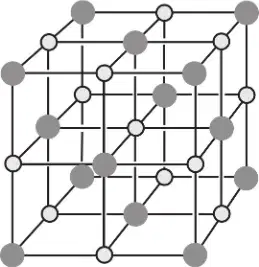
What does Figure 1 represent in the context of ionic compounds?
The structure of an ionic compound
The process of ionic bonding
The properties of ionic compounds
The formation of ions
Ionic compounds conduct electricity when dissolved in water but not in the solid state because:
they have free-moving ions in solution.
they have tightly bound ions in solid state.
water acts as a conductor.
solid state prevents ion movement.

This image shows the bonding between Lithium and Fluorine. What does the red arrow show?
electrons being shared
electrons being transferred to Fluorine
electrons being transferred to Lithium
electrons being destroyed

This is an image of the giant ionic lattice representing Sodium Chloride, what is represented by the +?
Cl ion
Cl atom
Na atom
Na ion

Is this ionic bond drawn correctly?
Yes
No

Ionic bonds form between...
(Choose all that apply)
A metal and a nonmetal
Two nonmetals
Two metals
A cation and an anion
This is an image of the giant ionic lattice representing Sodium Chloride, what is represented by the -?
Cl ion
Cl atom
Na atom
Na ion
What physical properties of ionic bonds will we be investigating in this lab?
(Choose all that apply)
melting points
freezing points
conductivity
density

