
 Worksheets
S2 Unit 11 Week 13 (Due 04-06-2025)
Total questions: 20
Worksheet time: 13mins
Two metals of equal mass but with differing specific heat capacities are subjected to the same amount of heat. Which metal will undergo the smallest change in temperature if neither metal changes phase?
the metal with the higher heat capacity
the metal with the lower heat capacity
both metals will undergo the same temperature change
you need to know the initial temperatures of both metals to answer this question
you need to know the identities of the metals to answer this question
A piece of a newly synthesized material of mass 12.0 g at 88.0°C is placed in a calorimeter containing 100.0 g of water at 20.0°C. If the final temperature of the system is 24.0°C, what is the specific heat capacity of this material?
10.2 J · g−1 · (°C)−1
1.58 J · g−1 · (°C)−1
2.18 J · g−1 · (°C)−1
9.50 J · g−1 · (°C)−1
A coffee cup calorimeter contains 150g of water at 24.6°C. A 110g block of metal at 40.0°C is then placed in the calorimeter. The contents of the calorimeter come to 28.0°C as the metal releases 2125 J of energy into the water.
What is the heat capacity of the metal?
1.61 J/g°C
0.867 J/g°C
2130 J/g°C
0.248 J/g°C
The enthalpy of fusion of methanol (CH₃OH) is 3.16 kJ/mol. How much heat would be absorbed or released upon freezing 25.6 grams of methanol?
2.52 kJ absorbed
3.95 kJ absorbed
0.253 kJ released
2.52 kJ released
3.95 kJ released
Calculate the enthalpy change that occurs when 1.00 kg of acetone condenses at its boiling point (329.4 K). The standard enthalpy of vaporization of acetone is 29.1 kJ · mol⁻¹.
-501 kJ
-29.1 kJ
-2.91 x 10⁴ kJ
+501 kJ
+29.1 kJ
Calculate the enthalpy change that occurs when 1 lb (454 g) of mercury freezes at its freezing point (234.3 K). The standard enthalpy of fusion of mercury is 2.29 kJ · mol⁻¹.
-2.29 kJ
-1.04 x 10³ kJ
+5.18 kJ
+2.29 kJ
-5.18 kJ
Juan freezes a bottle of water to ice (500 mL) in preparation for a road trip. How much heat can be absorbed by that ice before it is fully melted? The heat of fusion of water is 334 J/g.
1130 kJ
167 kJ
2090 kJ
6.02 kJ
0 kJ
How much heat is required to change the temperature of two cups of water (500 mL) from room temperature (25°C) to boiling? (Remember, the density of water is 1.00 g/mL)
78.5 kJ
157 kJ
1.57 kJ
15.7 kJ
0.785 kJ
What is the best definition of specific heat?
the quantity of heat energy that must be absorbed to make one gram of a substance boil
the quantity of heat energy that must be absorbed to increase the temperature of one gram of a substance by one degree Celsius
the boiling point of a substance
the difference between the freezing point and the boiling point of a substance
How many Joules are required to heat 2 L of water in a pot from 20°C to the boiling point of water? The specific heat of water is 4.18 g⋅°CJ and the density of water is 1 g/mL.
6.7 × 10⁵ J
1.7 × 10⁵ J
3.8 × 10⁴ J
6.7 × 10² J
3.8 × 10⁵ J
Copper has a heat capacity of 0.385 J/g/°C. If a 100 g sample of copper at an initial temperature of 50°C absorbs 400 J of energy, what is the new temperature of the metal? Assume no phase transition occurs.
60.4°C
88.5°C
39.6°C
10.5°C
Determine the specific heat of iron if 6.1 J of energy are needed to warm 1.50 g of iron from 20.0°C to 29.0°C?
0.45 J/g°C
2.2 J/g°C
37 J/g°C
1.0 J/g°C
The molar heat of fusion of water is 6.02 kJ/mol. Calculate the energy required to melt 46.8 g of water.
282 kJ
2.32 kJ
6.02 kJ
7.77 kJ
15.7 kJ
The specific heat of liquid water is 4.184 J/g°C. Calculate the energy required to heat 10.0 g of water from 26.5°C to 83.7°C.
837 J
572 J
239 J
2.39 × 10³ J
None of these
A friend is into heavy metal. On that note, if he supplied 3900 Joules of heat to a 100 gram chunk of LEAD (a rather heavy metal with a density of 11.34 g/cm³) at 25°C, and the temperature rose to 325°C, what is the specific heat of lead?
0.130 J/g·°C
0.120 J/g·°C
1.47 J/g·°C
0.444 J/g·°C
0.068 J/g·°C
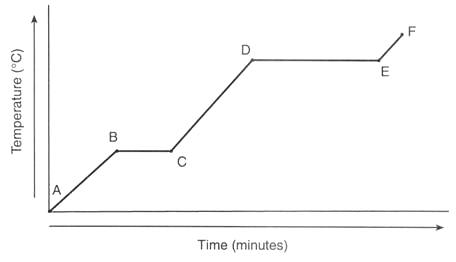
Between which points is the temperature of the substance remaining constant?
A-B only
A-B, C-D, and E-F
B-C only
B-C and D-E

Which letter indicates where water is in both the solid and liquid phase at the same time?
A
B
C
D
E

In which region(s) of the heating curve would water be a liquid and a gas at the same time?
A
B
C
D
E

Describe the substance at letter A.
Solid
Liquid
Melting
Evaporating
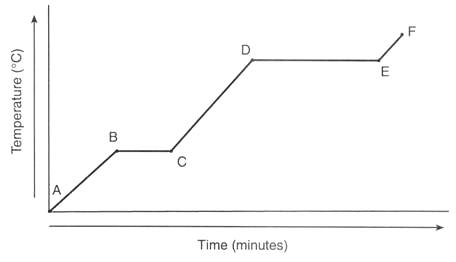
How many states of matter are present during line segment BC?
One
Two
Three
Depends on the temperature

