
 Worksheets
24-25.SocialStudies.USHistory1.Benchmark3
Total questions: 25
Worksheet time: 13mins
What was a precedent established by George Washington?
running for vice president
serving on the Supreme Court
serving two terms as president
being elected to the Senate
Which statement was most likely made by a Federalist during the debates over the ratification of the U.S. Constitution?
A. "A bill of rights is necessary to protect people's liberties."
B. "A strong central government is necessary for our country."
C. "The states must retain their original powers."
D. "The states must determine whether slavery will exist."
Which example best demonstrates the idea of promoting the general welfare as described in the Preamble to the U.S. Constitution?
Congress passes the Alien and Sedition Acts.
George Washington is inaugurated as the first president.
The Constitution gives Congress the power to tax.
James Madison writes essays supporting ratification.
Read the excerpt. The second question, whether the judges are invested with [given] exclusive authority to decide on the constitutionality of a law, has been . . . a subject of consideration with me. . . . Certainly there is not a word in the constitution which has given that power to them more than to the executive or legislative branches. —Thomas Jefferson to W. H. Torrance, 1815 Which item is associated with the decision discussed in this excerpt?
federalism
judicial review
popular sovereignty
capitalism
What was an obstacle that President Thomas Jefferson faced when making the Louisiana Purchase?
The Constitution was unclear about whether the United States could purchase the territory.
The purchase would violate the Northwest Ordinance's process for creating new states.
Great Britain still held control over the majority of the area being purchased.
The purchase would reduce the country's ability to settle boundary disputes.
The combination of resources, improved transportation, and technological breakthroughs all contributed to the ________.
Industrial Revolution
Agricultural Revolution
Digital Age
Renaissance
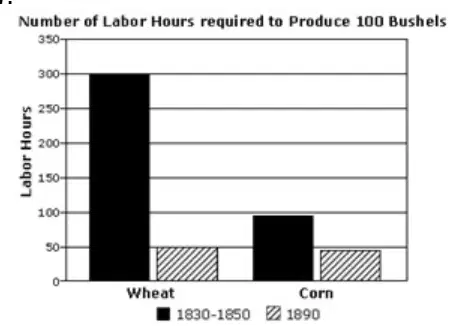
Which of the following factors was most responsible for the economic changes shown in the graph?
increases in government subsidies to farmers
increased immigration that boosted the rural labor force
cuts in taxes that enabled farmers to buy more seed and plant more acreage
inventions and new farming methods that allowed farmers to increase production
How did Robert Fulton's steamboat aid the economic development of the United States?
reducing traffic in the nation's ocean harbors
making transportation on rivers more efficient
ending American dependence on European shipping
serving as a method of connecting California and the East Coast
Based on the chart, what conclusions can be drawn about railroad construction in the United States?
The steam locomotive was invented in 1830.
Railroad construction gradually decreased after 1860.
As the country expanded, railroads became more important.
Increased railroad usage contributed to the start of the Civil War.
The Tariff of Abominations was strongly opposed in most of the South and led directly to the concept of nullification. Which statement below best describes nullification?
the nation should forbid all tariffs
a national election should decide tariff rates
the president should not have the right to veto acts of Congress
individual states could decide for themselves if acts of the federal government were constitutional
What event would have caused the dramatic increase in population in the state of California?
Westward Movement
Louisiana Purchase
The Gold Rush
Indian Removal Act
Which of these would be the best title for the illustration above?
Divine Nature
Manifest Destiny
Universal Expansion
Survival of the Fittest
What impact did the U.S. Supreme Court ruling have in the 1819 Maryland v. McCullough case?
According to the ruling, states could tax the federal government, weakening national power
According to the ruling, states could veto national legislation, weakening national power
According to the ruling, states could not raise their own militias, increasing national power
According to the ruling, states could not tax the federal government, increasing national power
What characteristics made American Lowell Mills different from most industrial factories?
They relied on mass production using machinery
They were staffed by women and had good working conditions
They paid higher wages than other factories
They had boardinghouses for the workers to live in
Which of the following best describes the prison reform movements of the early 19th century to address issues such as those above?
A. Prisons were eliminated in favor of work release
B. Prisons were made cleaner, safer, and less crowded
C. Prisons were eliminated in favor of combined asylums
D. Prisons were made into educational facilities
16. Read the excerpt below. "This controversial law allowed slave hunters to seize alleged fugitive slaves without due process of law and prohibited anyone from aiding escaped fugitives or obstructing their recovery. Because it was often presumed that a black person was a slave, the law threatened the safety of all blacks..." Text from an online exhibit describing the Fugitive Slave Act of 1850 Library of Congress, http://www.loc.gov/
What was the Fugitive Slave Act of 1850?
What did the Fugitive Slave Act of 1850 allow?
What was the impact of the Fugitive Slave Act of 1850 on black people?
What was the purpose of the Fugitive Slave Act of 1850?
What was one result of the Fugitive Slave Act that is described above?
Northerners who believed the law was unfair began to support the abolitionist movement.
Religious groups left the abolitionist movement to avoid political controversy.
Southerners used the law to challenge the constitutionality of abolitionist goals.
Abolitionist societies began to focus their efforts on promoting women's suffrage.
Which of the following was not part of the Compromise of 1850?
The remaining parts of the Mexican Cession were divided into the territories of New Mexico and Utah.
The slave trade in Washington, D.C. was ended.
A new fugitive slave law was established.
California became a slave state.
Which of the following statements is the best description of the Dred Scott decision?
A. Slaves were allowed to sue for their freedom, but they probably would not get it.
B. Congress would be allowed to determine which states would allow slavery.
C. Slaves were seen as property, so they could not legally sue to become free.
D. Slaves were seen as property, but they could still try to become free.
Which of the following was a result of the Kansas-Nebraska Act of 1854?
Fighting broke out between pro-slavery and anti-slavery groups in Kansas.
Kansas entered the Union as a slave state through popular sovereignty in 1856
Nebraskan settlers who supported abolition moved to Kansas.
The boundary established by the Missouri Compromise of 1820 was extended farther south.
What led the newspapers to write about "Bleeding Kansas" in 1856?
attacks on job-seeking Irish immigrants
conflict between cattle ranchers and farmers
fighting between pro-slavery and anti-slavery forces
reaction to the U.S. Supreme Court ruling against Dred Scott
What can be inferred from the chart above?
The population of slaves in all American states increased dramatically from 1830 – 1850
The population of slaves in all American states decreased dramatically from 1830 – 1850
Northern economies were factory based with less slaves than the south from 1830 - 1850
Southern economies were slowly freeing their slaves from 1830 - 1850
Which reason did the United States give for declaring war against Mexico in 1846?
to overturn a corrupt Mexican government
to defend U.S. territory from Mexican aggression
to end a Mexican slave rebellion
to respond to attacks on U.S. merchant ships by Mexican pirates
What impact did Harriet Beecher Stowe's novel, Uncle Tom's Cabin, have on the slave debate in America?
The novel strengthened the south's cause that slaves prospered under the southern plantation system
The novel strengthened the south's cause that slaves were treated gently and fairly
The novel strengthened the north's outrage over cruel and inhumane conditions of slavery
The novel strengthened the north's outrage over a lack of voting rights for slaves
As a result of Abraham Lincoln's election as President in 1860, what significant event occurred?
The American Civil War began
The Emancipation Proclamation was issued
The Gettysburg Address was delivered
The 13th Amendment was passed

