
Font size
 Worksheets
"The Three-Century Woman" and "The Fall of the Hindenburg" Quiz
Total questions: 1
Worksheet time: 2hrs 50mins
Excerpt 1:
“The Hindenburg!”
“That big gas thing the Germans built to fly over the Atlantic Ocean. It was called a zeppelin (3). Biggest thing you ever saw—five city blocks long. It was in May of 1937, before your time. You wouldn’t remember. My husband and I were coming back from Europe. No, wait a minute.”
Great-grandma cocked her head and pondered for the camera.
“My husband was dead by then. It was some other man. Anyway, the two of us were coming back on the Hindenburg. It was smooth as silk. You didn’t know you were moving. When we flew in over New York, they stopped the ball game at Yankee Stadium to see us passing overhead.”
Great-grandma paused, caught up in the memories.
“And then the Hindenburg exploded,” the anchor said, prompting her.
She nodded. “We had no complaints about the trip till then. The luggage was all stacked, and we were coming in at Lakehurst, New Jersey. I was wearing my beige coat—beige or off-white, I forget. Then whoosh! The gondola (4) heated up like an oven, and people peeled out of the windows. We hit the ground and bounced. When we hit again, the door fell off, and I walked out and kept going. When they caught up to me in the parking lot, they wanted to put me in the hospital. I looked down and thought I was wearing a lace dress. The fire had about burned up my coat. And I lost a shoe.”
Excerpt 2:
The zeppelin had just crossed the Atlantic Ocean after taking off from Frankfurt, Germany, 2 ½ days prior on its first transatlantic voyage of the season. Thirty-six passengers and a crew of 61 were on board.
As it reached its final destination in New Jersey, it hovered over its landing spot and was beginning to be pulled down to the ground by landing lines by over 200 crewmen when disaster struck. A burst of flame started just forward of the upper fin, then blossomed into an inferno that engulfed the Hindenburg’s tail.
“Oh, the Humanity!” Many jumped from the burning craft, landed on the soft sand of the naval base below, and lived to tell about it; others weren’t so lucky. Herb Morrison, a reporter for WLS Radio in Chicago, happened to be covering the event and cried out the now famous words, “Oh, the Humanity!” The majestic ship turned into a ball of flames on the ground in only 34 seconds.

In lines 1-5, the great-grandmother describes her journey on the Hindenburg. Which traditional narrative element is most similar to her experience of a journey with an unexpected event?
A character's ordinary day
A hero's quest with a sudden challenge
A peaceful voyage without conflict
A detailed historical account

The story of the Hindenburg's explosion has been told many times through various sources. How does great-grandma's account in this passage draw on a common theme found in survival stories?
It focuses on the technical details of the Hindenburg.
It emphasizes the historical significance of the event.
It highlights a first-person perspective of chaos and survival.
It presents a calm and detached view of the disaster.

In lines 4-5, great-grandma describes the Hindenburg explosion. Which traditional story element is reflected in this description?
The use of hyperbole to describe an event.
A peaceful resolution to a conflict.
The detailed account of a historical event.
The theme of overcoming a destructive force.
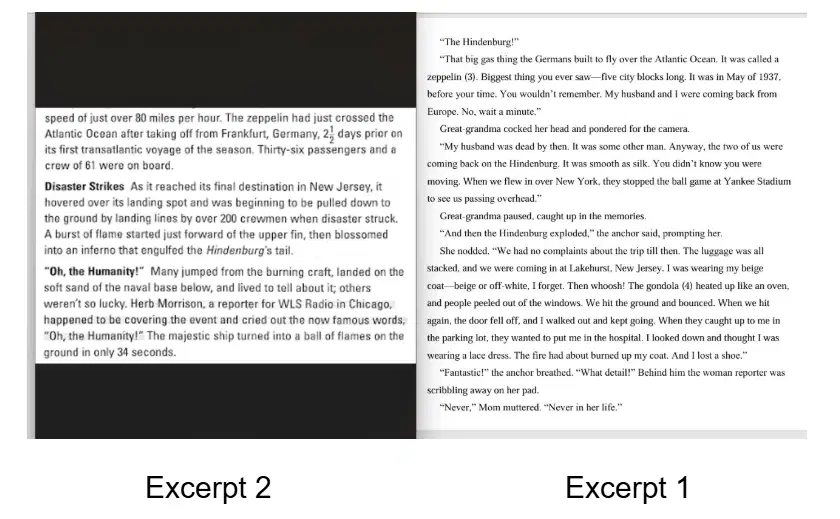
Using the previous passage (excerpt 1) and this one (excerpt 2), answer this question:
Both Excerpt 1 and Excerpt 2 describe the Hindenburg disaster. Which of the following literary devices, drawn from traditional storytelling, is most evident in Excerpt 1?
Objective reporting, focusing solely on factual details and avoiding personal perspectives.
The use of hyperbole to exaggerate the events and create a fantastical atmosphere.
First-person narrative to convey the chaos and emotional impact of a catastrophic event.
A detached, third-person point of view that summarizes the events without emotional investment.
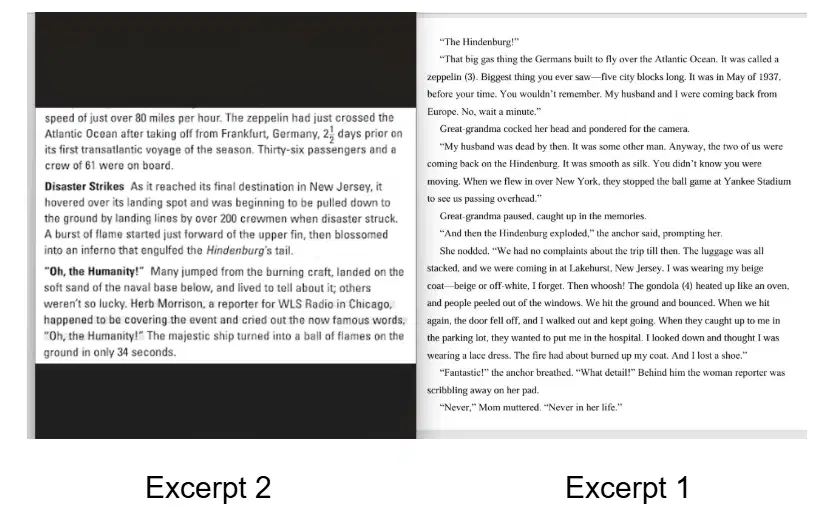
Using the two the first passage (excerpt 1) and the new one (excerpt 2), answer the following the question:
Both excerpts describe the Hindenburg disaster, but they emphasize different aspects of the event. Which of the following traditional storytelling themes is most evident in Excerpt 2's account?
The personal reflections of a journey.
The tragic downfall of a magnificent creation.
The power of human memory to preserve history.
The use of humor to cope with a difficult experience.
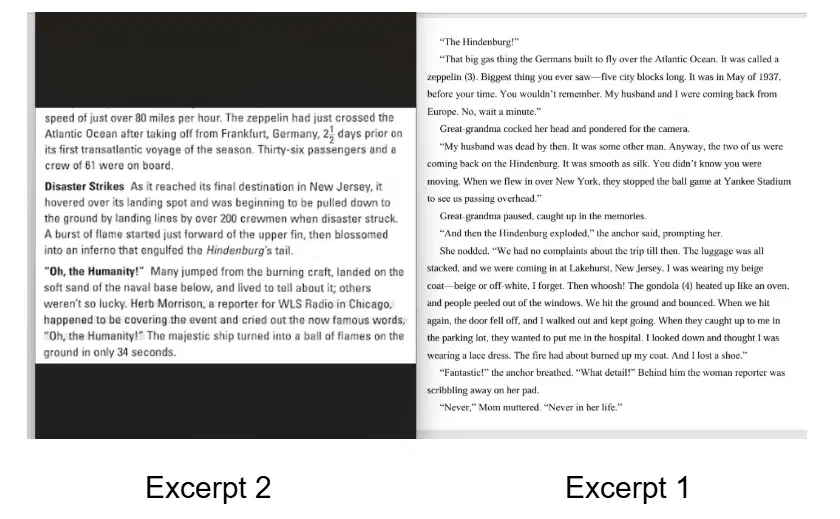
Using both excerpts, answer the question below:
Both excerpts tell the story of the Hindenburg disaster. Which element, commonly found in traditional oral storytelling, is most evident in Excerpt 1?
The use of a first-person perspective to create a vivid and personal account.
Detailed technical specifications of a vehicle.
Exaggerated statistics to emphasize the size of the Hindenburg.
Objective reporting focused solely on confirmed facts and figures.

Which statement best identifies a theme present in this passage?
The destructive power of technological advancements.
The importance of remaining calm in the face of disaster.
The way personal experience shapes the memory of historical events.
The celebration of human ingenuity and engineering feats.
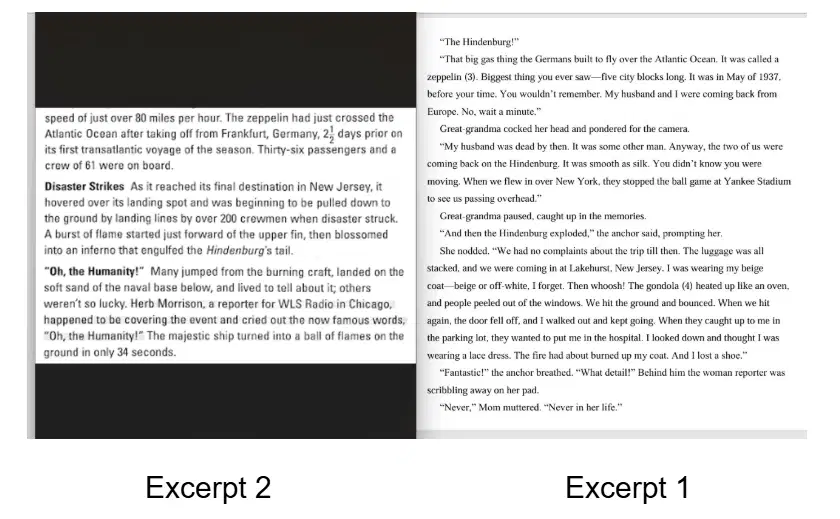
Both excerpts present information about the Hindenburg disaster. Which theme is conveyed in BOTH excerpts?
The inevitability of technological progress.
The contrast between beauty and destruction.
The enduring power of human memory.
The importance of scientific investigation.
Which theme is most emphasized by the inclusion of the radio reporter's words, "Oh, the Humanity!" in the passage?
The immediate emotional impact of tragedy on witnesses.
The technological aspects of airship travel.
The historical importance of the Hindenburg disaster
The scientific theories surrounding the cause of the fire.

What does the phrase "Her claw hand came out from under the covers and tapped it" say about the narrators view of her Great Grandma?
The narrator thinks their Great Grandma is funny.
The narrator doesn't respect their Great Grandma.
The narrator is scared of their Great Grandma.
The narrator has dehumanized their Great Grandma.

