
Font size
 Worksheets
U5Ch2 Study Guide
Total questions: 16
Worksheet time: 8mins
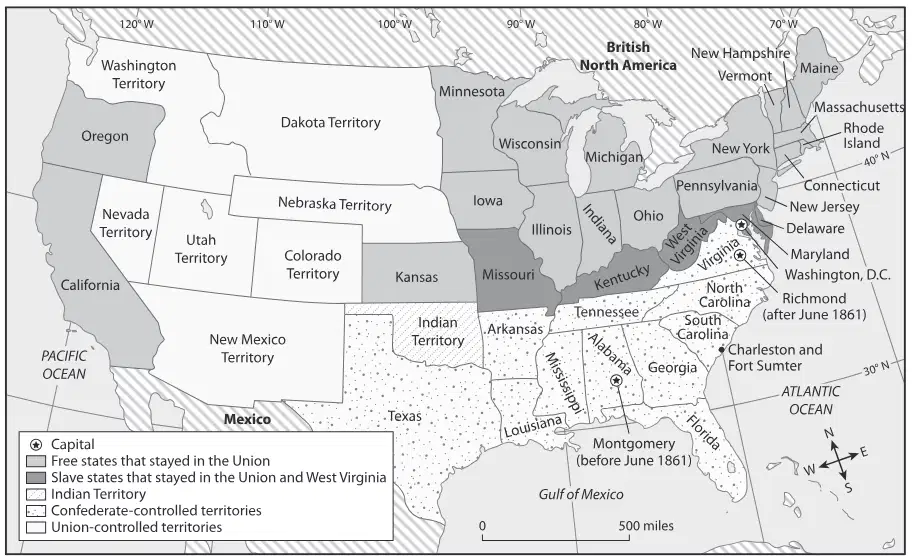
According to the map, which states were border states? Select the two correct answers.
Arkansas
Kentucky
Missouri
Ohio
Virginia
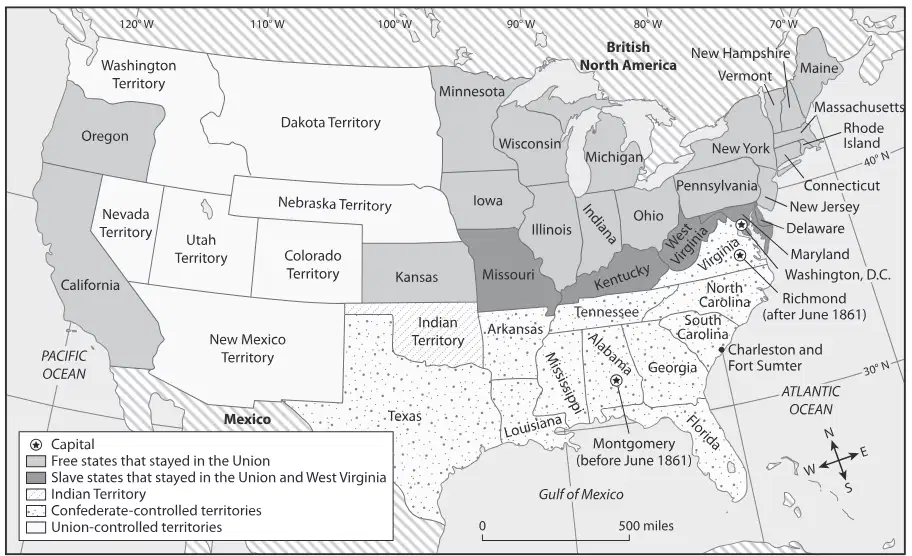
According to the map, which city was the Confederate capital for most of the Civil War?
Charleston
Montgomery
Richmond
Washington, D.C.

Use the image to answer the question. How did this person contribute to the Union war effort? Select the two correct answers.
by caring for wounded soldiers
by starting a school to train nurses
by bringing supplies to the battlefield
by founding Lincoln Hospital in Washington, D.C.
by serving as the first woman U.S. Army physician
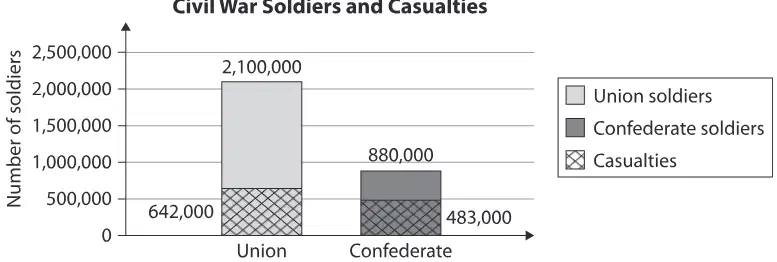
Use the graph to answer the question. Based on the graph, which statement is true?
The Confederacy had a larger army than the Union.
The Union had more casualties than the Confederacy.
The Confederacy had a larger population than the Union.
The Union relied on the draft longer than the Confederacy.
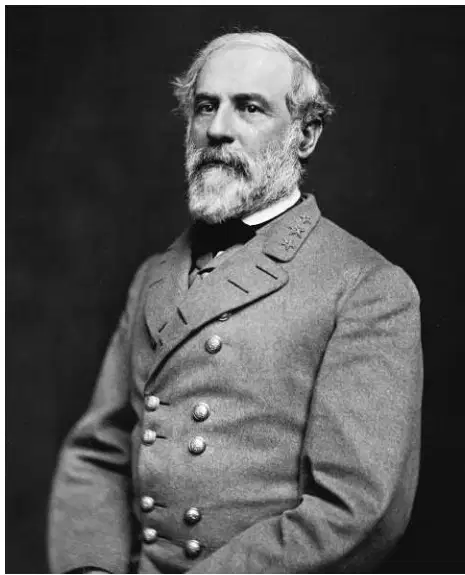
Use the image to answer the question. What is this person best known for?
defeating Union forces at the Battle of Manassas
being the most capable Confederate general
becoming the president of the Confederacy
wanting to spread the institution of slavery
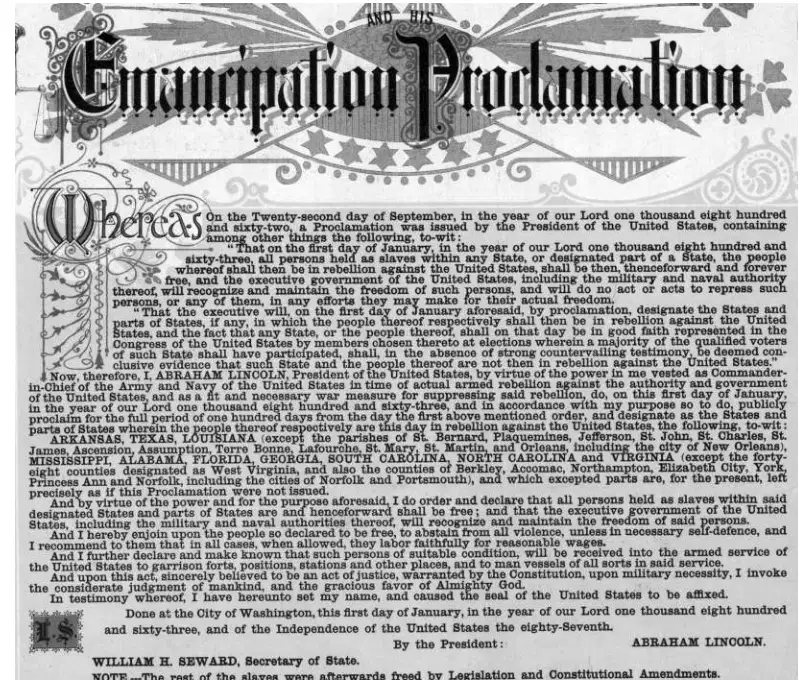
What was one effect of this document?
Enslaved people were freed in border states.
Abraham Lincoln won a second term as president.
Former Confederate states were readmitted to the Union.
African Americans were permitted to serve in the Union military.
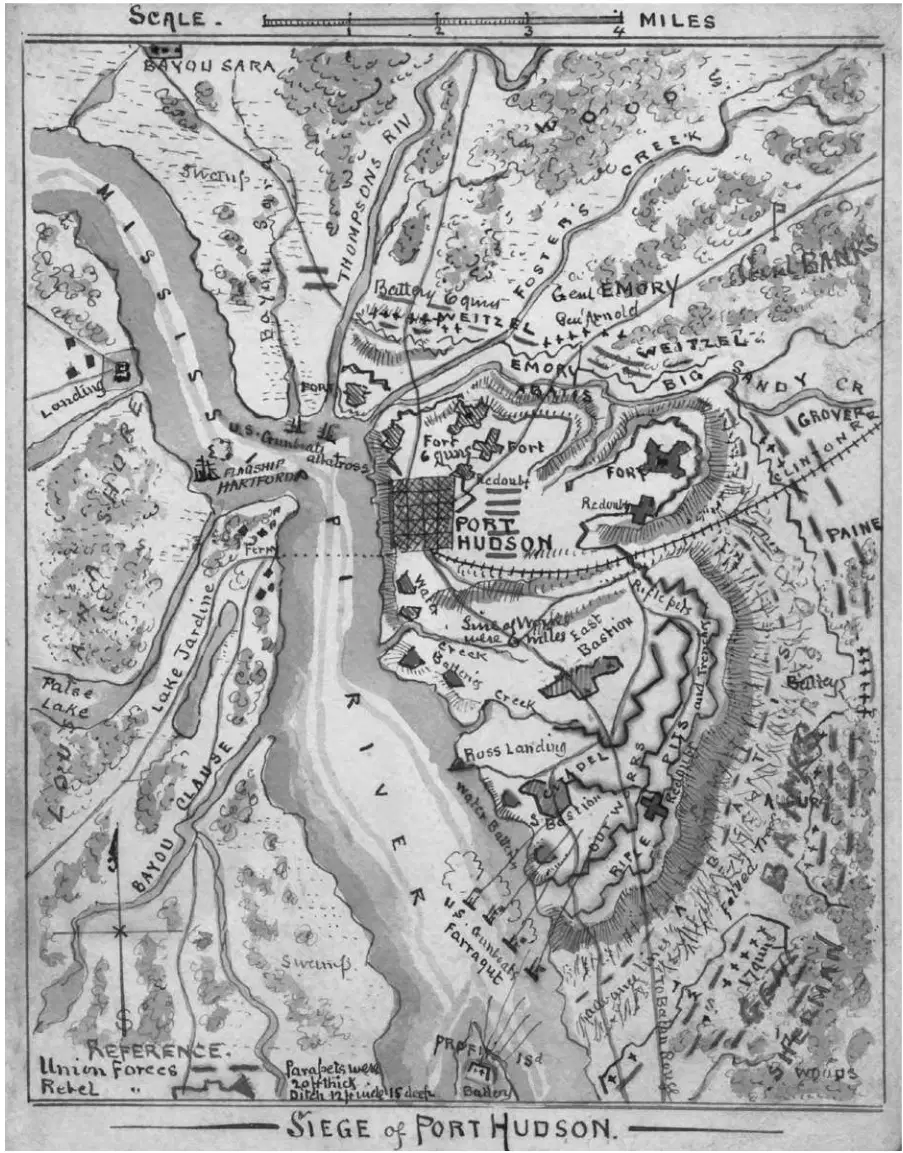
Based on the map, why was Port Hudson a strategic location?
It was built near the railroad.
It was near many tributaries.
It was close to New Orleans.
It was located on the Mississippi River.
Which group is President Lincoln referring to when he says, “Both parties deprecated war, but one of them would make war rather than let the nation survive”?
Constitutional Unionists
Northern Democrats
Southern Democrats
Republicans
With malice toward none, with charity for all, with firmness in the right as God gives us to see the right, let us strive on to finish the work we are in, to bind up the nation’s wounds, to care for him who shall have borne the battle and for his widow and his orphan, to do all which may achieve and cherish a just and lasting peace among ourselves and with all nations.
Which line from the excerpt challenges the claim that President Lincoln would like to punish the former Confederate states?
“… insurgent agents were in the city seeking to destroy it without war-seeking to dissolve the Union and divide effects by negotiation.”
“To strengthen, perpetuate, and extend this interest was the object for which the insurgents would rend the Union even by war, while the Government claimed no right to do more than to restrict the territorial enlargement of it.”
“Neither anticipated that the cause of the conflict might cease with or even before the conflict itself should cease.”
“With malice toward none, with charity for all, with firmness in the right as God gives us to see the right, let us strive on to finish the work we are in, to bind up the nation’s wounds. . . .”
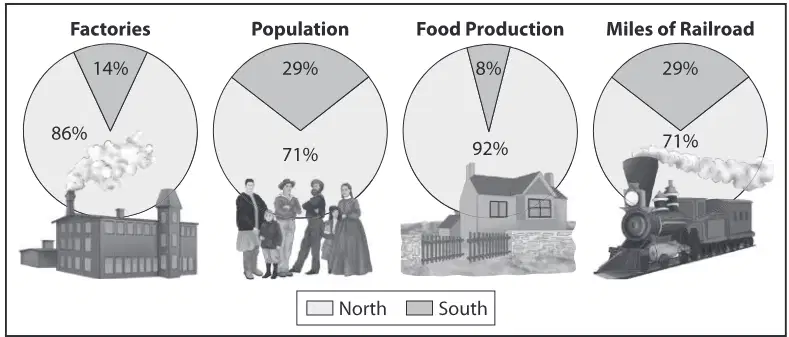
Use the graph to answer the question.
Which conclusion is supported by the graph?
The Union relied on trade with foreign countries.
The Union had more resources than the Confederacy.
The Confederacy had more infrastructure than the Union.
The Confederacy relied more on manufacturing than agriculture.
Use the excerpt from the Gettysburg Address to answer the question.
It is for us the living, rather, to be dedicated here to the unfinished work which they who fought here have thus far so nobly advanced. It is rather for us to be here dedicated to the great task remaining before us—that from these honored dead we take increased devotion to that cause for which they gave the last full measure of devotion—that we here highly resolve that these dead shall not have died in vain, that this nation under God shall have a new birth of freedom, and that government of the people, by the people, for the people shall not perish from the earth.
Why was this speech significant?
It led Confederate troops to attack Union soil.
It encouraged Northerners to join the Union Army.
It reminded Northerners what the Union stood for.
It made the Civil War about the abolition of slavery.
The Battle of Manassas made it clear that ______________________.
Civil War had few supporters
Confederacy had a stronger army
Union forces would not retreat easily
Civil War would not end quickly
What was one outcome of the Battle of Antietam?
Maryland stayed in the Union.
Abolition became an important cause for the Union.
George McClellan was removed from Confederate command.
Confederate troops were trapped on one side of the Potomac.
Why did William Tecumseh Sherman destroy farms, shops, and rail lines during his March to the Sea?
to provide food for his troops
to prove his talent as a general
to weaken the enemy at all costs
to help the president win reelection
Where did the Civil War come to an end?
Appomattox Court House
New Orleans
Richmond
Shiloh
There is no word in the English language that can express the state in which we are, and have been, these last three days. Day before yesterday, news came early in the morning of three of the enemy’s boats passing the Forts, and then the excitement began. It increased rapidly on hearing of the sinking of eight of our gunboats in the engagement, the capture of the Forts, and last night, of the burning of the wharves and cotton in the city while the Yankees were taking possession. . . . Nothing can be positively ascertained, save that our gunboats are sunk, and theirs are coming up to the city. . . . We went this morning to see the cotton burning—a sight never before witnessed, and probably never again to be seen. Wagons, drays,—everything that can be driven or rolled,—were loaded with the bales and taken a few squares back to burn on the commons. . . . All were as busy as though their salvation depended on disappointing the Yankees. . . . —Sarah Morgan Dawson, A Confederate Girl’s Diary
What is Dawson describing in this excerpt?
the occupation of New Orleans
the Battle of Gettysburg
the siege of Port Hudson
the Battle of Antietam

