
 Worksheets
Earth's Waters
Total questions: 32
Worksheet time: 16mins
Approximately what percentage of Earth's water is fresh water?
97 percent
71 percent
30 percent
3 percent
Water that falls to Earth as rain, snow, sleet, or hail is called (a) .
condensation
evaporation
precipitation
transpiration
Water that fills the cracks and spaces in underground soil and rock layers is called (a) .
saltwater
rainwater
groundwater
water vapor
Choose the answer that best completes each statement. 4. (a) are the streams and small rivers that feed into a main river.
watersheds
tributaries
divides
wetlands
Choose the answer that best completes each statement. 5. Wetlands provide habitats for many living things because of their sheltered waters and ___.
large supply of nutrients
thick layer of mud
lack of insects
ability to prevent floods
An aquifer is a(an) (a) .
underground layer of rock or sediment that holds water
well in which water rises because of pressure
type of hot spring from which the water periodically erupts
place where groundwater bubbles or flows out of cracks in the rock
A well in which groundwater rises because of pressure is called a(an) (a) .
geyser well
The three major steps of the water cycle are (a) .
evaporation, abrasion, and precipitation
irrigation, precipitation, and conservation
evaporation, condensation, and precipitation
saturation, evaporation, and liquification
Plants use water to undergo photosynthesis. They also release water into the atmosphere. Plants contribute to which part of the water cycle? (a)
irrigation
evaporation
condensation
precipitation
The horizontal distance between wave crests is the (a) .
frequency
wavelength
trough
wave height
The size of a wave is NOT affected by (a) .
length of time the wind blows across the water
salinity of the water
strength of the wind
distance the wind blows across the water
Salinity is a measure of (a) in water.
carbon dioxide
oxygen
dissolved salts
sand
Evaporation increases the _______ of sea water, since the salt is left behind as the water evaporates.
salinity
temperature
density
volume
The daily rise and fall of water on Earth's coastlines are called _______.
tides
waves
currents
erosion
The force of the sun's and moon's _______ pulling on Earth causes tides.
gravity
magnetism
light
heat
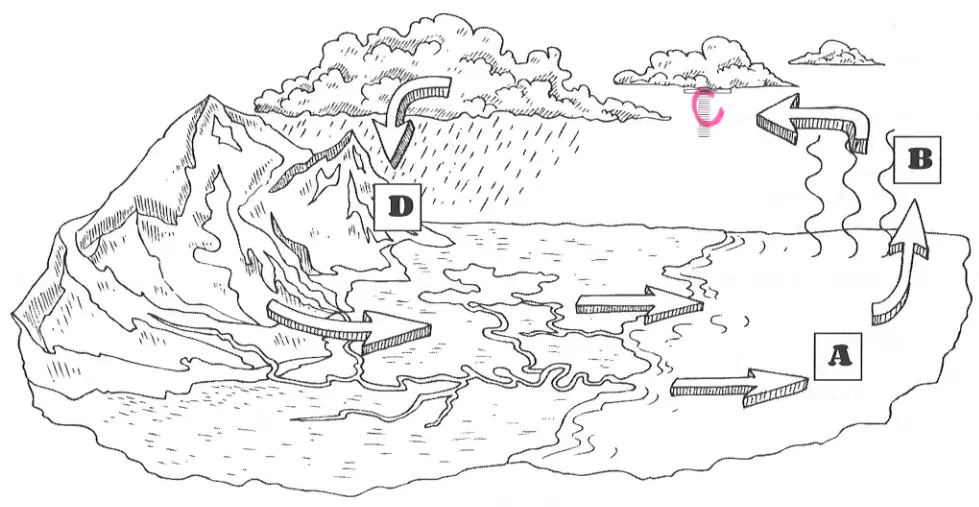
Identify the letter and name the step in which water changes from a liquid to a gas.
C: evaporation
A: condensation
B: freezing
D: sublimation

Identify the letter and name the step in which water returns to Earth's surface from the atmosphere.
E: precipitation
A: evaporation
B: condensation
C: transpiration
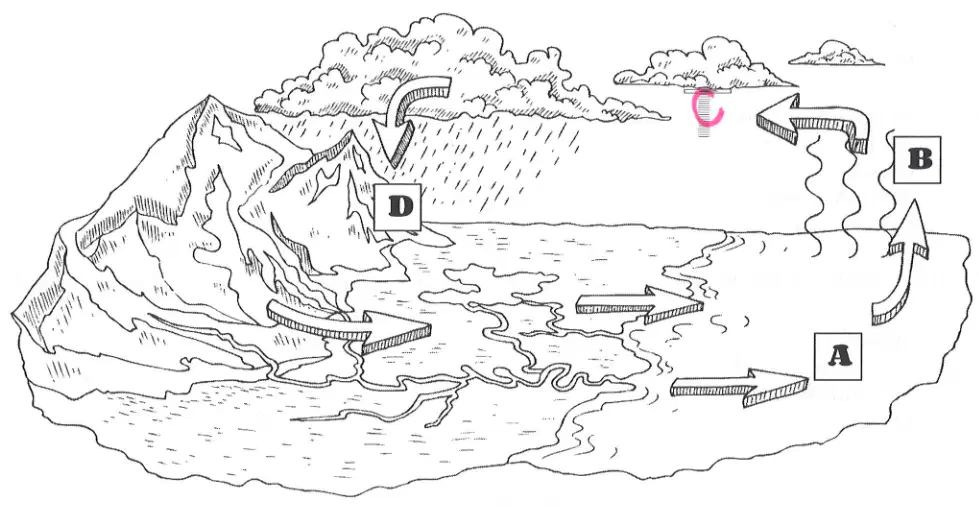
A raindrop falling in the mountains might take different paths to reach the ocean. Which of the following is a possible path?
Flow into a river and then into the ocean
Evaporate and form clouds
Get absorbed by plants and never reach the ocean
Freeze and become part of a glacier
Tides are caused by ____.
strong winds that blow over ocean waters
the interaction of Earth, the moon, and the sun
the shifting of the plates on the ocean floor
variations in the salinity of ocean water.
A large stream of moving water that flows through the oceans is called a(an) ____.
current
tsunami
tide
undertow
In the Northern Hemisphere, currents curve to the right because of the ____.
longshore drift
density
Coriolis effect
moon’s gravity
The movement of cold, deep ocean water to replace warm water at the surface is called ____.
upwelling
a surface current
the Coriolis effect
El Niño
20. Marshes, bogs, and _______ are examples of freshwater wetlands.
swamps
deserts
mountains
lakes
A place where heated groundwater bubbles to the surface is called a(an) _______
hot spring
geyser
volcano
fumarole
22. Ocean-floor research is difficult because of the _______ pressure and low temperature in the deep ocean.
high
low
medium
extreme
Winds are the main cause of _______ currents in the ocean.
surface
deep
tidal
upwelling
The top of the saturated zone is called the _______.
water table
aquifer
permeable layer
capillary fringe
Identify the parts of Earth's surface where the most evaporation occurs and the most precipitation falls.
Oceans and rainforests
Deserts and polar regions
Mountains and valleys
Urban areas and rural areas
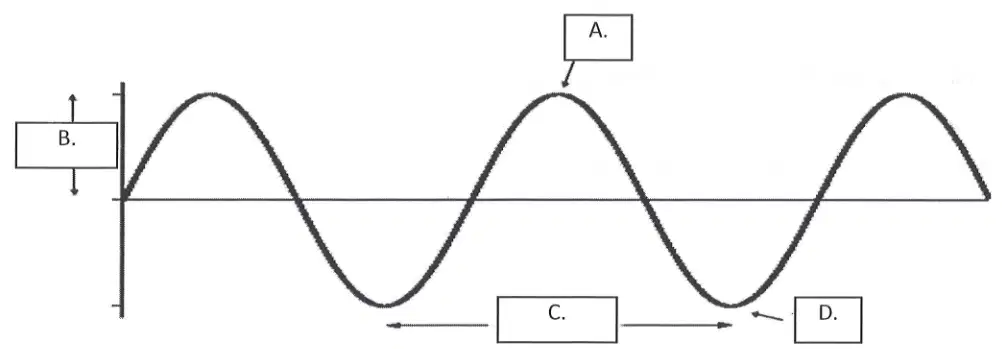
Identify the parts of the wave using the diagram above.
crest
A
amplitude
B
wavelength
C
trough
D
Choose the correct statement about how light, pressure, and salinity change with depth in the ocean.
Light decreases, pressure increases, salinity remains constant.
Light decreases, pressure increases, salinity increases.
Light increases, pressure decreases, salinity decreases.
Light remains constant, pressure increases, salinity decreases.
Contrast spring and neap tides and their causes.
Spring tides occur during new and full moons, while neap tides occur during the first and third quarters of the moon.
Spring tides occur during the first and third quarters of the moon, while neap tides occur during new and full moons.
Spring tides and neap tides occur at the same time and have the same causes.
Spring tides occur only in spring, while neap tides occur only in autumn.
Define upwelling and explain its importance.
Upwelling is the process where deep, cold, and nutrient-rich water rises to the surface, supporting marine life and fisheries.
Upwelling is the movement of warm surface water to the deep ocean, reducing marine biodiversity.
Upwelling is the process of ocean water evaporating, leading to increased salinity.
Upwelling is the phenomenon of ocean currents moving parallel to the coast, causing erosion.

