
 Worksheets
SPTH1024 Quiz
Total questions: 15
Worksheet time: 17mins
Which 2 of the following are examples of extrinsic risk factors ..?
Weather
Biological Gender
Poor Warm up
BMI
Joint mobility
When doing RROM what type of contraction are we getting the patient to perform
Isotonic
A pulsing action
Isometric
A maximal contraction
Using the Oxford Scale, match the grade of contraction to the correct definition.
No contraction
0
Visible / palpable muscle contraction but no movement
1
Movement against gravity only
3
Movement against gravity with some resistance
4
Movement against gravity with full resistance
5
Which of the following best describes stage of tendon disrepair in the tendinopathy continuum
Describes as a progression of the matrix and cellular changes.
Areas of cell death apparent.
Little capacity for reversibility
Chronically overloaded tendon.
An attempt at healing, similar to reactive, however with greater matrix breakdown.
Difficult to clinically identify.
Some reversibility possible through load management
Result of acute overload.
Short term thickening of the tendon.
Has the potential to return to normal with sufficient load management
Describes a chronically overloaded tendon that is easily identifiable. Only happens in the larger tendons in the body that are weight bearing
Which TWO are NOT mechanical risk factors for Plantarfasciopathy?
Rheumatoid arthritis
Age related increase in foot pronation
Overuse
Pes planus and cavus
Option 5
Overweight
Which 2 of the following are typical signs and symptoms of ligament injury?
Pinching sensation
Non-specific, diffuse pain.
Superficial rash
Pain associated with active ROM
There is usually a definite MOI
Which 3 areas would you want to palpate if you suspected Osgood Schlatter's disease
Please click on the following
Long head of bicep
coracoacromial ligament
Transverse ligament
Correctly place the injuries into either chronic or acute
Option 1
Osteoarthritis
ITB friction syndrome
Option 4
De Quervains Tenosynovitis
Stress fracture
MCL Rupture
Hip dislocation
Avulsion fracture
Shoulder Subluxation
When testing RROM for the following movements, which muscles are you targeting
Anterior Deltoid
Coracobrachialis
Supraspinatus
Lateral Deltoid
Subscapularis
Triceps Long Head
Latissimus Dorsi
Pec Major
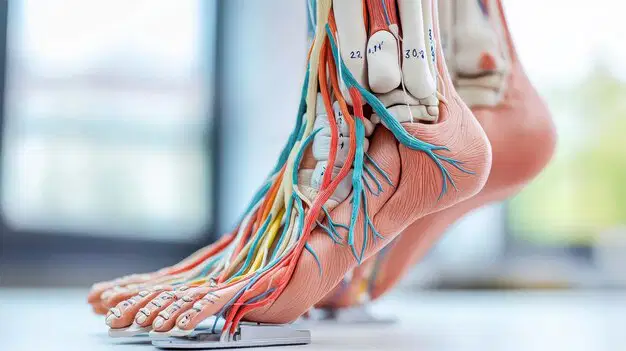
Where in the foot and ankle is pain most commonly experienced in the presence of Plantarfasciopathy.
Immediately inferior to the lateral malleolus
Slightly anterior to the inferior surface calcaneus
Plantar surface of the foot around the MCP joints
Dorsal surface of the foot at the midtarsal joints
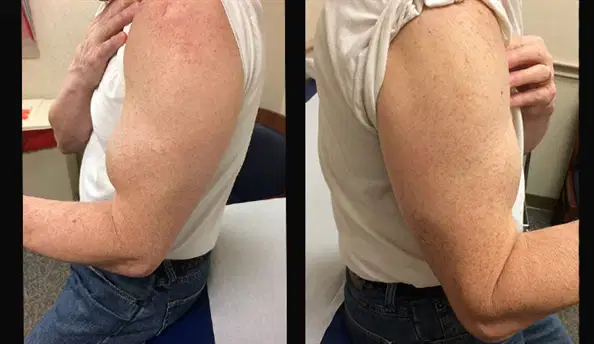
What is like to be the injury shown in the left arm based on these visual signs
Proximal bicep tendon rupture
Distal bicep tendon rupture
Proximal tricep tendon rupture
Biceps Brachii Bursitis
Mid humeral shaft fracture
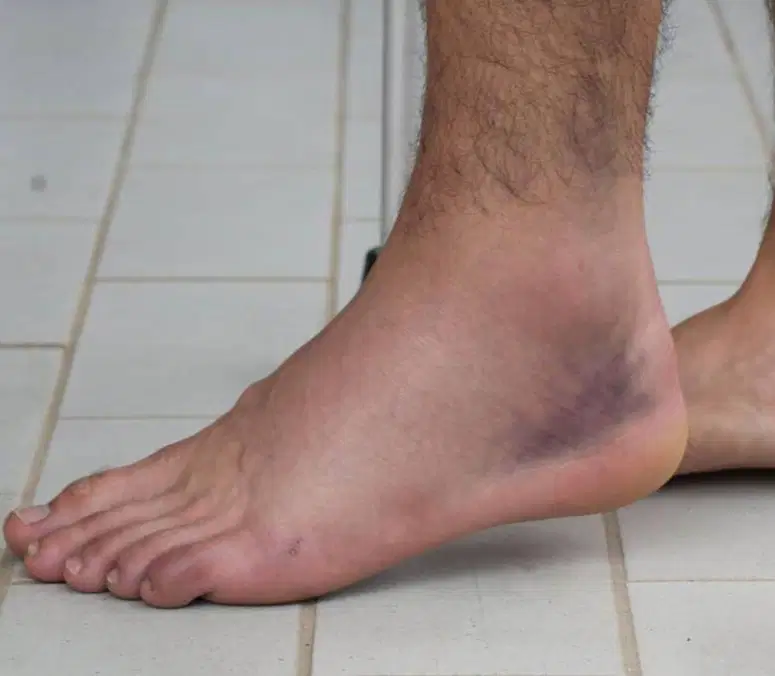
Based on the bruising pattern in the image what structures could also have been damaged as ligament
Tibialis Posterior
Achilles Tendon
Peroneal muscles
Flexor Hallucis Longus
Which description best describes a Maisonneuve fracture
A rare fracture where the fibula is entrapped behind the posterior tibia, causing an irreducible ankle dislocation.
A fracture of the distal tibia, often due to high-energy axial loading
Is a fracture of the distal fibula and sometimes tibia associated with a LAS
Stiff in the morning, easing when warm and then soreness later in the day is a typical pain pattern of which structure
Bone
Ligament
Capsule
Tendon
Muscle Belly

