
 Worksheets
4/3/25 STAAR Review
Total questions: 97
Worksheet time: 24hrs 15mins
Label parts of a plant cell.
Label: life cycle of a star
Label:
Label: Northern Hemisphere
Label: Southern Hemisphere

subscript in reactants
2
coefficient in reactants
3
compound
2NH3
products
2NH3
yield
arrow

This is a (a)
Physical Change or Chemical Change
Where is the groundwater being polluted?
More than one answer.
If you have a block that is 50g and has a density of 10 g/ml. The volume is 5 ml.
Label the parts of primary succession.

Skeletal System

Muscular System

Respiratory System

Ciruclatory System
The model shows Earth in four different positions in its orbit around the Sun. Which statement correctly explains which position of Earth represents summer in the United States?

The Earth rotates on its axis every (a) . This causes the Earth's (b) .
Match the correct example with the law it matches with
When an object is at rest it will stay at rest until a force acts upon it.
Newton's 1st law
A crate getting pushed.
Newton's 2nd law
Every action has an equal and opposite reaction.
Newton's 3rd law

Which of the following identifies the energy transformation represented by the car?
(a) ---> (b) ---> (c)
At which point on the roller coaster does the car have the most kinetic energy? (6.8A)
Label the correct movement of the object
When a part of Earth (a) the sun it is day time.
When a part of Earth (b) the sun it is nighttime.
When a part Earth (c) the sun it is summer.
When a part of Earth (d) the sun it is winter.
Match the following
Convergent Plate Boundaries
Plates push together & create mountains
Divergent Plate Boundaries
Plates pull apart & create new crust
Plates slide past each other & cause earthquakes
Transform Plate Boundaries
Oceanic & Continental crust collide and one is pulled under the other
Subduction

According to the Chemical Compounds table, how many total elements are in Ethanol?
How many atoms are in one molecule of baking soda, NaHCO3?

Match the following definitions with the right Newton's Law of Motion
Newton's 1st Law
An object at rest will stay in its current motion unless an outside force acts upon it.
Newton's 2nd Law
Force = (mass)x(acceleration)
Newton's 3rd Law
For every action, there is an equal and opposite reaction.

Match the following front symbol to its name.

Stationary Front

Cold Front

Occluded Front

Warm Front
Reorder the following starting with the phase where you see none of the moon.
new moon
waxing crescent
first quarter
waxing gibbous
full moon

Winter
C
Summer
A
Fall
B
Spring
D

Reorder the following to form the hierarchy of the universe from biggest to smallest.
universe
galaxy
solar system
planet

A steel ball is at one end of the box that is moving forward as shown. The box suddenly stops. According to (a) , the steel ball keeps rolling AFTER the box stops because of inertia. The ball continues rolling forward at the SAME speed.
Match the following Law of motion with the correct example
Newton's 1st law of motion
Roll a ball across smooth/rough surfaces. The ball rolls faster on smooth because less fiction
Newton's 2nd law of motion
Hit a ball with 2 different forces, the ball will have greater acceleration due to larger force
Newton's 3rd of motion
Bouncing the ball on the court is the action, the floor pushing the ball back up is the reaction
According to the Law of Conservation of Mass (Matter), Matter cannot be (a) or (b) , it can only be (c) . This means however many atoms of an element we have before a reaction must be (d) to the number after a reaction.
Match for Na(HCl3)4
1
Number of Sodium
4
Number of Hydrogen
12
Number of Chlorine
3
Number of Elements
Pete is driving down 7th street. He drives 150 meters in 18 seconds. Assuming he does not speed up or slow down, what is his speed in meters per second?
Motion Graphs show how displacement of an object over time. The type of graph you are reading depends on what is on the (a) The x-axis will always have the data for (b) . In science we learn to use (c) , (d) , and (e) graphs.
Label the different types of Distance/Time Graphs
Deceleration
Constant Speed Forward
Constant Speed Backwards
No Motion
Acceleration
POTENTIAL AND KINETIC ENERGY: (a) is the ability to do work. We cannot see it or touch it but every time something (b) , energy is used. (c) energy is the total energy an object needs to move. This includes (d) energy which is energy that is stored and (e) energy which is energy in motion.
Label the percentage of potential and kinetic energies on this roller coaster
100% Potential, 0% Kinetic
0% Potential, 100% Kinetic
50% Potential, 50% Kinetic
ENERGY TRANSFORMATIONS: Energy is broken down into different types. The types of (a) energies are gravitational, elastic, chemical, and nuclear. The types of (b) energies are thermal, electrical, sound, and radiant. Energy can change form it is never (c) , it can only be (d) from one type to another. This is called (e) .
Match the following
Flashlight
Chemical to radiant and thermal
Photosynthesis
Radiant to chemical
Solar Panel
Radiant to electrical
Force is known as a push or a pull.
When the forces acting on an object are equal, the forces are considered (a) . This means the object has (b) and the object has (c) or constant motion.
When the forces acting on an object are not equal, the forces are considered to be (d) . This means the object (e) in a specific direction with a specific amount of net force.
Identify whether the object’s forces are balanced or unbalanced. Drag them to the correct category.


Newton’s Second Law states, “ The (a) of an object is equal to the net (b) on an object divided by the (c) of an object.”
F=ma
A 956 kg car comes uniformity to a stop. If the vehicle begins to accelerate at 1.5 m/s2 , how many newtons of force would be acting on the vehicle?
Newton’s Third Law states, “For every (a) , there is an (b) and (c) (d) .”
Law of Inertia
Law of Force and Acceleration
Law of Action and Reaction


An object at rest stays at rest.
Bigger and heavier things don’t move as fast or as far as smaller, lighter things.
Forces act in pairs.
The “LAZY” Law
Organize the physical properties into the correct category.
Shiny luster
Ductile
Conductive
Solid at room temperature
Dull luster
Not conductive
Brittle as a solid
Label the parts of the chemical equations
Products
Reactants
Balance the chemical equation by adding the correct coefficients.
2
3
4

Select ALL the correct information. Choose Three
Is this Balanced or Unbalanced? What is the Net Force? What is the Direction of the Force?
left
right
250N
1250N
unbalanced

Select ALL the correct information. Choose Three
Is this Balanced or Unbalanced? What is the Net Force? What is the Direction of the Force?
no direction
left
balanced
unbalanced
0N
Galaxies are classified based on their --(8.8A)
size
color
shape
smell
The chemical formula represents the substance glucose.
2C6H12O6
How many molecules of glucose are represented?
2
6
12
24
A hurricane will weaken when it...
remains over warm waters
moves over colder waters
remains in tropical regions
hits land
moves towards the poles

If a 40 kg student is pushed in a rolling chair with a force of 30 N, what is the student's acceleration?
(a)

Nearest what city is the warm front located?

Newton’s First Law states that, “an object in motion will stay in motion and an object rest will remain at rest UNLESS a net force acts on the object. “
This law is also referred as the Law of
(a)

Take a look at the clip. How do The Hulk and Thor demonstrate Newton’s 1st Law of Motion?

Take a look at the clip. What is the action, what is the reaction force?

Is this chemical equation balanced?
Yes
No
Identify the trachea on the diagram.
Match the following organs to its function
Mouth
Allows chewing and mix food with saliva
Stomach
Churns and digests food
Small intestine
Digestion and absorption of nutrients
Liver
Filters blood and produces bile
Large intestine
Absorbs water from undigested food
Where does digestion of fat and protein occur?
Identify the types of joints in A, B and D.

Based on the food chain,
The grass is the (a) .
The deer is the (b) .
The tiger is the (c) .

The diagram shows a pond (a) .
The (b) of the ladybug is in the leaves and shrubs.
Label parts 1 until 5.

Match each diagram to the correct type of boundary.
A
Divergent boundary
B
Convergent boundary
C
Transform boundary

Diaphragm
The tubes that connect to the air sacs are called
bronchus
bronchioles
Air enters the body through the
nose
nasal passage
trachea
cilia
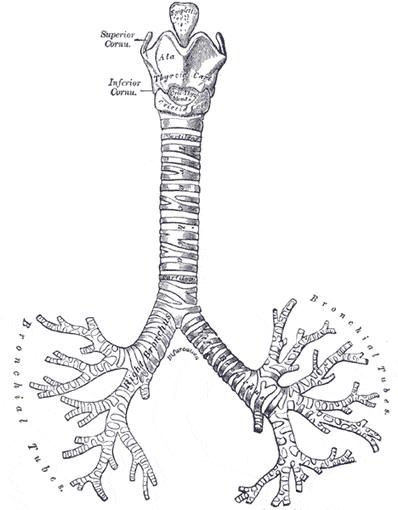

In the diagram, oxygen diffuses from the air sac into the capillaries.
true
false

Muscle beneath the lungs that contacts and relaxes to move gases in and out of the body
_____________ occurs when the diaphragm relaxes and moves up, reducing the space around the lungs and ______________ occurs when your diaphragm contracts and moves downward, enlarging the space around the lungs.
exhalation, inhalation
inhalation, exhalation

Gas exchange is ...
taking in oxygen and removing carbon dioxide.
taking in carbon dioxide and removing oxygen.
taking in oxygen and carbon dioxide.
removing oxygen and carbon dioxide.

Salivary glands are important because saliva produced
Contains enzymes such as amylase to digest carbohydrates
Helps dissolve food
Protects against gum disease, tooth decay, and oral infections
Contains bile to digest fat
Builds new tissues
Is not an essential nutrient
Fat helps our body to keep warm.
True
False

Which organ absorbs water and salts from undigested food?
Liver
Small intestine
Pancreas
Large intestine

produces bile to break up fat particles
pancreas
large intestine
liver

Digestive organ where most chemical digestion and absorption of food takes place
pancreas
small intestine
liver

Your bones are join together at your _________?
Skeleton
Muscles
Tendons
Joints
Muscles ... (Tick all that applies)
move blood by pumping the heart
create movement with bones, ligaments, tendons
move food through digestive system
protects internal organs

When our arms extend, the triceps ___ and the biceps ___.
contract; relax
relax; contract
contract; contract
relax; relax
What is an invasive species?
A native (naturally found) species which are added to an area
An organism that is new to an environment and has a negative effect on that environment.
A keystone species in an environment
None of the above
Why do the populations of invasive species grow so quickly?
Invasive species are native to an area
Invasive species are prey to many animals
Invasive species have no predators
Invasive species keep the ecosystem in equilibrium
Which of the following best describes global warming?
The current temperatures on Earth
The weather during the summer
The increase in the average temperatures on Earth
All of the above

What is true of tectonics plates?
They are constantly moving
Earthquakes cause them to move
They don't move for centuries at a time
There are fewer & fewer of them

What is the underlying force that drives plate tectonics?
Ocean tides
Volcanic eruptions
The rock cycle
Convection currents
The vast majority of earthquakes occur at the _____ of tectonic plates
boundaries
center
entirety
(a) is a sudden and violent shaking of the ground, sometimes causing great destruction, as a result of movements within the earth's crust or volcanic action.
Fold mountains are created by ____________ boundaries.
Convergent
Divergent
Transform
None of them
Calculate the speed of sound if a sound wave travels 1020 m in 3 seconds.
Speed = distance/time
3060
365 m/s
340 m/s
250 m/s

