
 Worksheets
Chapter 6 & 7 Study Guide
Total questions: 30
Worksheet time: 21mins
Match the following terms with their correct definitions: ___ore ___extinction ___natural resources ___conservation ___fossil fuels ___pioneer species ___renewable resources ___nonrenewable resources ___Minerals ___Ecosystem services
Having enough of a mineral to mine for profit.
ore
The disappearance of all members of a speices from Earth.
extinction
Anything naturally occurring in the environment that humans use.
natural resources
The practice of using less of a resource so that it can last longer.
conservation
Energy-rich substances formed from the remains of organisms
fossil fuels
What are the three types of symbiosis?
Mutualism, Commensalism, Parasitism
Mutualism, Parasitism, Predation
Commensalism, Parasitism, Competition
Mutualism, Competition, Predation
25. Why do many organisms have adaptations?
To survive in their environment by reducing competition
To look more attractive
To become extinct
To reduce their lifespan
How are parasitism and predation similar?
Both involve one organism benefiting at the expense of another.
Both involve mutual benefit between organisms.
Both involve organisms competing for resources.
Both involve organisms living in harmony.
When resources become limited, competition:
increases
decreases
remains the same
disappears
Which of the following human activities negatively affect biodiversity? Choose all that apply.
Introducing invasive species
Growing trees in deforested regions
Enacting captive breeding programs
Removing natural resources
30. What determines if an ecosystem is healthy?
Biodiversity levels
Amount of sunlight
Number of predators
Presence of water bodies
Which of the following are natural resources? Choose all that apply.
Trees
Coal
Sunlight
Wind
Concrete
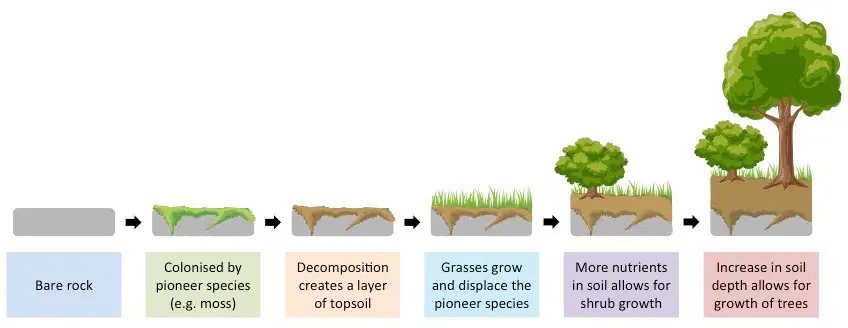
32. What does the picture below show?
A landscape
Secondary Succession
Teriary Succession
Primary Succession
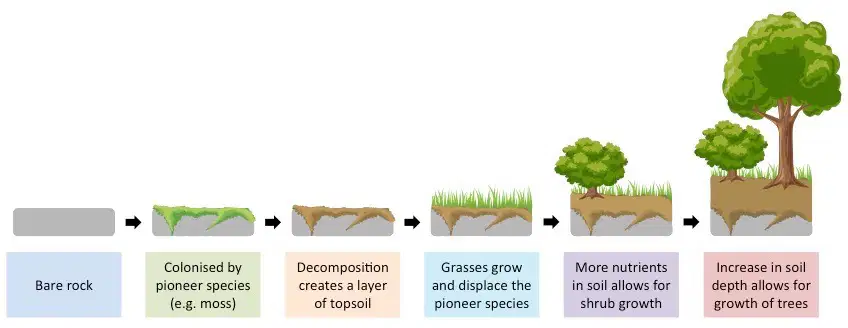
What organisms in the ecological succession above are pioneer species?
Lichens and moss
mature trees
Shrubs and bushes
Grasses and herbs
What type of organisms are found in a climax community?
Pioneer species
Intermediate species
Climax species
Invasive species
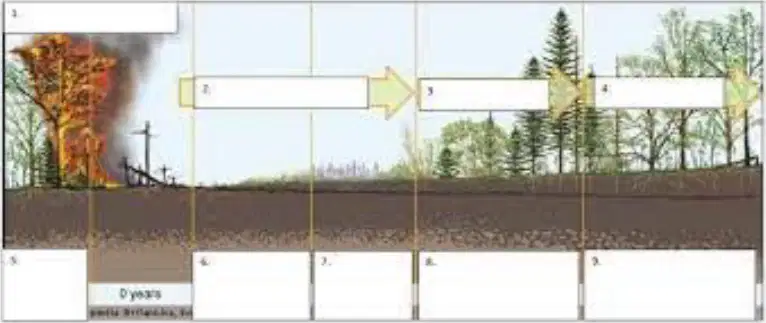
What type of succession does the picture below show?
Primary Succession
Secondary Succession
Tertiary Succession
Climax Succession
A resource that is either always available or is naturally rplaced in a short time
biogenetic resource
nonrenewable resource
renewable resource
final resource
What is a naturally occuring solid that has a crystaline structure and definite chemical composition?
crystal
mineral
natural resource
ore
What is a service where humans recieve benefits from an ecosystem?
Ecosystem Culture
Ecosystem Services
Ecosystem Community
Ecosystem Sustainability
(a) is a common type of symbiosis because all the species involved benefit. For example, a hummingbird drinks (b) from a flower, gaining food. The flower is (c) by the bird. Both species help each other.
Match the following types of symbiosis:
When two species are both benifiting from the relationship
+/+
Mutualism
When one species benefits and the other is unaffected
+ / 0
Commensalism
When one species benefits at the expense of the other
+ / -
Parasitism
Match the symbols with the the correct type of symbiosis
+, +
Mutualism
+, -
Parasitism
+, neutral
Commensalism
How do invasive species usually affect the availability of natural resources in an ecosystem?
Invasive species reduce the availability of natural resources for native species by outcompeting the native species for those resources.
Invasive species reduce the availability of natural resources for native species by interbreeding with the native species of that region.
Invasive species increase the availability of natural resources for native species by creating more material for decomposers.
Invasive species increase the availability of natural resources for native species by balancing the food web of the ecosystem.
What is a keystone species?
A species that is most abundant in an ecosystem.
A species that plays a critical role in maintaining the structure of an ecological community.
A species that has no predators in its ecosystem.
A species that can live in a variety of ecosystems.
_______ occurs when two organisms are trying to acquire or get the same resources.
Symbiosis
Competition
Predation
Collaboration
This type of interaction occurs when 2 organisms live closely together for survival.
Symbiosis
Competition
Predation
Cymbalosis
_______ occurs when 1 organisms kills and eats another for food.
Symbiosis
Competition
Predation
Collaboration
What is a stable ecological community that has reached equilibrium called? This ecosystem will have a high amount of biodiversity.
ecological succession
climax community
secondary succession
pioneer species
What type of succession occurs after an event like a forest fire?
primary succession
secondary succession
both
What is the ability of an ecosystem to maintain biodiversity and production called?
Nich Diversity
Economic Value
Sustainability
Cultural Service
According to most scientists, what is the ultimate cause of most mass extinctions?
overhunting
evolution of new species to replace old ones
major change in environment due to extreme natural events
asteroid impact
Species that are in danger of becoming extinct are called __________.
endangered
not lucky
extinct
in a jam

