
 Worksheets
Dependence on and Competition for Resources
Total questions: 20
Worksheet time: 18mins
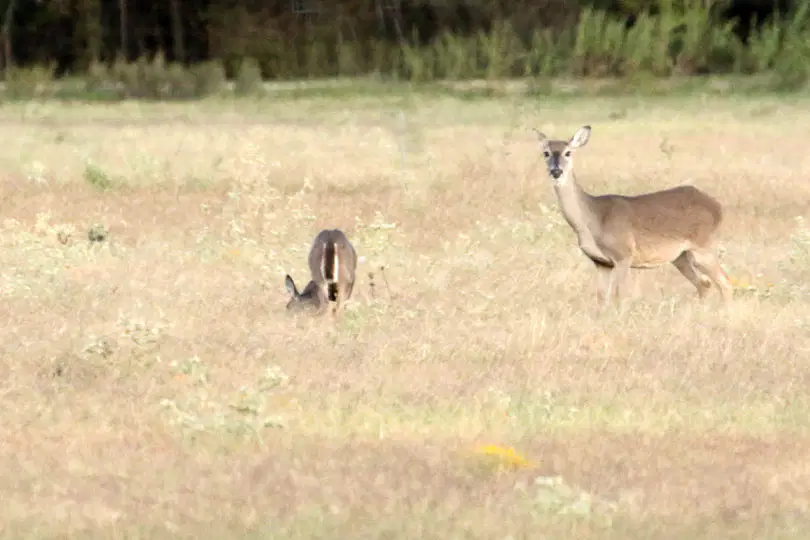
Predict: During an investigation of an ecosystem during a drought, you observe that the decrease in water has negatively affected the growth of prairie grass. What do you predict will happen to the deer population that feed on the grass?
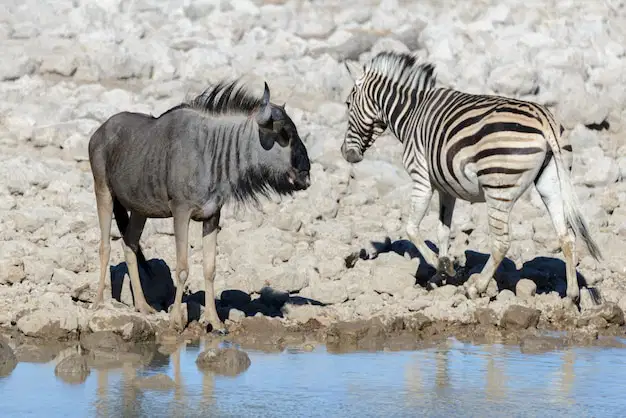
How does competition for biotic and abiotic factors affect the size of populations?

Jenn and Murphy are studying data from a small forest ecosystem in a city park. The data indicates that the deer population in the forest has grown significantly over the last several years. Why will the size of the deer population most likely decrease in the next few years?
The deer are competing for oxygen.
The deer are competing for soil.
The deer are competing for space.
The deer are competing for sunlight.
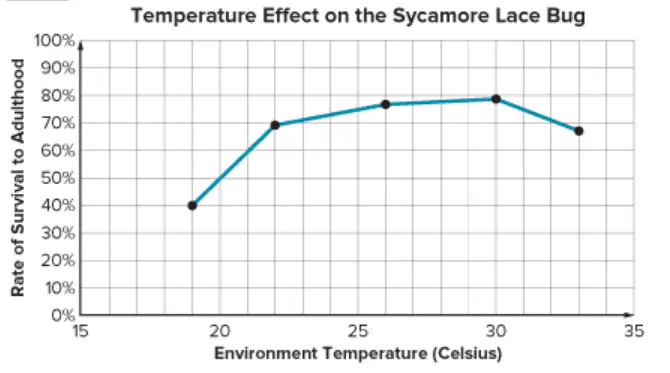
Environmental factors, such as temperature, can significantly affect the populations in an ecosystem. A group of scientists studied the sycamore lace bug (Corythucha ciliata) to determine how it is affected by the temperature of its environment. The scientists allowed batches of eggs to hatch and the larvae to grow to adulthood at five different temperatures. The survival rates of the lace bug at each temperature are on the graph.
19–22°C
22–26°C
26–30°C
30–33°C
Which is an example of an effect an abiotic factor could have on a population in an ecosystem?
An insect invasion kills a population of trees.
An increase in rainfall causes an increase in the population of many plants.
A fungus infects a population of bats, and many of the bats die.
An increase in fruit flies leads to an increase in a population of spiders.

Nutria are large semiaquatic rodents that were imported from South America to the United States by fur traders. In the late 1940s, a hurricane dispersed nutria throughout southeast Texas. They feed on native seedlings and saplings—native organisms that are naturally found in the ecosystem—and have cleared wide areas of floodplains and marshland along the Gulf Coast.
Which is most likely the effect of the introduction of nutria into southeast Texas ecosystems?
The nutria depend on native herbivores for food.
The nutria compete with native organisms for abiotic factors.
The nutria compete with native herbivores for food.
The nutria compete with native carnivores for food.
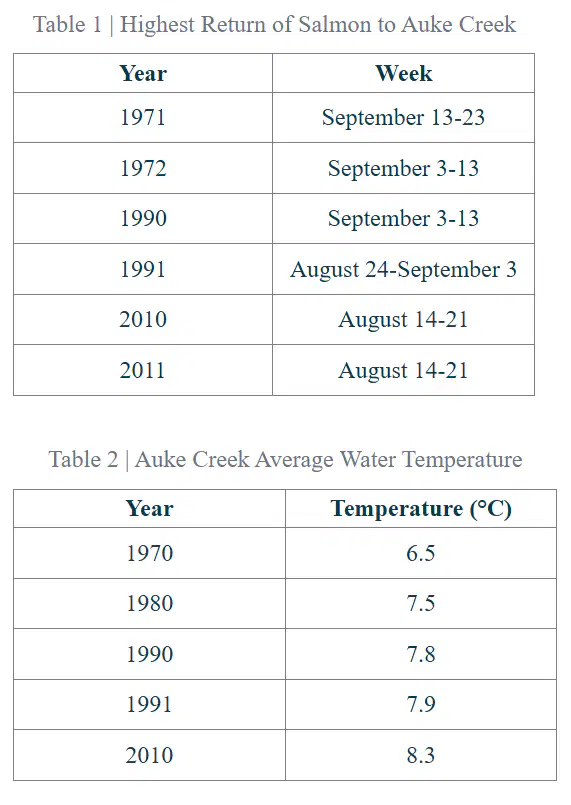
Pink salmon return to the same waters in which they were born to mate. Researchers collected data on the pink salmon returning to Auke Creek and the average water temperature. Table 1 shows the calendar dates of the highest percentage of pink salmon returning to Auke Creek in Juneau, Alaska, to mate in six years spanning from 1971–2010. Table 2 shows changes in the creek during the same time period.
The data in Table 1 and Table 2 show the relationship between salmon and which abiotic factor?
water availability
atmosphere
temperature range
light availability

Observe the food web below. Which populations directly compete with owls for food?
Snake, Hawks, and Fox
Rabbit, Frog, and Mouse
Bird, Snake, and Hawk
Rabbit, Fox, and Hawk
Grasses, Grasshopper, and Frog

Eutrophication occurs when algae grow rapidly and then die and decompose. The process of decomposing uses lots of oxygen. Fish in the water depend on oxygen to survive. What is the most likely effect of eutrophication on fish?
Competition for oxygen will increase, and fish population sizes will decrease.
Competition for oxygen will decrease, and fish population sizes will decrease.
Competition for oxygen will increase, and fish population sizes will remain the same.
Competition for oxygen will decrease, and fish population sizes will remain the same.
A scientist observes the plants in a forest ecosystem. In the spring, she notices that the wildflowers on the forest floor sprout and grow leaves before leaves grow on the trees. What is the best explanation for this observation?
The soil is better-suited to the needs of the wildflowers than the trees.
Wildflowers require warmer temperatures than trees for optimal growth.
Wildflowers compete more effectively for water than trees, so they can grow leaves sooner.
Growing leaves before the trees helps wildflowers compete with the taller trees for light.
Which of the following are examples of competition?
Select the 2 correct answers.
Two blackbirds fight over seeds on a birdfeeder.
A cheetah kills and eats an antelope.
A frog catches and eats a grasshopper.
One tree grows faster than another, blocking the light reaching the second tree.
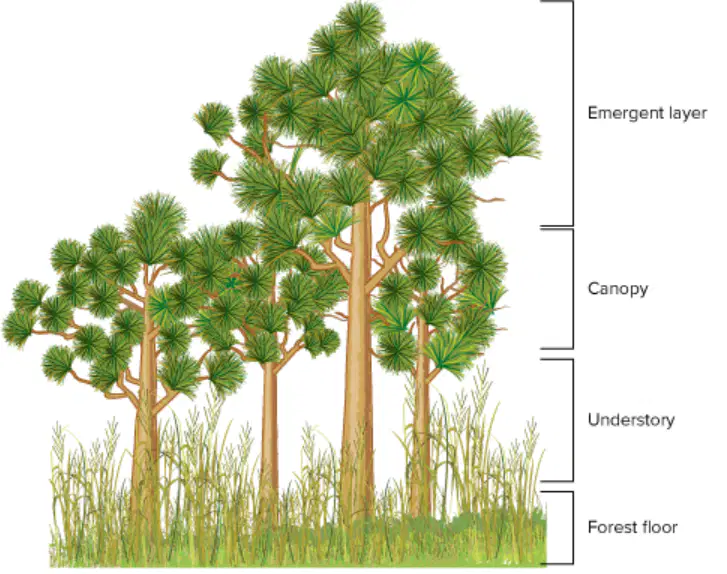
Rainforests can be described as having different layers as shown in the diagram below.
Plants in which layer face the greatest amount of competition for light? Explain your reasoning.
Enter your answer in the space.
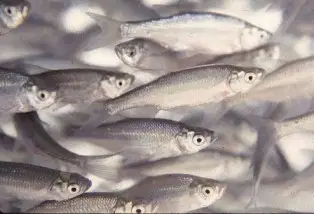
The Texas shiner is a type of fish found in the Edwards Plateau region of Texas. It is a predator. It typically lives in groups called schools.
Which best explains how the size of the school affects competition for resources?
Competition stays unchanged as school size changes, because the food supply adjusts.
The larger the school of Texas shiner, the more different types of food they compete for.
As a school of Texas shiner gets larger, there is more competition between individuals for food.
The smaller a school of Texas shiner, the greater the competition with other predators that use the same food supply.
the demand for resources, such as food, water, and shelter, in short supply in an ecosystem
limiting factor
abiotic factor
biotic factor
competition
a factor that can limit the growth of a population.
limiting factor
competition
abiotic factor
biotic factor
any nonliving factor in an organism’s environment, such as soil, water, temperature, and light availability.
abiotic factor
limiting factor
biotic factor
competition
any living factor in an organism’s environment.
biotic factor
abiotic factor
competition
limiting factor

Organisms depend on and compete for biotic and abiotic factors within their ecosystems for survival. Imagine a pond ecosystem that has tall trees, clear pond water, bright sunlight, thick soil, colorful flowers, and tall grass.
Which statement BEST explains how the population of grass depends on an abiotic factor present in the ecosystem?
The grass depends on the trees as shelter from the harsh weather.
The grass depends on the soil composition for growth and minerals.
The grass depends on predators that use them for food.
The grass depends on the flowers for pollination.

A population of lizards in a desert ecosystem depends on biotic and abiotic factors in order to survive.
Which statement correctly lists a biotic factor AND how the lizard population depends on it to survive?
The amount of sunlight each day affects the lizard's ability to find food.
The range of temperatures affects the lizards' ability to maintain homeostasis (balance inside it's body).
The food available affects the lizards' ability to meet their energy needs.
The soil composition affects the lizards' ability to burrow for shelter.
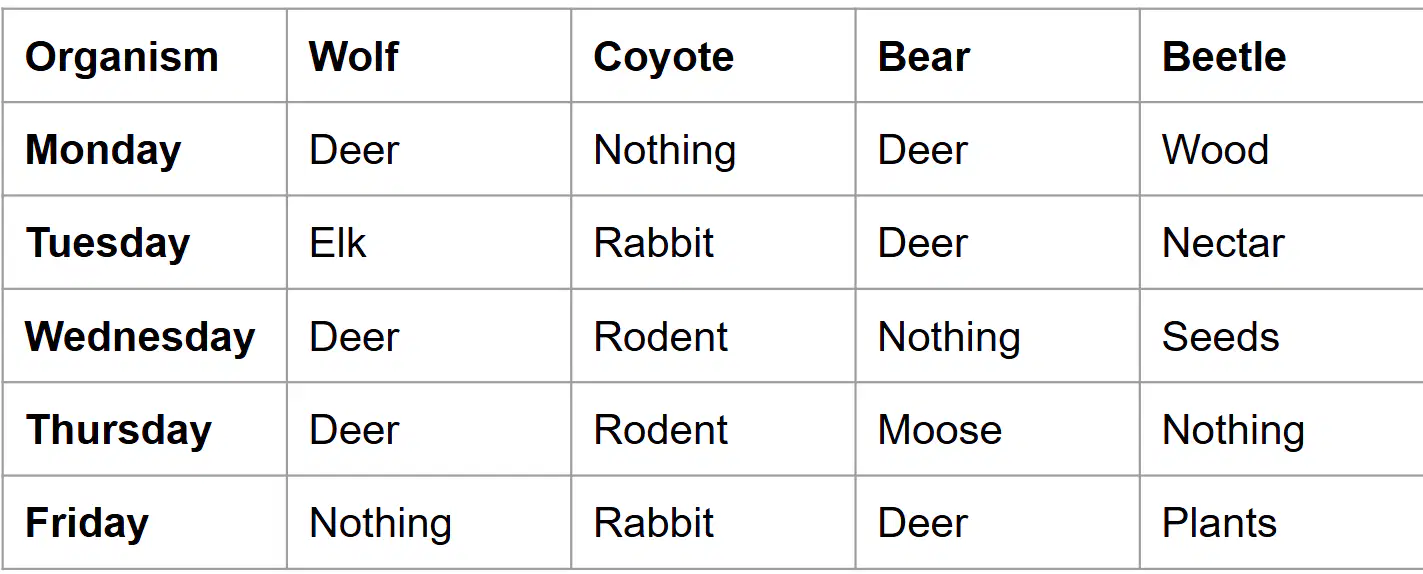
A scientist investigates the type of food that different populations in the same ecosystem depend on during a typical week. The observations are recorded in this table.
Based on the data, which statement BEST describes organisms that are competing for food resources?
The wolf and bear compete for food because they both prey on deer.
The beetle and the bear compete for food because the both eat on Monday.
The coyote and the bear compete for food because they are both carnivores.
The wolf, coyote, bear, and beetle all compete for food because they live in the same ecosystem.

