
Font size
 Worksheets
Comparing Organisms
Total questions: 18
Worksheet time: 14mins
Which of the following correctly describes a eukaryotic cell?
A. It lacks a nucleus and membrane-bound organelles.
B. It contains a nucleus and membrane-bound organelles.
C. It’s always unicellular.
D. It always undergoes photosynthesis.
Which characteristic is shared by both prokaryotic and eukaryotic cells?
The presence of a nucleus.
The presence of a cell membrane.
The presence of chloroplast.
The ability to reproduce sexually.
Which is the best evidence to support that broccoli is autotrophic?
A. It’s a eukaryote.
B. It’s multicellular.
C. It makes its own food through photosynthesis.
D. It gets its energy by consuming other organisms.
Which of the following best describes a multicellular organism?
A. They’re composed of a single cell that performs all life functions.
B. They can only be seen under a microscope.
C. They’re composed of cells without membrane-bound organelles.
D. They’re composed of multiple cells, with various specialized cells to perform specific functions.
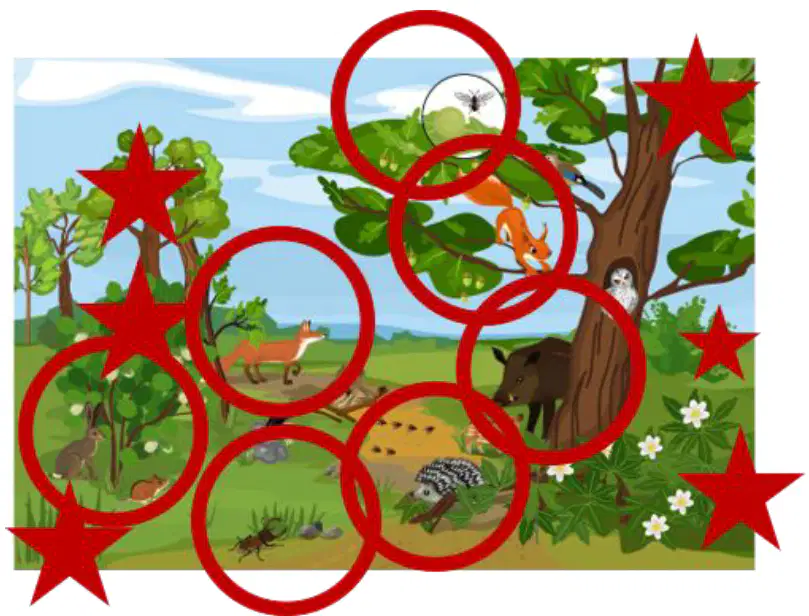
Hotspot: Follow the directions below to answer the question fully. Carefully observe the diagram below and identify how the autotrophs and heterotrophs are identified.
Autotrophs are marked with a star, and heterotrophs with a circle.
Autotrophs are marked with a circle, and heterotrophs with a star.
Both autotrophs and heterotrophs are marked with a circle.
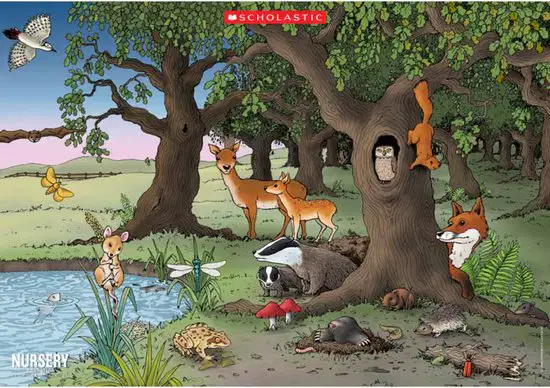
Choose the best explanation how the autotrophic and heterotrophic classifications of organisms in this woodland scene contribute to the flow of energy within this ecosystem.
Autotrophs produce energy through photosynthesis, while heterotrophs consume other organisms for energy, both contributing to the energy flow in the ecosystem.
Autotrophs consume other organisms for energy, while heterotrophs produce energy through photosynthesis, both contributing to the energy flow in the ecosystem.
Both autotrophs and heterotrophs produce energy through photosynthesis, contributing to the energy flow in the ecosystem.
Neither autotrophs nor heterotrophs contribute to the energy flow in the ecosystem.
Which of the following are characteristics that identify prokaryotic cells? Select ALL that apply.
lack of nucleus
presence of ribosomes
DNA located in a nucleoid region
presence of mitochondria
Which organism(s) can be classified as eukaryotes? Select ALL that apply.
plants
bacteria
animals
fungi
Which of the following are characteristics of autotrophic organisms? Select ALL that apply.
They’re always multicellular.
They rely on other organisms for food.
They can be either prokaryotes or eukaryotes.
They can make their own food using sunlight.
Which of the following is an example of a prokaryotic organism and a eukaryotic organism, and what is the primary difference between their cells?
Bacteria and Amoeba; Prokaryotic cells lack a nucleus, while eukaryotic cells have a nucleus.
Yeast and Virus; Prokaryotic cells have a nucleus, while eukaryotic cells lack a nucleus.
Fungi and Algae; Prokaryotic cells have membrane-bound organelles, while eukaryotic cells do not.
Protozoa and Archaea; Prokaryotic cells are larger than eukaryotic cells.
What would happen if there were no autotrophs?
The ecosystem would collapse due to lack of primary producers.
There would be an increase in biodiversity.
The oxygen levels in the atmosphere would increase.
Herbivores would thrive without competition.
Multicellular organisms ensure efficient functioning of their body systems by:
having specialized cells and tissues
relying on a single type of cell
functioning without any coordination
using only external factors


Euglena are unicellular organisms that live in pond water. They move around using a flagella (tail) and can perform photosynthesis when needed. They contain many organelles. What type of cells are they?
Animal Cell
Prokaryotic Cell
Eukaryotic Cell
Plant Cell
Sort the following statements based on if the statement is talking about prokaryotes or eukaryotes

Bacteria is what kind of cell?
Eukaryotic
Prokaryotic
Apple tree


