wayground logo

Free Printable Worksheets

Font size

S
M
L
XL
Worksheets

Embryology and Natural Selection

Total questions: 30

Worksheet time: 22mins

Name
Class
Date
1.
A change in the inherited characteristics of an organism over time is ________
a)
evolution.
b)
development.
c)
growth.
d)
ancestry.
2.

Another word for specific parts that form an organ, system, or living thing is __________.

a)

structure

b)

vertebrae

c)

function

d)

organism

3.
_____________  is the study of embryos to see how their similarities and differences indicate an evolutionary relationship.
a)
Paleontology
b)
Common ancestry
c)
Homologous structure
d)
Embryology
4.

The most recent ancestral species from which two different species evolved is known as ________________________.

a)

a common ancestor

b)

an embryonic stage

c)

development

d)

evolution

5.
Common ancestry relates to evolution because
a)
evolution only happens when there are common ancestors.
b)
Common ancestors make evolution happen more quickly.
c)
evolution can never take place with common ancestors.
d)
the more two organisms have in common, the more recent is their common ancestor during their evolution.
6.
In stage one (top row) of these embryos, most of the embryos________
a)
look very similar.
b)
have very different features.
c)
show different stages of development.
d)
have only a tail if they are non-human.
7.
In stage 2 (middle row) fish embryos _________
a)
are very different bird and mammal embryos.
b)
are still very similar to bird and mammal embryos.
c)
show arm and leg buds.
d)
are the only embryos with tails.
8.
In the the third embryonic stage (bottom row), mammal embryos _____
a)
have more characteristics in common with each other than with reptiles or birds.
b)
are still hard to tell from reptiles and birds.
c)
have the same features as fish, reptiles, and birds.
d)
do not have tails.
9.
The more similar the stages of embryonic development, the more likely that organisms share ____________
a)
a common ancestor.
b)
embryos.
c)
eggs.
d)
embryology.
10.
Which is not evidence for evolution?
a)
many animals have homologous structures due to common ancestry
b)
Many animals have vestigial structures from an ancestor
c)
We can observe changes in life forms by observing the fossil record
d)
All of these are evidence for evolution
11.
Embryos of chickens, fish and humans look very similar. They all have folds known as gill pouches in the neck region. What may this suggest?
a)
they all formed in the ocean 
b)
they all evolved from a common ancestor
c)
they are all going extinct
12.
Embryos look the most similar across different species during the early stages of developement.
a)
True
b)
False
13.

At what stage of development do vertebrates embryos look very similar to each other?

a)

Earliest stages of growth

b)

Middle stages of growth

c)

Late stages of growth

d)

Vertebrate embryos don't look very similar

14.
Which organism is most like the tortose?
a)
Fish
b)
Chick
c)
Salamander
d)
Human
15.

How do you "win" at natural selection?

a)

survive

b)

go extinct

c)

survive & reproduce

16.

What word describes a trait that helps an organism survive in its environment?

a)

natural selection

b)

mutation

c)

camouflage

d)

adaptation

17.
Which organisms are most likely to survive?
a)
the best adapted
b)
the fastest
c)
the strongest
d)
the most domesticated (tamed)
18.
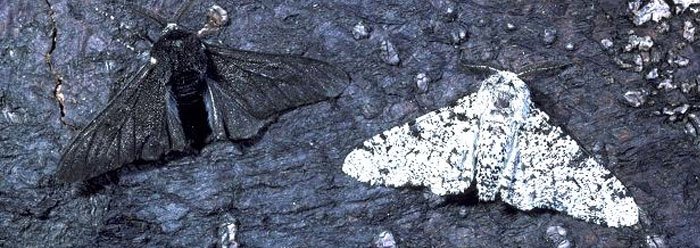
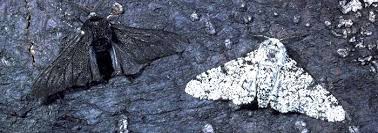
The trees these moths used to live on were white, but have been covered in soot from coal factories. Which moth will be more successful in this environment?
a)
Dark moth
b)
Light moth
c)
Both will be equally successful
d)
Neither will be successful
19.
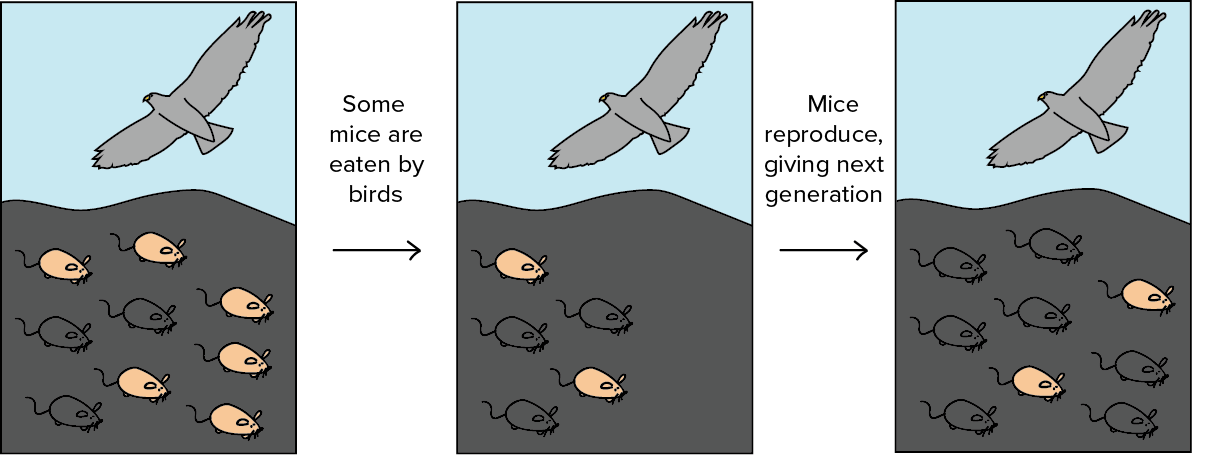
Why is the mouse population changing over time?
a)
The light mice can reproduce more successfully than the dark mice
b)
The hawks eat more dark mice than light mice because the dark mice taste better
c)
The hawks eat more light mice than dark mice because they can see the light mice more easily
d)
The hawks eat more dark mice than light mice because they can see the dark mice more easily
20.
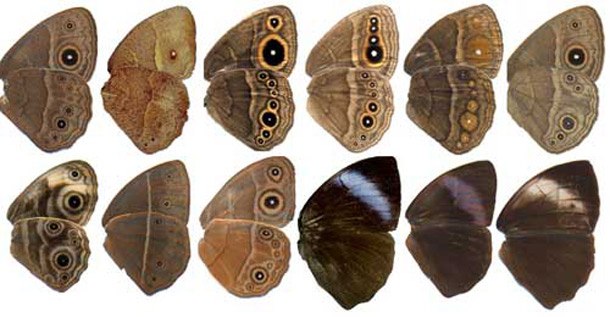
These moths are all the same species. The differences between their wings is an example of ________________
a)
Natural Selection
b)
Variation
c)
Homeostasis
d)
Extinction
21.
Process by which individuals that are better suited to their environment survive and reproduce most successfully; also called survival of the fittest.
a)
Extinction
b)
Speciation
c)
Natural Selection
d)
Artificial Selection
22.

Natural selection explains HOW organisms change over time. What is the process in which populations are changed over time?

a)

Digestion

b)

Elimination

c)

Evolution

d)

Adaptation

23.

According to natural selection, light colored tree trunks would favor ___________________________.

a)

light colored moths

b)

dark colored moths

c)

red colored moths

d)

red and light colored moths

24.

The trees these moths used to live on were white, but have been covered in soot from coal factories. Which moth will be more successful in this environment?

a)

Dark moth

b)

Light moth

c)

Both will be equally successful

d)

Neither will be successful

25.

Predict which moth would increase in population over time.

a)

light colored

b)

dark colored

26.
Over time, the climate of an island became drier, which resulted in changes to the populations of various island finch species. Finch populations with a certain beak shape thrived, while those not having that beak shape decreased. Which of the following describes a necessary condition for these changes in the finch populations to occur?
a)
fewer mutations
b)
limited food resources
c)
limited beak variations
d)
overproduction of offspring
27.
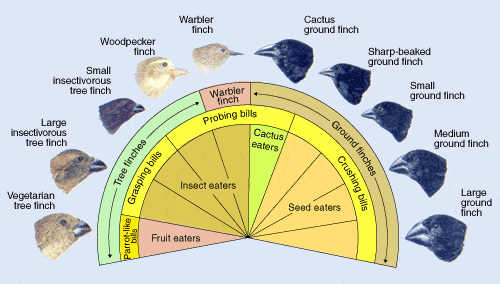
All of these finches have different shaped beaks, they are an adaptation to gain access of 
a)
Water
b)
Food
c)
Shelter
28.
What did the beak type of finches on different islands tell Darwin?
a)
Finch populations evolved over time to favor beaks based on food type
b)
Finch populations had not evolved over time
c)
The finch beaks had no relationship to the available food on the islands
d)
Humans artificially selected finches based on their desired beak type
29.

Finch species living on the Galapagos Islands exhibit a variety of beak types that favor different foods. Finches that eat seeds and plant parts have beaks of the shorter, thicker variety, while finches that eat insects and other small organisms have thin, pointed beaks. 78% of the finches on an island in the Galapagos have beaks that are identical to Finch 1. What conclusion can you reach about the availability of food for the finches on this island?

a)

Plants have died out and there are only insects for food.

b)

There is a wide variety of foods for the finches to eat.

c)

There is an abundance of seeds and nuts.

d)

There is an abundance of insects.

30.

Around 1977, there was a huge drop in finches with small beaks while there was a great increase in large-beaked birds. How can you explain this?

a)

Competition for food favored large beaks; the small beaked birds died off.

b)

Available food changed and the small beaked birds could not readily adapt.

c)

The larger beaked birds preyed on the smaller beaked birds.

d)

The small-beaked birds migrated to another location.