
 Worksheets
Properties of Parallelograms and Their Diagonals PRACTICE
Total questions: 10
Worksheet time: 10mins
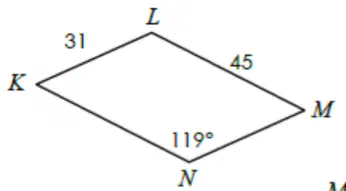
Each quadrilateral below is a parallelogram. Find the missing measures. Round to the tenths.
MN = (a)
KN = (b)
m<K = (c)
m<L = (d)
m<M = (e)
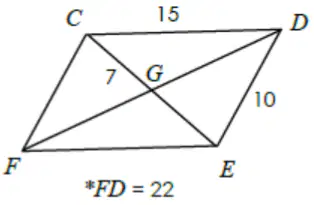
Each quadrilateral below is a parallelogram. Find the missing measures. Round to the tenths.
CF = (a)
FE = (b)
CE = (c)
GD = (d)
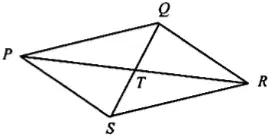
Each quadrilateral below is a parallelogram. Find the missing measures. Round to the tenths.
Given: PQ=24, PS=19, PR=42, TQ=10, m<PQR=106, m<QSR=49, m<PRS=35.
QR = (a)
SR = (b)
PT = (c)
SQ = (d)
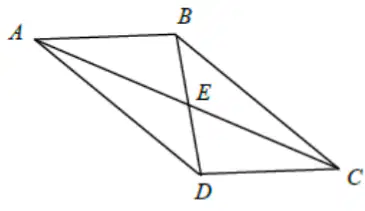
Each quadrilateral below is a parallelogram. Find the missing measures. Round to the tenths.
AC = 8x-14 and EC = 2x+11. Solve for x.
9
0
4.2
18
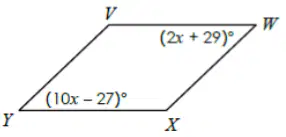
Each quadrilateral below is a parallelogram. Find the missing measures. Round to the tenths. Find m∠V.
m∠V = 137°
m∠V = 56°
m∠V = 43°
m∠V = 7°
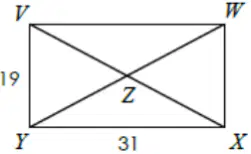
In the rectangle, find the following:
VW = (a)
WX = (b)
YW = (c)
ZX = (d)
VX = (e)
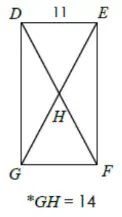
In the rectangle, find the following:
GF = (a)
GE = (b)
DF = (c)
HF = (d)
DG = (e)
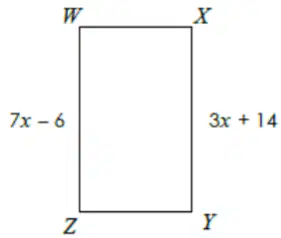
Find WZ in the rectangle.
5
29
26
20
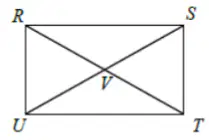
Find the missing measures. Round to the tenths. 4. If RT = 5x - 14 and US = 2x + 10, find VT.
26
13
24
8
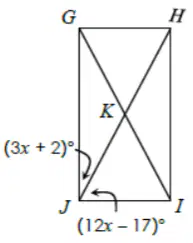
Find m∠JHI.
105°
7°
45°
23°

