Wayground logo

Free Printable Worksheets

Font size

S
M
L
XL
Worksheets

Topic 5 Enzymes

Total questions: 25

Worksheet time: 8mins

Name
Class
Date
1.

Enzymes are large proteins.

a)
b)
2.

The chemical that an enzyme works is called a substrate.
a)
b)
3.
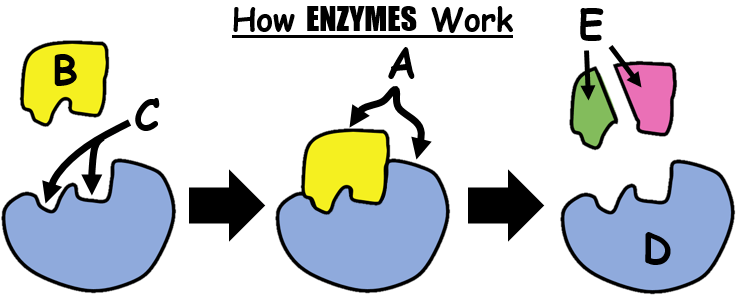
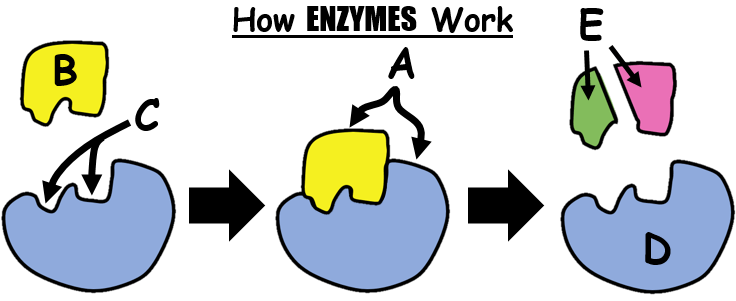
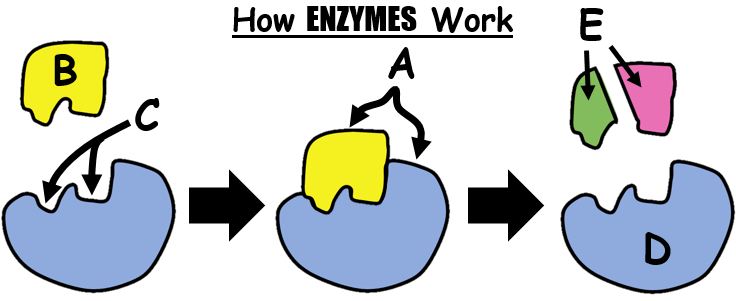
In the diagram, what is letter A? 
a)
product
b)
substrate
c)
enzyme-substrate complex
d)
active site
4.
Letter D...
a)
active site
b)
enzyme
c)
substrate
d)
products
5.
Letter B...
a)
active site
b)
enzyme
c)
substrate
d)
products
6.
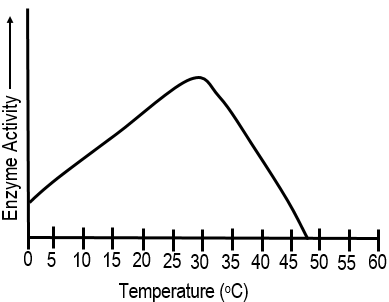
Based on the graph, what is the optimal temperature for this enzyme? 
a)
15oC
b)
40oC
c)
30oC
d)
35oC
7.

Changes in pH and temperature can ___________________ an enzyme which causes it to lose its shape and affects its function.

a)

puncture

b)

denature

c)

double

d)

delete

8.
An enzyme speeds up a chemical reaction in the cell but can only be used once.  True or False? 
a)
true
b)
false
9.

Enzymes are specific. This means that an enzyme only works with molecules that are....

a)

the right size and shape

b)

broken down already

c)

present in water

d)

too big for the body to handle

10.

What does an enzyme need in order to work properly?

a)

The right amount of oxygen & CO2

b)

The right temperature & amount of water

c)

The right temperature & pH

d)

The right temperature & pressure

11.

What do enzymes do?

a)

Build things up or break them down

b)

Help filter waste from the body

c)

Create environments where food can be eaten

d)

Add and remove water

12.
With what 3 letters do enzymes typically end?
a)
-ose
b)
-ase
c)
-ese
d)
-tic
13.
What happens when enzymes are heated to a high temperature?
a)
The enzymes die.
b)
The shapes of the enzyme are altered denature
c)
The enzymes' amino acid sequence changes.
d)
The enzymes remain the same
14.
Which of these is most likely an enzyme?  
a)
Sucrose
b)
Galactose
c)
Fructose
d)
Amylase
15.
Enzymes are composed of which of the following monomers? 
a)
amino acids
b)
carbohydrates
c)
nucleotides
d)
monosaccharides
16.
What is indicated by letter A?
a)
enzyme
b)
product
c)
substrate
d)
active site
17.
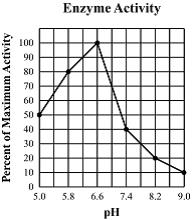
Which of the following conclusions can be drawn from this graph?
a)
The optimum pH of the enzyme is 6.6.
b)
The optimum pH of the enzyme is 5.8
c)
The enzyme’s activity increases as pH increases 5.0 to 9.0
d)
The enzyme’s activity is greater around pH of 8.0 .
18.
What is a substance called if it speeds up a chemical reaction?
a)
reusable
b)
catalyst
c)
specific
d)
fragile
19.
An enzyme speeds up a reaction by
a)
lowering the activation energy.
b)
raising the activation energy.
c)
releasing energy.
d)
absorbing energy.
20.
Enzymes will make a reaction go _______ and use ______ energy.
a)
faster, less
b)
faster, more
c)
slower, less
d)
slower, more
21.

Each enzyme only has 1 substrate that will fit its active site.  What is this called?

a)

reusable

b)

catalyst

c)

fragile

d)

specific

22.

Substances that are changed during a chemical reaction

a)

reactants

b)

products

23.
After the enzyme and substrate bind together and perform the reaction, what does the substrate become?
a)

asubstrate (s)

b)

enzyme(s)

c)

product(s)

d)

inhibitor(s)

24.

What happens when enzymes are cooled down?

a)

The enzymes die

b)
The shapes of the enzyme are altered or denatured
c)

The enzyme slows down

d)

The active site is altered

25.

Which enzyme breaks down proteins?

a)

Rennin

b)

Amylase

c)

Pepsin

d)

Lipase