
Font size
 Worksheets
Thermochemistry Test
Total questions: 12
Worksheet time: 6mins
A piece of metal is heated, and then submerged in cool water. Which statement below describes the best what happens?
The temperature of the metal will increase
The temperature of the water will increase
The temperature of the water will decrease
The temperature of the water will increase and the temperature of the metal will decrease
Calculate ΔH for the following reaction:
C2H4(g) + H2(g) → C2H6(g) ΔHC2H4(g) = 52.5 kJ/mol ΔHC2H6(g) = -84.7 kJ/mol
-32.2 kJ/mol
32.2 kJ/mol
137.2 kJ/mol
-137.2 kJ/mol
Which statement is true for the combustion of ethanol?
C2H5OH(l) + 3O2(g) → 2CO2(g) + 3H2O(l) ΔH = -1370 kJ
The potential energy of the products is less than the potential energy of the reactants.
The reaction is endothermic.
The potential energy of the products is more than the potential energy of the reactants.
None of the statements above are correct.
What is the amount of heat required to raise the temperature of 200.0 g of aluminum by 11°C? (CAl = 0.21 cal/g°C)
460 cal
460 J
462 cal
462 J
All of the following have ΔHf° = 0.0 kJ/mol EXCEPT:
O2(g)
Ca(s)
Br2(l)
Hg(l)

During interval DE, which energy change occurs for the particles in this sample?
The potential energy of the particles decreases
The potential energy of the particles increases
The average kinetic energy of the particles increases
The average kinetic energy of the particles decreases

What happens to the substance during interval BC?
IMF are decreasing and the substance is melting
IMF are decreasing and the substance is freezing
IMF are increasing and the substance is melting
IMF are increasing and the substance is freezing
Systems in nature tend to undergo changes toward
Lower enthalpy and higher entropy
Lower enthalpy and lower entropy
Higher enthalpy and higher entropy
Higher enthalpy and lower entropy
Given the following two reactions:
C(s) + O2(g) → CO2(g) ∆H = -393.5 kJ
2Fe(s) + 3/2 O2(g) → Fe2O3(s) ∆H = -824.2 kJ
Calculate the enthalpy change for:
2Fe2O3(s) + 3C(s) → 4Fe(s) + 3CO2(g)
-467.9 kJ
-430.7 kJ
467.9 kJ
430.7 kJ
Which of the following represents an increase in entropy?
freezing of water
boiling of water
crystallization of salt from a solution
2 NO(g) → N2O2(g)
For any reaction at equilibrium, which of the following is true?
ΔH < 0
ΔS = 0
ΔS < 0
ΔG = 0
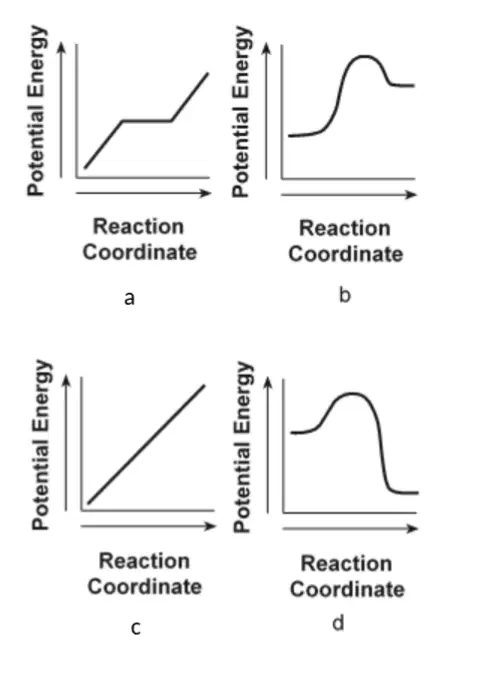
Which diagram represents the potential energy changes during an endothermic reaction?
Diagram a
Diagram b
Diagram c
Diagram d

