
 Worksheets
ACAP - Space Systems
Total questions: 30
Worksheet time: 1hrs 6mins
Which statement explains why seasons occur in the Northern and Southern Hemispheres?
Earth is closer to the Sun in the summer.
Earth is closer to the Sun in the winter.
Earth is tilted on its axis, and each hemisphere points toward the Sun in the summer.
The orbit of Earth is not a perfect circle.
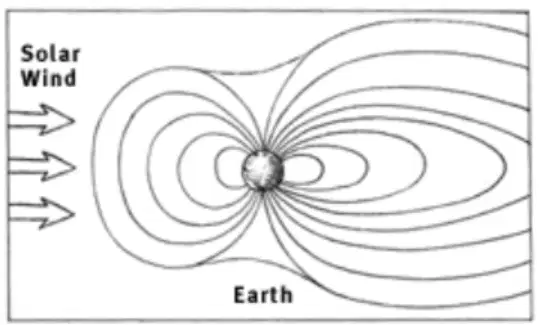
The following diagram shows solar wind approaching Earth. The lines surrounding Earth represent Earth’s magnetic field. What effect of Earth’s magnetic field does this model best represent?
Earth’s magnetic field can protect its surface from solar wind and other space weather.
Earth’s magnetic field sometimes causes problems with satellites and other communication systems.
Surface wind and the tides are both controlled by Earth’s magnetic field.
The poles of Earth’s magnetic field reverse at predicted intervals.
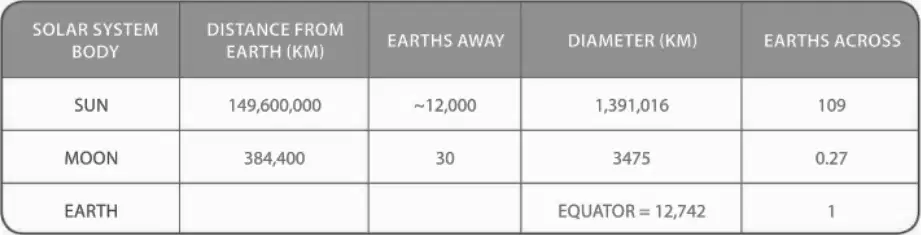
Jackie wants to draw a scale model of the Earth and Moon on a poster. If Earth is 2.0 centimeters (cm) in diameter on Jackie's poster, how many centimeters away should she draw the Moon to best represent the distance between Earth and the Moon?
15 cm
20 cm
30 cm
60 cm
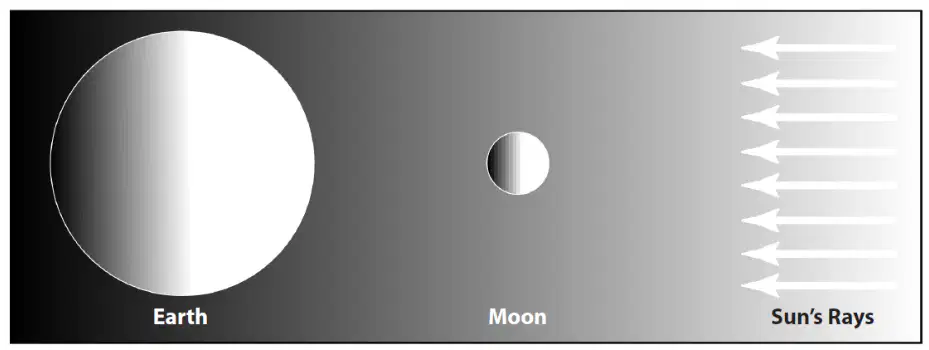
The diagram below shows the Moon, Earth, and the Sun’s rays as viewed from space. For observers on Earth, which phase of the Moon is represented by the diagram?
New moon
Full moon
First quarter moon
Waxing crescent moon
A calendar year contains 365 days, but every four years an extra day is added. Which statement explains why this extra day is necessary every four years?
The axis of Earth is tilted.
The orbit of Earth is not exactly 365 days.
The gravitational pull of the Sun affects Earth’s orbit.
The Moon crosses the orbit of the Sun every 28 days.
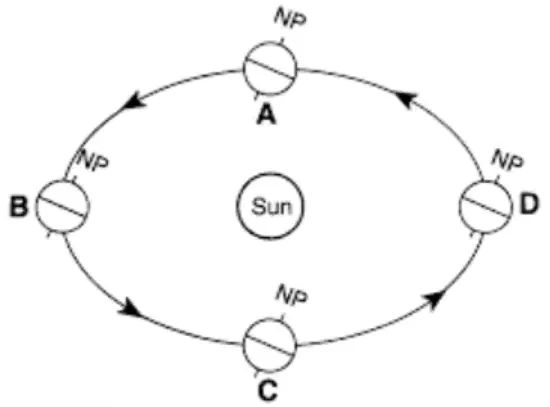
The following image shows Earth's position around the Sun at four different times throughout the year. Earth's axis is shown at every position with "NP" representing the North Pole. Which position represents the autumnal equinox in the Northern Hemisphere?
A
B
C
D
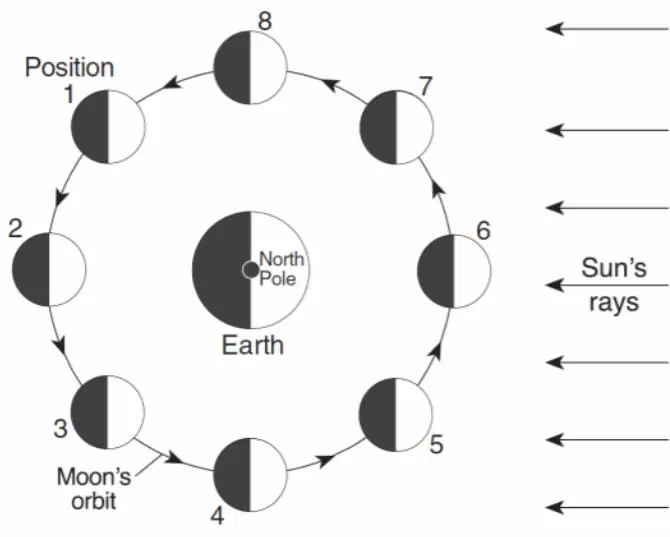
The diagram below represents the Moon in 8 positions in its orbit around the Earth. Which position would best represent a full moon as seen from Earth?
1
2
4
6
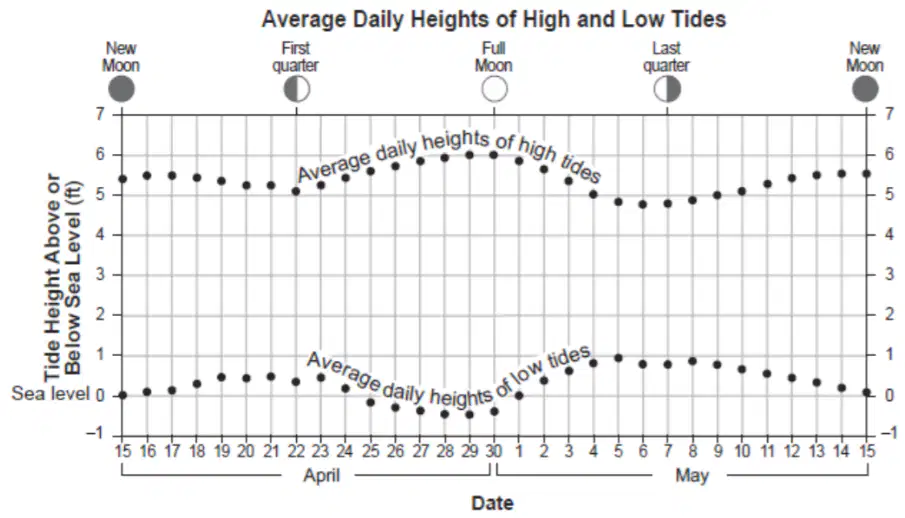
The graph shows the average daily heights above or below sea level of high and low tides from April 15 to May 15 at the same location. Five Moon phases are indicated at the dates on which they occurred. Which conclusion is best supported by the information provided?
High and low tides are both greater when there is a new or full moon than a quarter moon.
High and low tides are both greater when there is a quarter moon than a new or full moon.
The gravitational pull from the moon on the tides is greater during a quarter moon than a new or full moon.
The gravitational pull from the moon on the tides is greater during a new or full moon than a quarter moon.
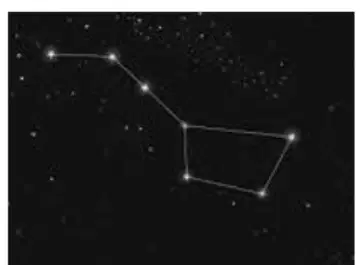
A student observed stars in the sky on the same night and drew observations in her notebook. She noticed that the “Big Dipper” constellation seemed to change positions in the sky throughout the night. Which choice best explains why the Big Dipper appears to change positions in the sky on the same night?
A. Earth is in orbit around the Sun.
B. Earth is rotating on its axis.
C. Earth is in orbit around the North Star.
D. Earth is the center of the universe, and every star is in orbit around Earth.

Which part of the Earth is receiving the most direct Sunlight?
Northern Hemisphere
Southern Hemisphere
Polar Hemisphere
MidAtlantic Hemisphere

A group of students are building a scale model of the solar system using different objects to represent the mass of each planet. The table below shows their data for the four inner planets.
Based on the information above, what should be the mass for the object that represents Mars?
1 kg
2 kg
4 kg
8 kg

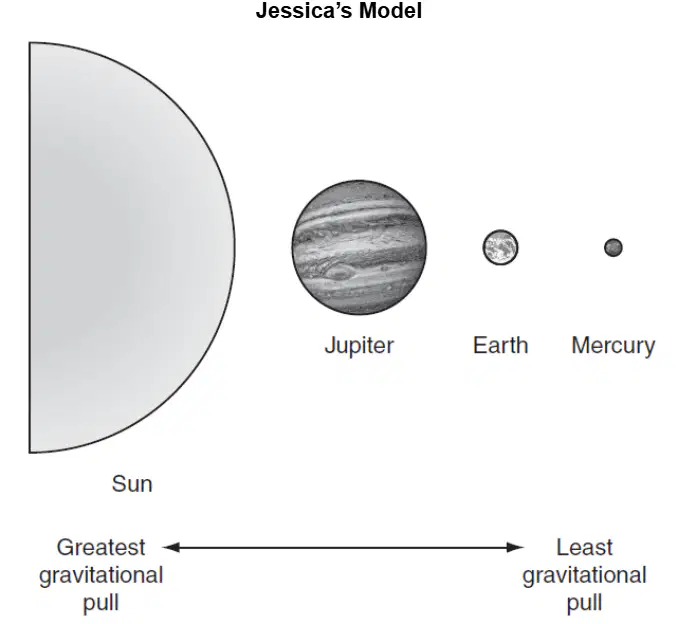
Jessica has created the diagram shown to model three planets in the order of their gravitational force with the sun.
Which change to the model will make it more accurate and why?
Reorder the planets to Mercury, Earth, Jupiter, because the Sun pulls more strongly on smaller planets than on larger planets.
Reorder the planets to Mercury, Earth, Jupiter, because both distance from the Sun and the planets’ masses influence gravitational pull.
Keep the same order but move Earth and Mercury much farther away, because gravitational pull increases as distance from the Sun increases.
Put all three planets the same distance from the Sun, because the Sun’s constant mass causes the same gravitational pull on all three planets.
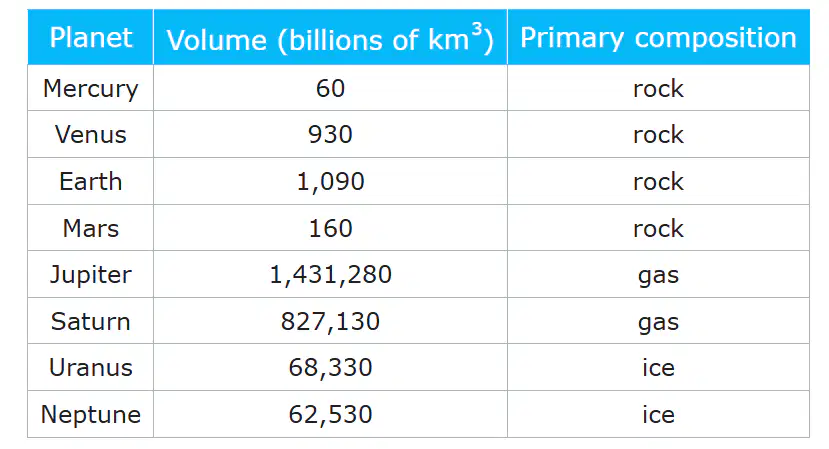
Use the data to answer the question below.
Is the following statement about our solar system true or false?
75% of the planets are made mainly of rock.
True
False
Use the data to answer the question below.
True or false: Of the four largest planets, three are made mainly of gas.
True
False

Approximately how many tides are there a day?
4 high tides, 4 low tides
2 spring tides, 2 neap tides
2 high tides, 2 low tides
1 high tide, 1 low tide


Rotation is_____


The day of the year with the most daylight hours is the
spring equinox
fall equinox
summer solstice
winter solstice
What is an Equinox
Full tilt toward sun
Full tilt away from sun
Shortest day
Equal day and night
Why do astronauts jump higher on the moon than on Earth?
There is no oxygen on the moon
Earth has an atmosphere and the moon doesn't
The moon exerts less gravitational force on astronauts
The moon's rotation is much faster than Earths.
The gravitational putll on an object.
mass
weight
gravity
acceleration
The amount of matter in an object.
mass
weight
gravity
atoms
What would happen to the planets if the Sun lost its gravity?
They would become a black hole
They would combine into a new star
Nothing, they would stay in orbit
They would move out of orbit in a straignt line.

