
Font size
 Worksheets
8.13B Carbon and Nitrogen Cycle
Total questions: 20
Worksheet time: 26mins

How does carbon in a grass plant get into a lion?
The lion eats an antelope that ate the grass
Carbon from grass doesn't end up in a lion.
The lion absorbs the carbon given off by transpiration
The lion breathes in carbon given out by the plant

What would happen within the nitrogen cycle if a bactericide, a substance that kills bacteria, was added to the soil?
The rate at which nitrogen is broken down would increase, resulting in faster absorption by plants.
Microorganisms would not be present to break down the nitrogen into a usable form for plants.
More nutrients would be added to the soil, increasing the amount of nitrogen available to plants.
Nitrogen would be blocked from entering the soil, making it unavailable for plants to use.
When sawdust is added to soil, organisms in the soil will use all the available nitrogen to break the sawdust down. What effect will the lack of nitrogen have on the plants that are near the sawdust?
The plants will not be able to grow.
The plants will grow faster than before.
The plants will be replaced with new plants.
The plants will evolve to no longer need nitrogen.
What is the significance of the carbon and nitrogen cycles to ecosystem stability?
They provide energy to the ecosystem.
They help in the recycling of nutrients.
They increase the population of predators.
They reduce the need for sunlight.
What could be a consequence of disrupting the carbon and nitrogen cycles?
Increased biodiversity
Enhanced plant growth
Ecosystem instability
More oxygen production

Which component can be added to the flask to reduce the concentration of carbon dioxide in the model atmosphere created by the disks?
Bacteria to use carbon during nitrification
Plants to absorb carbon in the process of photosynthesis
Snails to use carbon through cellular respiration
Mushrooms to absorb carbon during decomposition

F
G
H
I
What would be the most likely effect of a wildfire that burned a large area of a forest?
F More sugars and starches would be available for animals in the area.
G The availability of fossil fuels for use by industries in the area would be reduced.
H Less carbon dioxide would be removed from the atmosphere in the area by plants.
J An increase in animal respiration would increase the release of carbon dioxide in the area.
F
G
H
J

How does carbon get from animals and back into the atmosphere? (CHOOSE ALL THAT APPLY)
Respiration (breathing)
After they die, they are broken down by decomposers
Photosynthesis
None of these

What do 'plants' do with the carbon they receive?
They turn it into water
They don't need carbon
They turn it into food by photosynthesis
They keep it forever

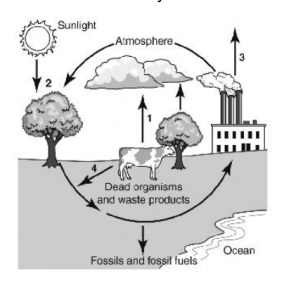
What part of the carbon cycle is represented by A?
photosynthesis
decomposition
combustion
cellular respiration

What part of the carbon cycle is represented by B?
photosynthesis
decomposition
cellular respiration
combustion

What part of the carbon cycle is represented by C?
combustion
decomposition
cellular respiration
photosynthesis
Which of the following release carbon into the atmosphere? (Select all correct answers)
Forest fires
Burning fossil fuels
Photosynthesis
Human and other animals breathing out CO2

What is the name of the process that reduces nitrates (NO3-) to nitrogen gas (N2), thus restoring N2 to the atmosphere?
Nitrogen fixation
Deamination
Denitrification
Nitrification
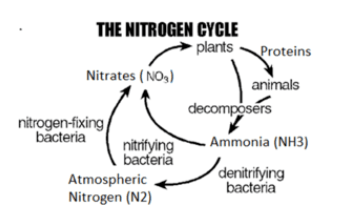
According to this diagram, plants absorb
nitrates
nitrogen fixing bacteria
animals
decomposers

The carbon cycle includes processes that release carbon into the atmosphere and places that act as carbon reservoirs. The diagram below shows both major processes that release carbon and major carbon reservoirs. Which of these disruptions would cause an excess output in the carbon cycle?
The destruction of terrestrial biota
Increases in marine biota
A reduction in the use of fossil fuels
A thickening of ocean sediments
A student sets up a compost bin outdoors. Inside the bin microorganisms convert the student’s vegetable and paper scraps into rich fertilizer. Which of the following best describes the role that these microorganisms play in natural habitats?
The microorganisms help balance the numbers of producers and consumers.
The microorganisms help keep nutrients cycling through the ecosystem.
The microorganisms turn solar energy into sugars.
The microorganisms function as autotrophs.

