
 Worksheets
US IMP
Total questions: 14
Worksheet time: 8mins
(Primary Source – President Monroe, 1823):
“…the American continents… are henceforth not to be considered as subjects for future colonization by any European powers.”
What was the primary purpose of this statement?
To prevent further European imperial expansion in the Western Hemisphere
To encourage U.S. alliances with Britain against France
To encourage U.S. alliances with Britain against France
To justify U.S. annexation of Caribbean territories
Which of the following best explains the shift in U.S. foreign policy from the Monroe Doctrine (1823) to the Roosevelt Corollary (1904)?
From passive warning to active intervention in Latin America
From military dominance to complete economic isolation
From alliance-building with Europe to global disarmament
From imperial conquest to strict neutrality in the Americas
(President McKinley, 1898, regarding the Philippines):
“…we could not leave them to themselves — they were unfit for self-government… there was nothing left for us to do but to take them all, and to educate the Filipinos…”
Which idea is most evident in McKinley’s statement?
A justification for imperialism
Belief in isolationism and neutrality
A call for Filipino independence
U.S. opposition to overseas expansion
Which of the following best explains why U.S. entry into WWI marked a turning point in its role as a world power?
The U.S. became dependent on European colonies
The U.S. withdrew from Latin America permanently
The U.S. shifted from relative isolation to active involvement in shaping global order
The U.S. abandoned all commitments to democracy abroad
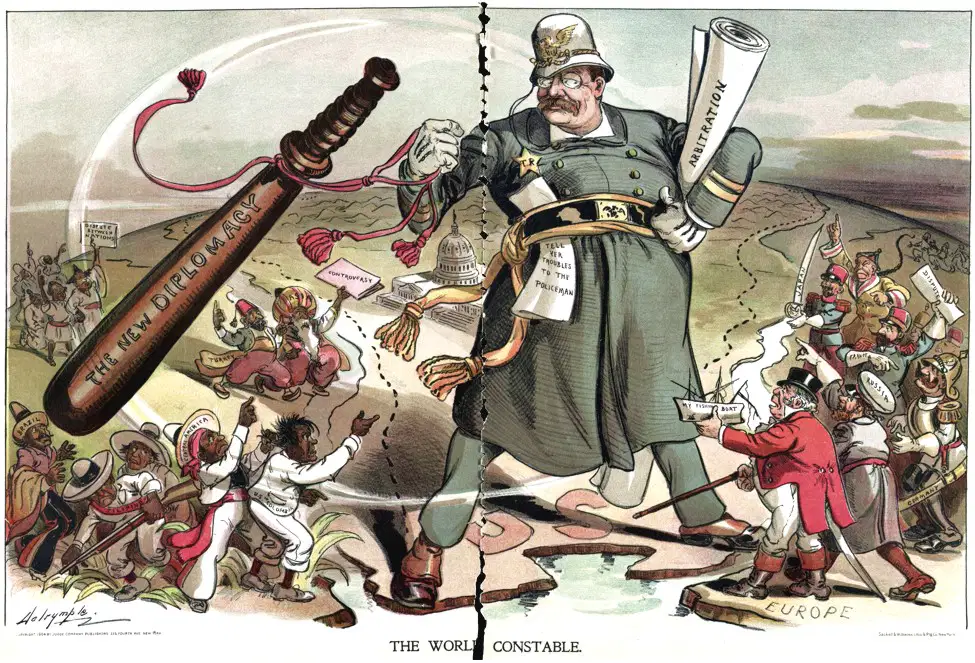
The poltiical cartoon shown best aligns with which American foreign policy?
deffered deffiance
imperialistic gain
active intervention against imperialism
isolationism
Stimulus (Senator Albert Beveridge, 1900):
“God has not been preparing the English-speaking peoples for a thousand years for nothing but vain and idle self-admiration… He has made us the master organizers of the continent."
European-style balance of power
Isolationism
Neutrality and restraint
Manifest Destiny
Why did many critics describe the Spanish-American War as a “splendid little war”?
Because it was the bloodiest conflict in U.S. history
Because it resulted in U.S. defeat but moral victory
Because it ended all imperial ambitions in Asia
Because it was short, resulted in few U.S. deaths, and brought significant territorial gains
“…we make Mexico a proposal of alliance… make war together, make peace together… the restoration of the lost territory in Texas, New Mexico, and Arizona.”
Why did the publication of this message inflame U.S. public opinion?
It showed Germany encouraging Mexico to attack the United States
It proved Britain was spying on American diplomats
It promised U.S. control of Canadian provinces
It revealed German plans to annex Cuba
Which of the following best explains the connection between U.S. economic growth and its foreign policy in the late 19th century?
Economic stagnation encouraged strict neutrality in all matters
Economic decline forced the U.S. to return to isolationism
U.S. farmers and businesses opposed all foreign trade
Industrial expansion encouraged overseas markets and new territories

Which of the following statements BEST defines the Open Door Policy?
The US would encourage greater immigration from Europe and Asia.
The US would seek spheres of influence in China.
Japan would not be permitted to trade in China.
All nations should have equal trading right in China.
All nations should have equal trading rights world-wide.
Which foreign policy from the early 1900s expanded the goals of the Monroe Doctrine?
Hepburn Act
Open Door Policy
Roosevelt Corollary
Square Deal
“…we make Mexico a proposal of alliance on the following basis: make war together, make peace together… Mexico is to reconquer the lost territory in Texas, New Mexico, and Arizona.”
Why was this telegram significant in the U.S. decision to enter WWI?
It revealed Britain’s plans to annex Mexico
It encouraged U.S. neutrality to protect its borders
It showed Germany trying to ally with Mexico against the United States
“The world must be made safe for democracy. Its peace must be planted upon the tested foundations of political liberty.”
What best explains Wilson’s reasoning for asking Congress for a declaration of war?
To punish Britain for its blockade of Germany
To defend U.S. imperial possessions in Asia
To protect U.S. neutrality in Europe
To present U.S. intervention as a moral mission to defend democracy

