
 Worksheets
Art from Australia, Oceania, Central and South America
Total questions: 35
Worksheet time: 17mins
What are the main ideas often involved in Oceanic art?
Spiritual beliefs and rituals
Modern technology and innovation
Political ideologies
Urban development
In Central and South America, art begins with a history of indigenous artists, followed by the influence of European settlers and then moving beyond Eurocentrism.
True
False
List some of the art elements and principles used by artists from Australia, Oceania, Central, and South America.
Color, Line, Shape, Balance, Contrast
Melody, Harmony, Rhythm, Dynamics
Grammar, Syntax, Semantics, Pragmatics
Algorithm, Data Structure, Complexity, Computation
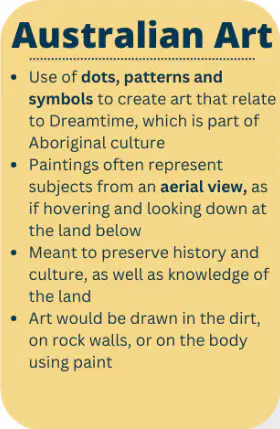
What is a common theme in Australian art?
Use of dots, patterns, and symbols
Use of large heads
Use of wool and bright colors
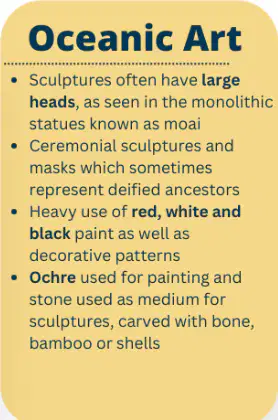
What is a characteristic of Oceanic art?
Use of wool and bright colors
Sculptures with large heads
Use of dots and patterns
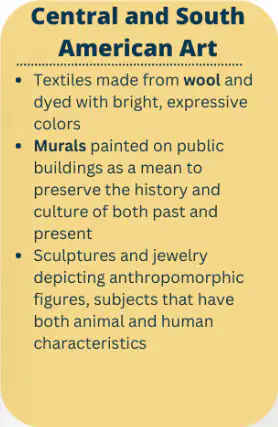
Central and South American art often uses textiles made from ______.
wool
cotton
silk
linen
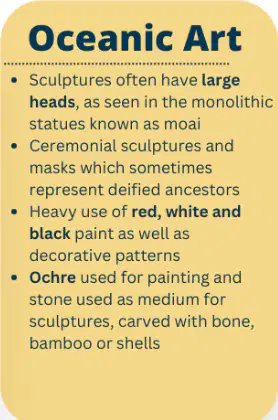
What medium is used in Oceanic art for painting and sculptures?
Ochre
Wool
Dots and patterns
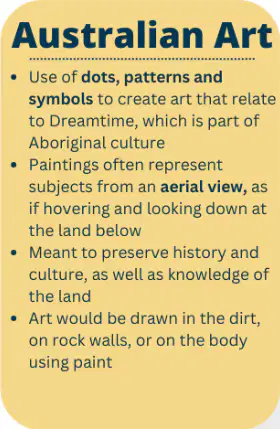
Australian art is meant to preserve ______ and culture.
history
tradition
innovation
modernity
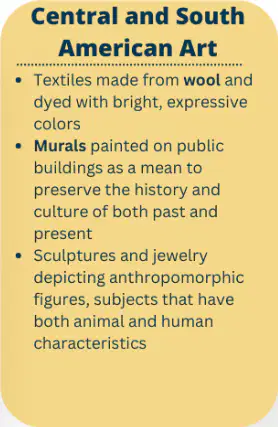
What is a feature of Central and South American murals?
Painted on public buildings
Use of large heads
Drawn in the dirt
In Aboriginal Australian art, the Dreamtime refers to:
A period of history
A spiritual belief system
A type of painting
A traditional dance
A common theme addressed by artists in Australian art is:
Nature and Landscape
Urbanization
Technology
Politics
Which of the following is a symbol used in Oceanic art for spiritual beliefs?
Moai
Totem
Pyramid
Obelisk
The impact of colonialism and post-colonialism on Oceanic art is:
Significant and transformative
Minimal and negligible
Non-existent
Purely positive
Which ancient civilizations in Central and South America constructed pyramids for spiritual beliefs?
Incas
Aztecs
Mayans
All of the above
What is the symbolic significance of the color red according to the image?
Passion and love
Danger and warning
Anger and aggression
All of the above
How can lines convey movement and energy as described in the image?
By being static and straight
By being curved and dynamic
By being thick and bold
By being dotted and broken
What do geometric shapes such as squares, circles, and triangles convey according to the image?
Harmony and balance
Chaos and disorder
Aggression and conflict
Mystery and intrigue
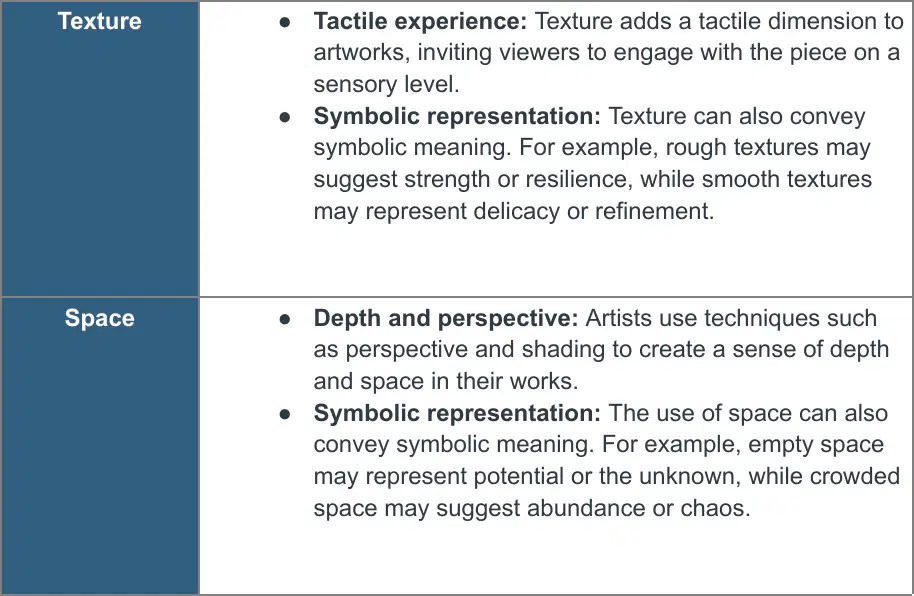
What is the tactile experience in art?
It adds a visual dimension to artworks.
It adds a tactile dimension to artworks.
It adds a symbolic dimension to artworks.
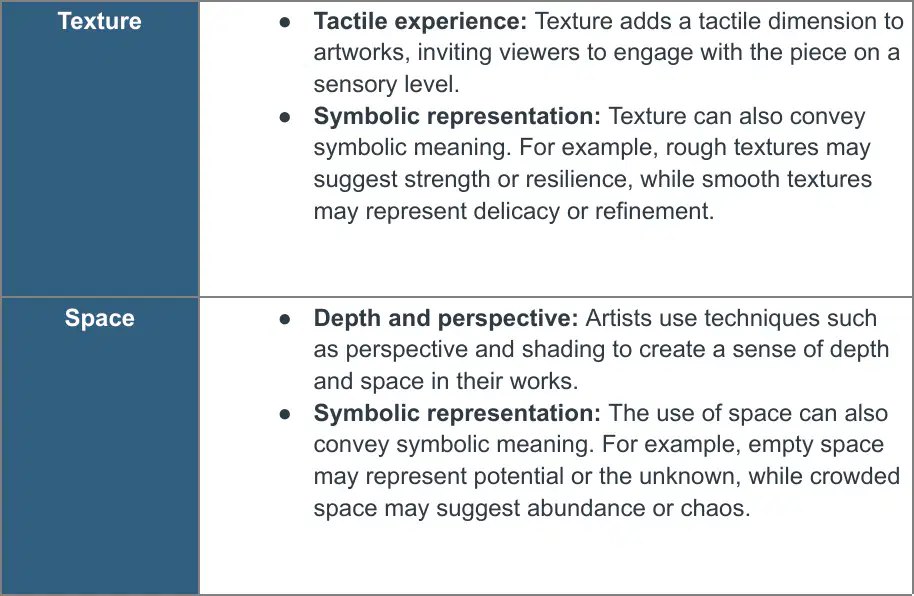
What can rough textures in art suggest?
Delicacy
Refinement
Strength or resilience
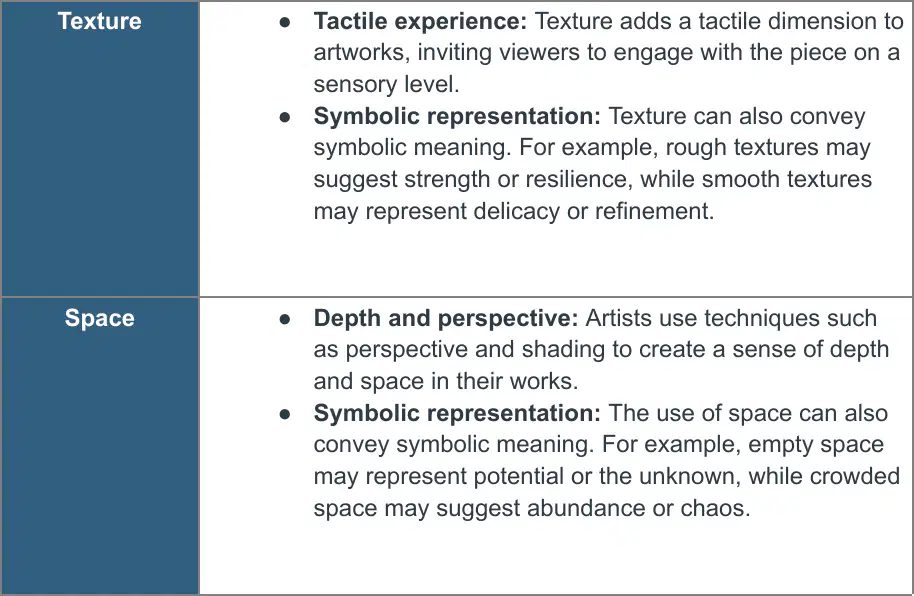
Artists create a sense of depth and space in their works by using techniques such as:
perspective and shading
color and texture
line and form
all of the above
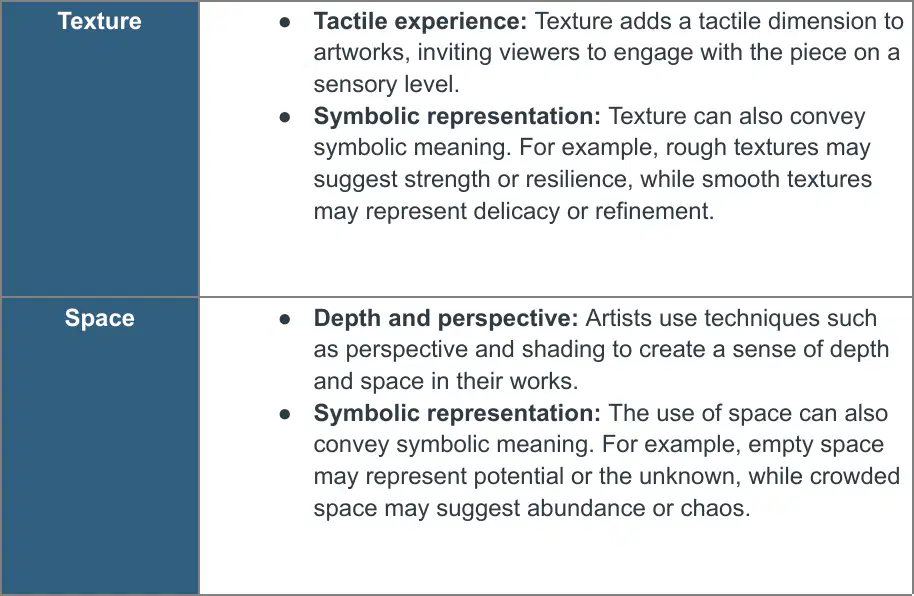
What does empty space in art symbolize?
Abundance
Potential or the unknown
Chaos
The colonial period had a significant impact on the art of certain regions. What was one of the main influences?
Introduction of new artistic techniques and materials
Complete eradication of traditional art forms
No impact on the art of the regions
Art became less diverse
Following independence, what movements did many artists in certain regions embrace?
Modernism
Cubism
Impressionism
Surrealism
Globalization in the contemporary era has led to:
Increased cultural exchange
Decreased cultural exchange
No change in cultural exchange
Isolation of cultures
Contemporary artists often address pressing social and political issues. Which of the following is NOT one of these issues?
Inequality
Human rights
Environmental concerns
Fashion trends
The Dot Painting Movement initiated by the Papunya Tula artists in the 1970s is significant because:
it introduced a new art form that became a symbol of Aboriginal culture.
it was the first art movement to use digital technology.
it focused on urban landscapes and modern themes.
it was primarily a European art movement.
What are the two aspects of Polynesian Tattoos mentioned in the table?
Cultural significance and personal identity
Artistic expression and historical context
Religious symbolism and tribal affiliation
Geometric patterns and natural elements
The historical significance of Polynesian tattooing is:
A form of artistic expression and identity
A modern fashion trend
A recent cultural development
An influence from Western culture
What did they serve as a visual representation of?
Tattoos served as a visual representation of significant life events such as coming-of-age ceremonies, marriages, and achievements.
Tattoos served as a visual representation of ancient myths and legends.
Tattoos served as a visual representation of geographical locations and maps.
Tattoos served as a visual representation of culinary recipes and ingredients.
Polynesian tattoos were a powerful symbol of cultural identity, connecting individuals to their ancestors, their community, and the natural world.
True
False
The resurgence of interest in traditional Polynesian tattooing in recent decades is driven by:
cultural identity and heritage preservation
modern fashion trends
celebrity endorsements
technological advancements in tattooing
What have they influenced?
Polynesian tattoo designs have gained global popularity.
Polynesian tattoo designs are only popular in Polynesia.
Polynesian tattoo designs are not known outside of Polynesia.
Polynesian tattoo designs are a recent trend.
What are they personalizing designs to reflect?
contemporary influences and personal stories.
historical events and traditions.
futuristic themes and technology.
natural elements and landscapes.

