
 Worksheets
USHG Regents Review - Full Year
Total questions: 146
Worksheet time: 2hrs 1mins
How did the arrival of Europeans impact the Native American population?
The arrival of Europeans led to a significant reduction in the Native American population due to diseases, displacement, and violence.
The arrival of Europeans had no impact on the Native American population
The arrival of Europeans led to the complete assimilation of the Native American population
The arrival of Europeans caused the Native American population to increase
What were some of the major conflicts between the Native Americans and the European colonizers?
Land disputes, cultural clashes, and the spread of diseases
Religious harmony, economic cooperation, and mutual respect
Cultural assimilation, diplomatic negotiations, and technological exchange
Language fluency, trade agreements, and peaceful coexistence
What were some of the long-term effects of colonization on the Native American population?
Peaceful coexistence with European settlers
Respect for Native American culture and traditions
Increase in population due to improved living conditions
Loss of land, forced assimilation, spread of diseases, and decline in population due to warfare and displacement.
Pamphlet written by Thomas Paine, spoke about the colonies becoming independent from Great Britain.
Common Sense
Declaration of Independence
Olive Branch Petition
Treaty of Paris (1783)
Signed in 1776 by US revolutionaries; it declared the United States as a free state.
Common Sense
U.S. Constitution
Articles of Confederation
Declaration of Independence
This act forced colonists to put expensive tax stamps on all legal documents
Stamp Act
Declaratory Act
Townshend Revenue Act
Quartering Act
This act forced colonists to pay taxes for essential products such as paint, glass, paper, lead, and tea.
Townshend Revenue Act
Declaratory Act
Quartering Act
Stamp Act
This act forced the colonists the let British troops live in their homes.
Quartering Act
Declaratory Act
Townshend Revenue Act
Soldiering Act

The war between the British and the French between 1754 and 1763 is known as the __________________________.
French and Indian War
King Philip's War
Bacon's Rebellion
Shay's Rebellion

What is the Proclamation of 1763?
Ended the French and Indian War
Announcement that banned colonists from settling west of the Appalachian Mountains
Announcement that allowed colonists to settle west of the Appalachian Mountains
Announcement that banned colonists from settling in Canada

British Parliament (government that creates laws) passed a law that placed a tax on newspapers, pamphlets, and all printed materials. Which act was this called?
Sugar Act
Stamp Act
Townshend Act
Tea Act

In 1773, Parliament passed the ____________________ giving the British East India Company complete control over tea sales in the colonies. Colonies could only buy tea from Great Britain.
Tea Act
Townshend Act
Intolerable Acts
Sugar Act

As a response to the Townshend Act, colonists threw snowballs and clubs at British soldiers. British soldiers opened fire killing 5 colonists. This event is known as the _____________________________.
Boston Tea Party
Boston Massacre
The start of the American Revolution
The Battles of Lexington and Concord

British Parliament passed a series of laws called the ______________________________, which punished the colonists for the Boston Tea Party.
Intolerable Acts (or Coercive Acts)
Sugar Act
Townshend Acts
Tea Act

What were the punishments of the Intolerable Acts?
Renewed the Quartering Act
Closed the Boston Harbor
Placed a military governor in charge of Massachusetts
All of the above
approve
Separation of Powers
Checks and balances
Ratify
Bill of Rights
first 10 amendments (freedoms) written by James Madison
Separation of Powers
Checks and balances
Ratify
Bill of Rights
one who favored ratification of Constitution (strong central gov’t)
Federalist
Anti-Federalist
Patriot
Loyalist
one who opposed ratification of the Constitution (weaker central gov’t)
Federalist
Anti-Federalist
Loyalist
Patriot
designed to prevent one branch from seizing too much power. Example: President nominates judges, Senate approves nominations
Separation of Powers
Checks and balances
Ratify
Bill of Rights


Who represents the Executive Branch?
Congress: Senate and House of Representatives
The President and his cabinet
The Supreme Court
The State governors
Who represents the Legislative Branch?
Congress: Senate and House of Representatives
The President and his cabinet
The Supreme Court
The State governors
Who represents the Judicial Branch?
Congress: Senate and House of Representatives
The President and his cabinet
The Supreme Court
The State governors
What is Federalism?
Power is divided between federal and state government
Power is divided between federalist and anti-federalists
Power is split into three branches of government
Power is split between America and England
Which of the following is true about the Federalists?
Supported the new Constitution
Wanted to keep power in the states
Believed in creating a strong central government
Wanted to include the Bill of Rights
Supported the Articles of Confederation
Which of the following is true about the Anti-Federalists?
Supported the new Constitution
Wanted to keep power in the states
Believed in creating a strong central government
Wanted to include the Bill of Rights
Supported the Articles of Confederation
Who were the leaders of the Federalists?
Alexander Hamilton
Thomas Jefferson
John Adams
James Monroe
Which areas supported the Federalists?
The Southern States
Urban areas with big business
The Northern States
Rural areas that farmed
Loyalists who supported England
How did the Federalists view the Constitution?
Loose interpretation of the rules
Strict interpretation of the rules
Supported government flexibility
Focus should be about individual rights
What was the Federalists' ideal economy
Manufacturing
Farming
Trade
Agriculture
Who were the leaders of the Anti-Federalists?
Alexander Hamilton
Thomas Jefferson
John Adams
James Monroe
Which areas supported the Anti-Federalists?
The Southern States
Urban areas with big business
The Northern States
Rural areas that farmed
Loyalists who supported England
How did the Anti-Federalists view the Constitution?
Loose interpretation of the rules
Strict interpretation of the rules
Supported government flexibility
Focus should be about individual rights
What was the Anti-Federalists' ideal economy
Manufacturing
Farming
Trade
Agriculture
Which group wanted to create a national bank?
Federalists
Anti-Federalists
One consequence of Eli Whitney's new invention, the cotton gin was that it-
a. Made cotton production faster and increased the demand for slave labor in the South
b. Established gin and other alcoholic beverages as vital industries in the North
c. Provided important technology for New England's large cotton plantations
d. Created stronger trade ties between the United States, China, and Japan
The Supreme Court case Marbury v. Madison (1803) is most closely associated with-
a. Interstate commerce
b. Foreign tariffs
c. judicial review
d. The rights of indentured servants
America's first two political parties were the -
a. Federalists and Nationalists
b. Federalists and Democratic-Republicans
c. Democrats and Republicans
d. Republicans and Nationalists
The War of 1812, which took place between 1812-1815, was a war primarily between the United States and _________.
France
Great Britain or England
Spain
Germany

What is Nationalism?
Coming to an agreement
Forcing someone into military service
Having extreme pride in one's nation

Which of these was NOT a cause of the War of 1812?
Britain was kidnapping American sailors (impressment).
Britain was hurting US trade and harming its economy
Britain was arming and assisting Native Americans to attack US settlers
Britain was upset about America attacking London.

The future president who was the American General during the Battle of New Orleans was ______.
Abraham Lincoln
James Buchanan
Theodore Roosevelt
Andrew Jackson
The case of Marbury v. Madison established, ___________, which means that the Supreme Court reviews laws to check their constitutionality.
judicial review
ongoing review
legislative branch
Marbury's Law
What is the Embargo Act?
Allowed Americans to colonize Texas
Prohibited American ships from trading with European Nations
Prohibited American ships from trading with African nations
Prohibited Americans from settling the Ohio River Valley
What is judicial review?
The Supreme Court can declare laws constitutional or unconstitutional
Congress can declare laws constitutional or unconstitutional
The Supreme Court can impeach the president
The president can impeach Supreme Court justices
Soon after the United States Constitution was adopted, disagreements arose over the proper role of government in the economy. These disagreements led to the development of the first
corporations
political parties
cabinet officies
civil rights movement
Which proposal was included in Secretary of the Treasury Alexander Hamilton’s financial plan in the 1790s?
incentives to encourage agricultural expansion
direct taxes on states to support government operations
creation of a national bank
free trade with other nations
In his farewell address, George Washington warned against
permanent alliances and political parties
the Bank of the United States
loose interpretation of the Constitution
the Treaty of Greenville
Actions and policies of the government under President George Washington generally resulted in the
establishment of strong political ties with other nations
failure to create a financial program for the country
liberation of many enslaved persons
strengthening of the federal government
The economic policy that made the "mother country" rich by not letting colonies trade with anyone else was known as...
Salutary Neglect
Free Market System
Capitalism
Mercantilism
What did Common Sense convince the colonists to demand from the "Mother Country" (Britain)?
Money
Seperation
Love
Peace

What was a main argument of common sense?
The colonists were petty in their complaints about the king.
The colonies should declare immediate independence from the king.
Taxes are a natural part of life.
A council should be created to work with the king.
Common Sense was a pamphlet Thomas Paine published to distribute in the colonies to...
explain to Britain why they should end the quartering act
influence more people to join the independence movement.
to join the Loyalist party
abide by the Intolerable acts
What was the first written form of Gov't in America
Magna Carta
English Bill of Rights
Mayflower Compact
Inalienable Rights
What did the Mayflower Compact establish?
Self-government
Religious freedom
Economic prosperity
Military alliance
Which region was known for producing large quantities of cash crops such as tobacco and cotton?
Southern
Middle
New England
None of the above
Ship building and fishing were major economic activities in which region?
Southern
Middle
New England
Canada

People who could not afford to come to America agreed to work without pay for a certain number of years is called...
Indentured Servants
Slaves
Settlers
Debtors

Which 5 colonies makes up the Southern colonies?
Virginia, Maryland, North Carolina, South Carolina, Georgia
Virginia, Delaware, North Carolina, South Carolina, Georgia
Virginia, Pennsylvania, North Carolina, South Carolina, Georgia
Virginia, North Carolina, South Carolina, Georgia, Florida
What was the first legislature made up of elected representatives in Jamestown called?
Virginia Company
House of Burgesses
Mayflower Compact
Senate
What do you call a person who was opposed to slavery and worked toward ending it?
Secessionist
Lincolnist
Abolitionist
Whig
This means that the people get to decide on an issue, including whether or not to allow slavery in their territory
Reconstruction
Popular Sovereignty
Secede
Congress
The US Supreme Court decided that this man was still just a slave, even though he had lived in a free territory, setting the stage for slavery to be legal everywhere
Uncle Tom
Tony Stark
Dred Scott
Brown v Board
What Amendment grants citizenship to all person born on American soil except for Native Americans.
12th Amendment
14th Amendment
13th Amendment
15th Amendment
What laws sought to restrict the freedoms of African Americans after slavery ended and they become the basis of Jim Crow Laws?
Cheat Codes
Morse Codes
Black Codes
Nuclear Codes
Slavery is outlawed in the US by this amendment:
13th Amendment
15th Amendment
19th Amendment
12th Amendment
Which is the best description of Reconstruction?
rebuilding the US after a big earthquake
a period of rebuilding in the US after the Civil War
a period of rebuilding in the US after the Revolutionary War
unfair treatment of African Americans after the Civil War
The 15th Amendment states that a person cannot be denied the right to vote based on ____________________.
race
previous condition of servitude
both
___________________ wanted African Americans to have full citizenship.
Carpet Baggers
Jefferson Davis
Andrew Johnson
Radical Republicans
What are companies who dominate a specific industry (steel, oil, etc.) called?
Monopolies
Local Business
Corporations
Competitors
Captains of Industry valued competition in a free market because they believed only the strongest companies would survive and result in better goods and services. This is an example of
Unionism
Control Market
Socialism
Social Darwinism
What was a common characteristic of the Pullman Strike, Haymarket Affair, and Homestead Strike?
They were defeats for owners
They were victories for unions
They became violent
They were victories for workers


Who was a photographer that worked to expose how the other half lived?
Jacob Riis
Ida Tarbell
Jane Addams
Ida B Wells
What are the crowded, unsafe apartment buildings that many immigrants were forced to live?
Tenements
Sod Houses
Settlement Houses
Insulae
Who created a monopoly in oil?
Andrew Carnigie
John D. Rockefeller
Henry Bessemer
Granville Woods
Theodore Roosevelt

What is the purpose of a Union?
To achieve better rights for workers
To give the workers a way to blow off steam after work
A way for the business to control workers
A way to make sure workers stay happy
Between 1848 and 1920, suffragists protested for women to have the right to vote.
Which amendment guaranteed women this right in the United States?
16th
17th
18th
19th
The Jungle exposed unsanitary and unsafe practices in the meatpacking industry.
Which muckraker is responsible for exposing the conditions?
Jacob Riis
Lewis Hines
Ida Tarbell
Upton Sinclair

Founder of the NAACP
Pushed for the "Talented Tenth"
Attended Harvard University
Ida B Wells
Booker T Washington
W E B DuBois
Martin Luther King Jr.
Key Reforms of the Progressive Era
· Initiative
· Referendum
· Recall
· Direct Primary
· 17th Amendment
How did the reforms listed above impact the US?
A system of separate schools for new immigrants
They gave citizens a greater voice in the democratic process of government
More sources of revenue and taxes in state governments.
They successfully brought economic relief to the urban working class

Prohibition banned the making, selling, buying, or drinking of alcohol. Which amendment made this possible?
17th Amendment
18th Amendment
19th Amendment
21st Amendment
Reporters, journalists, photographers, and authors who used the media to raise concerns about the negative effects of industrialization were known as
muckrakers
suffragists
immigrants
abolitionists
____________?____________
A period of time when social, economic and political problems caused by rapid industrialization were exposed and in some cases reformed.
What is the most likely title for this?
Industrialization
Progressive Era
Reconstruction
Prohibition
The purpose of the Sherman Anti-Trust Act was to
break up monopolies
give equal rights to women
help people living in poverty
end racism
The idea that the government will tax at different rates based on how much money you make.
Tax Invasion
Salary Tax
Sales Tax
Graduated Income Tax

The campaign to stop abuse in the homes by urging people and the government to stop alcoholism was called
Women Suffrage
Temperance Movement
Alcoholics Anonymous
Fair Weather Fan
All the following were reasons for US imperialism except:
to develop closer relations with European nations
need for more natural resources
need for new markets to sell goods
fear of running out of land to settle
Why did the United States "need" territories like the Philippines and Hawaii?
they acted as refueling stations for ships
they had once belonged to the United States
to rid the Americas of European powers
so that those countries did not imperialize the US
Fake news is the modern term for what during the 1890s?
yellow journalism
red journalism
false advertising
negative journalism
What event led to the start of the Spanish-American War?
sinking of the USS Maine
sinking of the USS Lusitania
attack on southern Florida by Cuba
the coronation of Liliuokalani
What role did the media(yellow journalism) play in the Spanish American War?
shaped public opinion to go to war
only covered facts of the events of the war
play no role in the war whatsoever
shaped public opinion to give the president war powers to declare war on Cuba
Which president built on the Monroe Doctrine's limitations on colonization in the Western Hemisphere?
T. Roosevelt
Taft
Wilson
Seward
________________was a widely held belief in the 19th century United States that its settlers were destined to expand across North America.
Imperialism
Annexation
Monroe Doctrine
Manifest Destiny
An economic and political domination of a strong nation over other weaker nations.
Colony
Imperialism
Annex
Empire
Which of the following was NOT a motivating factor of imperialism?
Establish naval bases around the world
Expand to new world markets
Slavery
Spread American influence & democracy
This gave every country equal access to trade with China.
Boxer Rebellion
Open Door Policy
Modernization
Sphere of Influence
Which policy statement called for America to exercise an "international police power"?
Monroe Doctrine
Moral Diplomacy
Platt Amendment
Roosevelt Corollary
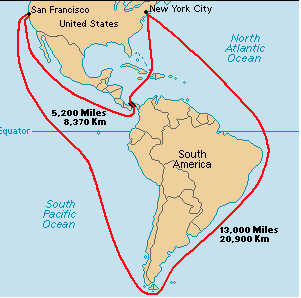
What does this map support?
The US fought the Spanish navy in the Atlantic and Pacific
The Spanish-American War led to new US territories
America became a colonial power in South America by surrounding it
The Panama Canal is critical to US trade
How did the US gain construction rights for the Panama Canal?
By attacking Panama with US warships
By annexing Panama to the US
By signing an agreement with the Colombian Senate
By encouraging a local uprising against the Colombian government
The Roosevelt Corollary was related to which prior foreign policy?
Monroe Doctrine
Big Stick Policy
Dollar Diplomacy
Moral Diplomacy

