
NEW
Font size
 Worksheets
2019 FBM
Total questions: 50
Worksheet time: 2hrs 40mins
The relationship between quantity supplied and price is known as:
Supply curve
Demand curve
Derived demand
Direct marketing
Suppose that the supply curve shifts to the right. What is the most likely effect on price and quantity?
Price will increase and quantity may change
Price will decrease and quantity may decrease
Price will decrease and quantity will increase
Price will increase and quantity will increase
At a price of $15, Jim buys 3 CD’s per month. When the price increases to $20, Jim buys 2 CD’s per month. John says that Jim’s demand for CD’s has decreased. Is John correct?
Yes, John is correct
No, John is NOT correct. Jim’s demand has increased.
No, John is NOT correct. Jim’s quantity demanded has increased, but his demand has stayed the same.
No, John is NOT correct. Jim’s quantity demanded has decreased, but his demand has stayed the same.
If the percentage change in quantity demanded is equal to the percentage change in price, demand is:
Inelastic
Unit elastic
Elastic
Perfectly elastic
The fewer the number of substitutes for a good, the:
Lower its income elasticity of demand
Higher its income elasticity of demand
Lower its price elasticity of demand
Higher its price elasticity of demand
Which of the following is NOT an assumption of the theory of perfect competition?
Each firm produces and sells a differentiated product
There are many sellers and buyers, none of which is large in relation to the total sales or purchases
Buyers and sellers have all relevant information with respect to prices
There is easy entry and exit
A monopoly may exit because:
Government has refused to grant a public franchise
The firm is so large and is currently experiencing such vast diseconomies of scale that it can out-compete all newcomers
One firm has the exclusive ownership of a secure resource
Both A and B
The profit maximizing quantity of output is where:
Demand equals supply
Average total cost is at a minimum
Price equals average variable cost
Marginal revenue equals marginal cost
Pete’s Burgers has fixed costs of $100. When Pete’s Burgers makes 500 hamburgers, their variable costs are $100. When Pete’s makes 600 hamburgers, their variable costs are $200. What is the average total cost when they are making 600 hamburgers and what is the marginal cost for the range between 500 and 600 hamburgers?
ATC=$0.20 ; MC=$1.00
ATC=$0.50 ; MC=$1.00
ATC=$0.40 ; MC=$1.00
ATC=$0.50 ; MC=$2.00
Grocery stores do not often advertise sales prices on table salt because:
The demand for salt is elastic
The demand for salt is unit elastic
The demand for salt is inelastic
The demand for salt is negative
In a market, the price where the demand curve and the supply curve intersect is known as this price:
Equilibrium
Ceiling
Cross
Own
Which of the following causes a movement along a given market demand curve for pork chops but does NOT shift the curve?
Change in population
Change in the price of hamburger, a substitute product
Change in the supply of pork chops
All of the above
Costs that do NOT change in the short run regardless of the output level for a firm are called:
Opportunity costs
Fixed costs
Variable costs
Perfectly elastic costs
The incremental cost to a wheat farmer of producing one more bushel of wheat is this type of cost:
Opportunity
Total
Average Variable
Marginal
A governmental price that is a minimum price that must be paid to sellers is called:
A price ceiling
A price floor
A quota
A salvage value
Average fixed cost is total fixed cost:
Per year
Minus total variable cost
Per unit of output
Divided by total cost
Five months ago, Wilson opened up a health club. Which of the following is an implicit cost related to the health club?
Wilson paid $120 for an outside laundry service to clean towels used at the club.
Wilson previously worked as an accountant earning $3,500 per month
Wilson paid $100 for the pest control exterminator to spray the health club
Wilson usually eats two hamburgers a day, priced at $6.00 each
At 200 units of output, total cost is $40,000 and total variable cost is $18,000. What does total fixed cost equal at 200 units?
$22,000
$200
$110
$90
The value of the US dollar can have a significant impact on the world market and impact the competitiveness of US grain exports. If the US dollar decreases in value relative to other currencies, what would be the expected impact on US corn and soybean prices in the world market?
Would make corn and soybeans prices higher and make them more expensive to foreign buyers
Would make corn and soybeans prices lower and make them more expensive to foreign buyers
Would not change the prices of corn and soybeans to foreign buyers
Would make corn and soybeans prices lower and make them less expensive to foreign buyers
The accounting method that records cash receipts when they are received and cash expenses when they are paid is known as:
Cash method
Real-Time method
First in, first out method
Accrual method
The law of diminishing returns (or diminishing marginal product) states which of the following will eventually decrease if a corn farmer keeps putting more fertilizer on a given acre of corn ground?
Profit
Revenue
The additional corn yield per additional pound of fertilizer
Net cash flow
What is the management term used to describe an annual period of time used by a business to record income and expenses if that annual period does NOT correspond to a normal calendar year?
Leap year
Fiscal year
Tax year
Grace period
What is the future value in five years of $100 today if the annual interest rate is 6%?
(100) (1.06)
(100) (1.05)6
(100) (1.06)^5
(1.06)5100
A governmental tax on imports is also called
An embargo
A trade quota
A subsidy
A tariff
Which of the following are equal if a firm is at a breakeven level of production?
Total revenue and total cost
Total assets and total liabilities
Price and average variable costs
Cash outflows and cash inflows
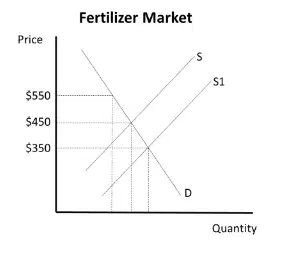
What is the equilibrium price for fertilizer under the original demand (D) and supply (S) curves?
$550
$450
$350
Not enough information to determine
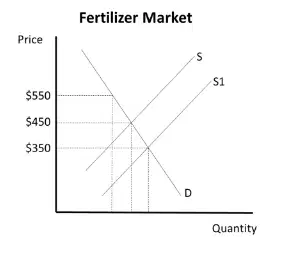
Which of the following would cause the supply curve to shift from the original curve (S) to the new curve (S1)?
New technology that increases the efficiency in fertilizer production
Increases in the prices of raw material used in making fertilizer
Higher demand for fertilizer
Adverse weather affecting crop production

What happens to the equilibrium quantity of fertilizer with the shift of the supply curve from S to S1?
Equilibrium quantity decreases
Equilibrium quantity stays unchanged
Equilibrium quantity increases
Not enough information to determine
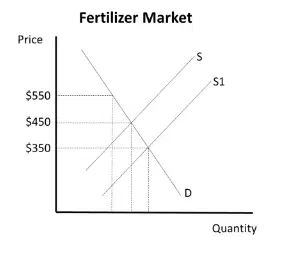
Which of the following would occur at a market price of $550?
Equilibrium
A surplus
A shortage
More demand than supply
At any point in time, a farm business has a positive net worth if:
Net income is greater than zero
Total assets are greater than zero
Current assets minus current liabilities is greater than zero
Total assets minus total liabilities is greater than zero
The annual rate of return earned by a farmer on his/her assets was 5%. Net earnings for the year were $30,000. This implies:
Total assets = $150,000
Equity = $600,000
Total assets = $600,000
Equity = $150,000
Which of the following would be the best value to use for the cost of feeding homegrown (non-purchased) corn to beef cattle?
Zero
The cost of producing the corn
The average of corn costs for 2 or 3 recent years
The opportunity cost of the corn
A farmer recently sold a depreciable asset for $1500. The farmer had claimed $700 of depreciation between the times of purchasing and selling the asset. If the farmer reported a taxable realized gain of $200, at what price had the farmer originally purchased the asset?
$2,000
$2,400
$1,000
$1,300
Suppose a farmer’s electricity expenses this year were $4,400 while the same costs last year were $4,000. What is the percentage increase in the cost of the electricity this year versus last year?
11%
9.1%
10%
8%
Which of the following farm firm decisions is more likely to impact the firm’s total costs, rather than the firm’s total revenues?
What inputs to use
What price to charge for the product
How to market the product
Who to sell the product to
Which of the following would most likely be considered a fixed cost?
Purchased feed
Machinery depreciation
Seasonal labor
Machinery repairs
Which of the following has happened for a farm firm whose current assets have increased more than current liabilities?
Solvency has increased
Net worth has increased
Liquidity has increased
Debt has increased
If a producer’s debt-to-asset ratio decreases, the producer’s
Profitability has increased
Net cash flow has decreased
Long-term credit riskiness has decreased
Total asset value has decreased
A grain farmer who rents land and does so with a crop-share lease agreement agrees to pay the land owner which of the following?
A fixed cash payment per acre
A variable cash payment per acre
A percentage of the profits per acre
A percentage of the harvested crop
A rice farmer is going to apply 28 ounces of a herbicide that costs $128.00 per gallon. If the custom application cost is $6.50 per acre, what is the producer’s total cost of making this application?
$28.00 per acre
$34.50 per acre
$6.50 per acre
$51.50 per acre
A cattle producer can sell his calves that weigh 500 pounds now for $1.40 per pound or can hold them until they weigh 700 pounds and sell them for $1.20 per pound. If the cost of gain is estimated at $0.85 per pound, which of the following statements is true if the producer sells his calves at 700 pounds?
The producer would make $140 more per head by selling at 700 pounds
The producer would make $170 more per head by selling at 700 pounds
The producer would have made $30 more per head by selling at 500 pounds
The producer would have made $700 more per head by selling at 500 pounds
Assume a marginal income tax rate of 10% on the first $15,000 of income and 15% on the next $10,000 of income for Jim. How much income tax would Jim owe if he made $25,000 in income?
$3,750
$2,500
$1,500
$3,000
A producer has total production expenses for his cattle operation of $530 per adult cow. If the producer has an average weaning weight of 550 pounds and a 70 percent weaning percentage, what is his breakeven selling price for his calves?
$0.96 per pound
$1.38 per pound
$137.66 per hundredweight
Both b and c
A farmer is considering purchasing a half section of land. How many acres would that be?
320 acres
1,280 acres
1,600 acres
640 acres
A producer applies 200 pounds per acre of Triple Super Phosphate fertilizer to his crop. If the fertilizer has an analysis of 0%N, 46% P, and costs $500 per ton, what was the producer’s cost per acre and per pound of phosphorous applied?
Cost is $50.00 per acre and $0.54 per pound of phosphorous applied
Cost is $30.00 per acre and $0.65 per pound of phosphorous applied
Cost is $30.00 per acre and $0.30 per pound of phosphorous applied
Cost is $60.00 per acre and $1.00 per pound of phosphorous applied
How many bushels are contained in one futures contract for soybeans?
10,000 bushels
5,000 bushels
30,000 bushels
There is no standardized number of bushels for soybean futures contracts
If a cotton producer is expected to harvest in late October or early November and wants to hedge his crop, which contract would he use assuming he wants to sell the cotton shortly after harvest?
March cotton futures contract
July cotton futures contract
October cotton futures contract
December cotton futures contract
The current futures price for a December 2019 corn contract is $4.20 per bushel. Which of the following December 2019 corn put option strike prices would be considered “Out-of-the-Money”?
Strike price of $4.20
Strike price of $4.40
Strike price of $3.80
Strike price of $4.50
If the local cash price for corn is $4.30 per bushel while the nearby corn futures contract price is $4.10 per bushel, what is the basis?
A negative $0.20 per bushel
A positive $0.20 per bushel
A positive $4.10 per bushel
A negative $4.10 per bushel
A producer wants to hedge his soybean crop and sells a November 2019 soybean contract for $9.00 bushel in July 2019. The producer harvests the soybean and sells it at the local elevator in September 2019 for $8.50 per bushel and, at the same time, offsets his futures position. The November 2019 soybean contract was trading at $8.25 per bushel when the producer offset his futures position. How much did the producer gain or lose on his futures position?
Producer loss $0.50 on his futures position
Producer made $0.50 on his futures position
Producer loss $0.75 on his futures position
Producer made $0.75 per bushel on his futures position

