Wayground logo

Free Printable Worksheets

Font size

S
M
L
XL
Worksheets

Polar Graphs and Rectangular Conversion

Total questions: 28

Worksheet time: 21mins

Name
Class
Date
1.

Which letter represents the point

(−4,4π3)(-4,\frac{4π}{3})  ?

a)

F

b)

E

c)

B

d)

A

2.

Which coordinates land at point A? CHOOSE ALL THAT APPLY!

a)

(−4,−2π3)(-4,-\frac{2\pi}{3})

b)

(4,−5π3)(4,-\frac{5\pi}{3})

c)

(−4,4π3)(-4,\frac{4\pi}{3})

d)

(4,−4π3)(4,-\frac{4\pi}{3})

3.

Convert the polar point into rectangular form:

(2,−π4)\left(\sqrt{2},-\frac{\pi}{4}\right)  

a)

(1,1)(1,1)  

b)

(1,−1)(1,-1)  

c)

(−1,0)(-1,0)  

d)

(−1,−1)(-1,-1)  

4.

This is a _____ ____.

(a)  

5.

Rewrite the following polar equation into rectangular form.

r=43cos⁡θ+7sin⁡θr=\frac{4}{3\cos\theta+7\sin\theta}  

a)

7x+3y = 47x+3y\ =\ 4  

b)

y=47x−37y=\frac{4}{7}x-\frac{3}{7}  

c)

7x−3y = 47x-3y\ =\ 4  

d)

y=−37x+47y=-\frac{3}{7}x+\frac{4}{7}  

6.
Write the polar equation into a rectangular equation?
r=2sinΘ+2cosΘ
a)
x2+y2=2x+2y
b)
r=2x+2y
c)
r=x2+y2
d)
x2-y2=2x-2y
7.

Rewrite the following from rectangular form into polar form.


y = - 4

a)

r=−4cos⁡θr=-\frac{4}{\cos\theta}  

b)

r=−4sin⁡θr=-\frac{4}{\sin\theta}  

c)

r=4sin⁡θr=\frac{4}{\sin\theta}  

d)

r=−4θr=-4\theta  

8.

Convert to a rectangular equation: r=4cos⁡θ+5sin⁡θr=4\cos\theta+5\sin\theta  

a)

x2+y2+4x−5y=0\sqrt{x^2+y^2}+4x-5y=0  

b)

x2+y2−4x−5y=0\sqrt{x^2+y^2}-4x-5y=0  

c)

x2+y2−4x−5y=0x^2+y^2-4x-5y=0  

d)

x2+y2−5x−4y=0x^2+y^2-5x-4y=0  

9.

Which polar equation is equivalent to the rectangular equation y=xy=x  ?

a)

θ=−π3\theta=-\frac{\pi}{3}  

b)

θ=π6\theta=\frac{\pi}{6}  

c)

θ=π4\theta=\frac{\pi}{4}  

d)

θ=π\theta=\pi  

10.

What movie is this?

(a)  

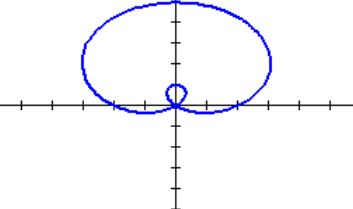
11.

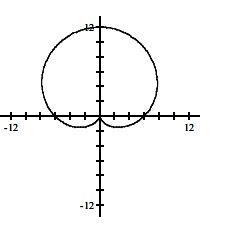
Which of the following could be the equation for...

a)

r = 6 + 6 sin θ

b)

r = 12 sin θ

c)

r = 6 - 6 sin θ

d)

r = 6 + 6 cos θ

12.
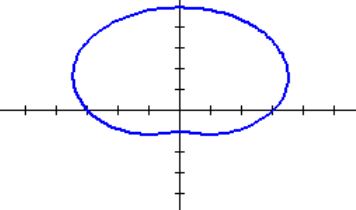
Which of these is an equation for this dimpled limaçon?
a)
r = 3 + 2 cosθ
b)
r = 2 + 3 cosθ
c)
r = 2 + 2cosθ
d)
r = 2 - 3cosθ
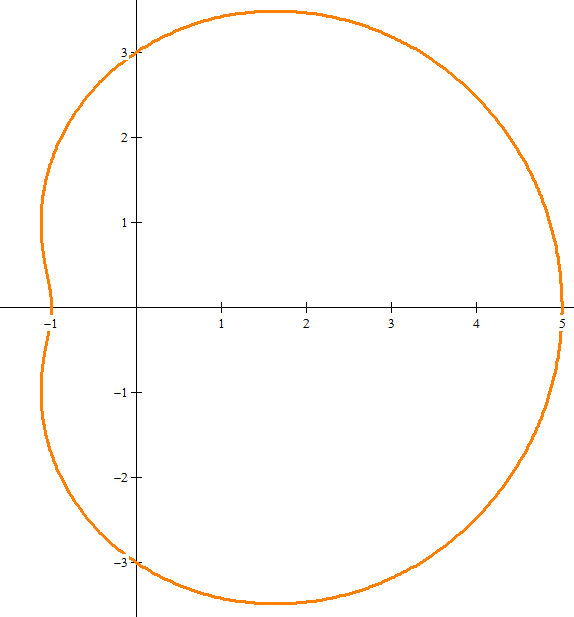
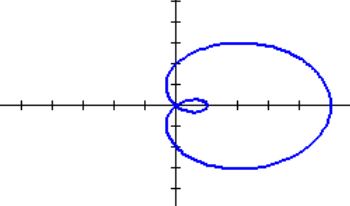
13.
Choose the correct equation.
a)
r = 3 + 2 cosθ
b)
r = 2 + 3 cosθ
c)
r = 2 + 2cosθ
d)
r = 3cosθ
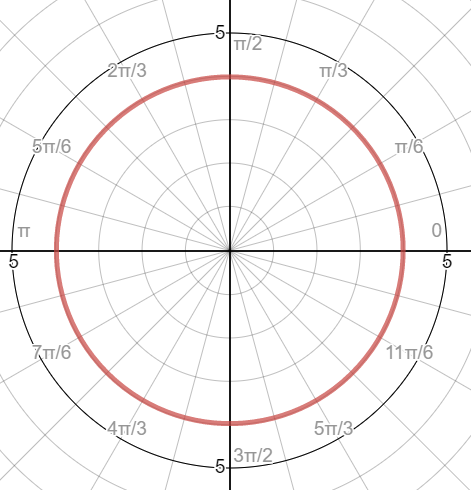
14.

What is the equation?

a)

r = 4

b)

r = 8

c)

r = 4sin(Θ)

d)

r = 8sin(Θ)

15.

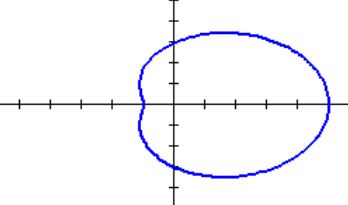
This particular equation generates what graph
a)
b)
c)
d)
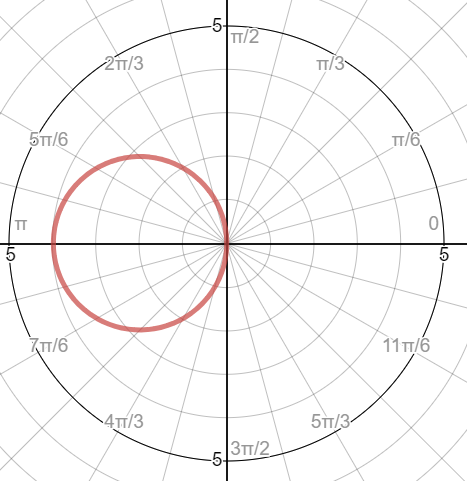
16.

What is the equation for this graph?

a)

r=6sin⁡θr=6\sin\theta

b)

r=−6sin⁡θr=-6\sin\theta

c)

r=6cos⁡θr=6\cos\theta

d)

r=−6cos⁡θr=-6\cos\theta

17.

What is the polar equation of the graph shown here?

a)

θ=−π4\theta=-\frac{\pi}{4}

b)

θ=π3\theta=\frac{\pi}{3}

c)

θ=π\theta=\pi

d)

θ=π6\theta=\frac{\pi}{6}

18.

Identify the equation in the polar graph

a)

r =7+4sin⁡θr\ =7+4\sin\theta

b)

r = 7+4cos⁡θr\ =\ 7+4\cos\theta

c)

r = 4+7sin⁡θr\ =\ 4+7\sin\theta

d)

r =4+7cos⁡θr\ =4+7\cos\theta

19.

What is the equation?

a)

r = 4sin(Θ)

b)

r = -2sin(Θ)

c)

r = 2cos(Θ)

d)

r = -4cos(Θ)

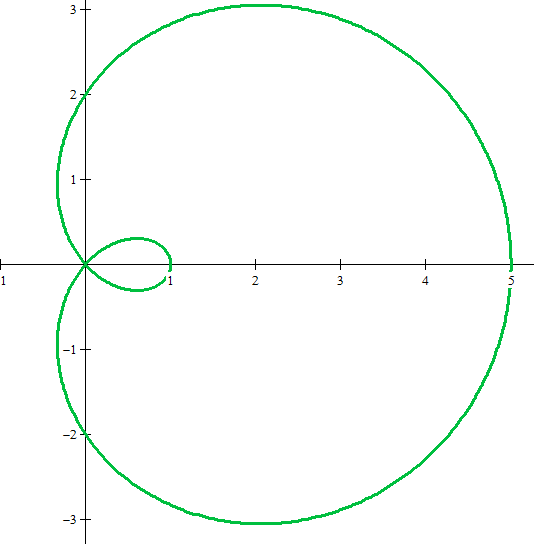
20.
a)

r=5+2cos⁡θr=5+2\cos\theta

b)

r=2+5cos⁡θr=2+5\cos\theta

c)

r=3+4cos⁡θr=3+4\cos\theta

d)

r=4+3cos⁡θr=4+3\cos\theta

e)

r=7cos⁡θr=7\cos\theta

21.

This refers to the presence of distinct and opposite charges or orientations, such as the positive and negative poles of a magnet or the positive and negative terminals of a battery. It's a fundamental concept in understanding the behavior of electromagnetic fields and interactions

(a)  

22.

Which of these is the equation of the graph shown?

a)

r=5cos⁡4θr=5\cos4\theta

b)

r=5sin⁡5θr=5\sin5\theta

c)

r=4cos⁡8θr=4\cos8\theta

d)

r=5cos⁡8θr=5\cos8\theta

e)

r=5sin⁡4θr=5\sin4\theta

23.

Which of the following could be the equation for...

a)

r = 2cos(7θ)

b)

r = 7sin(14θ)

c)

r = 2sin(7θ)

d)

r = 2sin(14θ)

e)

r = 2sin(3.5θ)

24.

The petals of the graph of r=5sin⁡(4θ)r=5\sin\left(4\theta\right)  will be at intervals of

a)

30°30\degree  

b)

45°45\degree  

c)

60°60\degree  

d)

90°90\degree  

25.

Which input creates the end of the first petal of the graph of r=8sin⁡(3θ)r=8\sin\left(3\theta\right)  .

a)

0

b)

π3\frac{\pi}{3}  

c)

π2\frac{\pi}{2}  

d)

π6\frac{\pi}{6}  

26.

Which is the FIRST input value that creates the endpoint of the last petal of r=2sin⁡(7θ)r=2\sin\left(7\theta\right) when graphing in order from 0 to 2π0\ to\ 2\pi

a)

π14\frac{\pi}{14}

b)

13π14\frac{13\pi}{14}

c)

27π14\frac{27\pi}{14}

d)

5π14\frac{5\pi}{14}

e)

11π14\frac{11\pi}{14}

27.

Which input creates the end of the third petal of the graph of r=4sin⁡(3θ)r=4\sin\left(3\theta\right)  when graphing in order from 0 to π0\ to\ \pi

a)

2π3\frac{2\pi}{3}

b)

3π4\frac{3\pi}{4}  

c)

5π6\frac{5\pi}{6}  

d)

11π12\frac{11\pi}{12}  

28.

Which interval creates the loop (highlighted) of

r = 2 + 4 cosθ

a)

[0,π3]\left[0,\frac{\pi}{3}\right]

b)

[π3, 2π3]\left[\frac{\pi}{3},\ \frac{2\pi}{3}\right]

c)

[2π3, 4π3]\left[\frac{2\pi}{3},\ \frac{4\pi}{3}\right]

d)

[4π3, 5π3]\left[\frac{4\pi}{3},\ \frac{5\pi}{3}\right]

e)

[5π3, 2π)\left[\frac{5\pi}{3},\ 2\pi\right)