
 Worksheets
Study Guide: Unit 5: Protein Synthesis
Total questions: 24
Worksheet time: 12mins
The molecule that carries genetic information in cells is called ____.
DNA
RNA
Protein
Carbohydrate
The molecule that acts as a messenger carrying instructions from DNA for controlling the synthesis of proteins is called ____.
mRNA
DNA
Protein
Enzyme
The principle that describes the flow of genetic information from DNA to RNA to protein is known as the ____.
Central dogma
Genetic drift
Natural selection
Gene flow
The ratio that describes the pairing of nitrogenous bases in DNA is known as ____.
Chargaff’s ratio for complementary base pairs
Mendel’s ratio for genetic inheritance
Watson-Crick ratio for DNA structure
Franklin’s ratio for X-ray diffraction
The process of copying a segment of DNA into RNA is called ____.
Transcription
Translation
Replication
Mutation
What is Translation?
The process of converting mRNA into a protein.
The process of converting DNA into RNA.
The process of converting proteins into DNA.
The process of converting RNA into DNA.
What are Amino Acids?
Building blocks of proteins.
Sugars that provide energy.
Fats that store energy.
Vitamins that regulate body processes.
What is the function of RNA Polymerase?
An enzyme that synthesizes RNA from a DNA template.
A protein that breaks down RNA molecules.
A molecule that transports amino acids to ribosomes.
An enzyme that replicates DNA strands.
What is a Codon?
A sequence of three nucleotides that codes for an amino acid.
A type of protein found in cells.
A segment of DNA that regulates gene expression.
A molecule that carries genetic information.
What is the difference between a Nontemplate (Sense) strand and a Template (Antisense) strand?
The Nontemplate strand is the DNA strand that is not used for RNA synthesis, while the template strand is the one that is used to transcribe RNA.
The Nontemplate strand is the one used for RNA synthesis, while the template strand is not used to transcribe RNA.
The Nontemplate strand and Template strand are identical in sequence.
The Nontemplate strand is only found in prokaryotes, while the Template strand is found in eukaryotes.
What is a Template strand?
The DNA strand that serves as a template for RNA synthesis.
The RNA strand that serves as a template for DNA synthesis.
The DNA strand that serves as a template for protein synthesis.
The RNA strand that serves as a template for protein synthesis.
What is mRNA?
Messenger RNA, which carries genetic information from DNA to the ribosome.
A type of protein that forms the structure of ribosomes.
A lipid molecule that stores energy in cells.
A carbohydrate that provides structural support in plant cells.
What is tRNA?
Transfer RNA, which helps decode mRNA into a protein.
A type of DNA that carries genetic information.
A protein that catalyzes chemical reactions.
A lipid that forms cell membranes.
What is a Protein?
molecule composed of a long chain of amino acids (polypeptide)
type of carbohydrate used for energy storage.
lipid molecule that forms cell membranes.
nucleic acid responsible for genetic information
What is a Polypeptide?
A long chain of amino acids that makes proteins.
A type of carbohydrate used for energy storage.
A lipid molecule that forms cell membranes.
A nucleic acid involved in genetic information storage.
What is a Codon chart?
chart used to determine which codons code for which amino acids.
chart used to determine the sequence of DNA strands.
chart used to identify the structure of proteins.
chart used to map the human genome
Where is DNA found?
In the nucleus of a cell.
In the mitochondria.
In the cell membrane.
In the cytoplasm.
Where does DNA Replication occur?
in the nucleus
in the cytoplasm
in the mitochondria
in the ribosome
Where does Transcription occur?
In the nucleus of a cell.
In the mitochondria.
In the cytoplasm.
In the ribosome
Where does Translation occur?
In the ribosome.
In the nucleus.
In the mitochondria.
In the Golgi apparatus.

What structure is the ribosome in the picture?

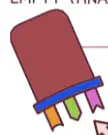
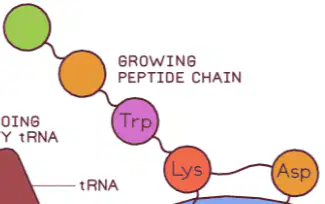
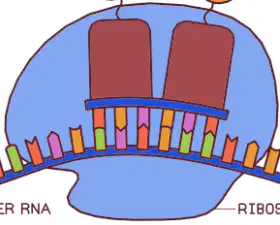
What structure is the mRNA in the picture?
What structure is the polypeptide chain in the picture?
What structure is the tRNA in the picture?

