
 Worksheets
Plant Water and Nutrient Movement Quiz
Total questions: 11
Worksheet time: 6mins
Which of the following statements about the movement of water and inorganic nutrients in plants is true?
Water and nutrients move from the roots to the leaves via the stem or trunk.
Water and nutrients move from the leaves to the roots via the stem or trunk.
Water and nutrients can move either from leaves to roots or from roots to leaves via the stem or trunk.
Water and nutrients are taken up by the roots and move symplastically by active transport to leaves.
Water and nutrients are pumped from the roots to the leaves via a proton pump.
About ____% of a plant’s water escapes through the stomata, although the stomata account for just ____% of the external leaf surface.
75; 10
75; 1–2
95; 10
95; 1–2
The basis of the pull generated by transpiration in the xylem is ____.
positive root pressure from differences in solute potential between soil and root.
positive pressure generated by the shrinking in diameter of the trunk or stem.
negative pressure at the air-water interface in the leaf.
pressure created by proton pumping of stomatal guard cells.
adhesion of water molecules to xylem cell walls.
Which reflects the correct relationship of water potentials for a typical tree on a sunny day?
leaf Ψ < trunk Ψ < soil Ψ
outside air Ψ > leaf mesophyll Ψ < root Ψ
leaf Ψ > trunk Ψ > soil Ψ
soil Ψ < root Ψ > leaf Ψ
none of the above
Which reflects the correct relationship of water potentials for a typical tree on a sunny day?
leaf Ψ < trunk Ψ < soil Ψ
outside air Ψ > leaf mesophyll Ψ < root Ψ
leaf Ψ > trunk Ψ > soil Ψ
soil Ψ < root Ψ > leaf Ψ
none of the above
Water can follow two pathways in plants, apoplastic and symplastic. How do these pathways differ?
The apoplastic route is for water; the symplastic route is for nutrients.
The apoplastic route is entirely external to cell membranes; the symplastic route is inside of cells.
The apoplastic route is for nutrients; the symplastic route is for water.
The apoplastic route is used in phloem; the symplastic route is used in xylem.
Which of the following is a benefit of positioning and aligning leaves relative to one another?
A layer of still air can be created under the leaves, raising the O₂ concentration found there.
More water can be lost from the surface of the leaves during the day.
Proper positioning can allow more light down to the lower leaves on the plant.
Certain arrangements can allow the plant to maximize its leaf area index (LAI).
On hot sunny days, horizontally aligned leaf blades tend to be kept cooler.
Which of the following correctly contrasts root pressure (RP) and the cohesion-tension mechanism (CT)?
The RP system uses the symplastic route; the CT mechanism uses the apoplastic route.
In the RP system, the Casparian strip helps to keep unwanted items out of the xylem; in the CT mechanism, it helps to keep desired items in the xylem.
The CT system coordinates with the phloem; RP does not.
The RP system depends on solutes in the root; the CT system depends on solutes in the leaf.
The RP system results in faster rates of flow at night than does the CT system during a sunny day.
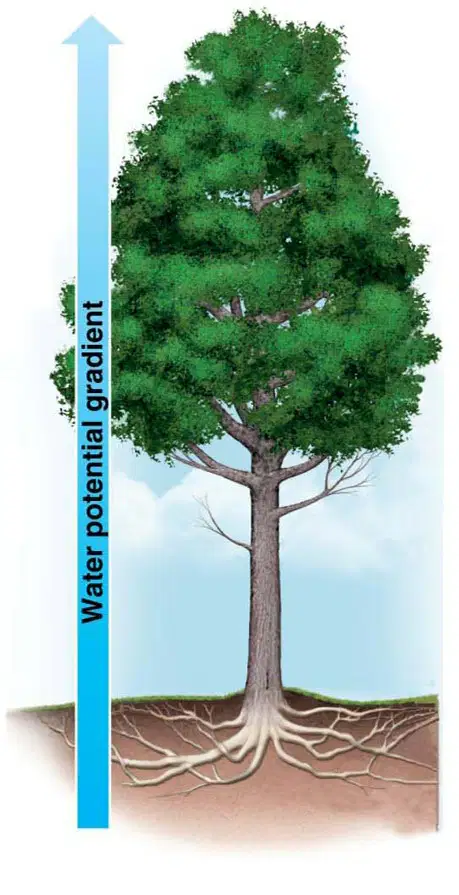
Consider a water molecule starting in the soil. Which of the following is the third structure that the molecule would encounter as it moves from the soil to the leaves?
Casparian strip
a root hair
cell wall of a mesophyll cell
vessel member in xylem tissue
air inside of a leaf
Which of the following is not a way that plants use sunlight?
to help sense how to best align their leaves throughout the day
to drive transpiration-powered flow in their xylem tissue
to help determine whether to open or close their stomata
to set their “internal clock,” which influences many metabolic processes
to cool their leaves by using light to promote evaporative cooling
Which of the following is not a function resulting from the action of guard cells?
lowering the loss of water upon detecting certain signals from water-stressed roots
keeping the leaves at a more positive water potential relative to the roots
allowing an optimal rate of photosynthesis to occur by letting CO₂ enter the leaf
permitting cooling of the leaf by the evaporative loss of water
allowing water to exit the leaf and so generating tension in the xylem tissue

