
 Worksheets
STAAR Countdown: Landmark Court Cases Review
Total questions: 12
Worksheet time: 3hrs 46mins

Part A. How did the Brown v. Board of Education ruling affect the Civil Rights Movement?
The ruling led to increased segregation that targeted a select group of citizens.
The ruling reappealed laws that had previously protected the policy of segregation.
The ruling resulted in racial equality for all minority citizens living in the country.
The ruling prevented other minority groups from protesting for equal treatment.

Part B. Which statement from the excerpt provides evidence to support your answer to Part A?
"Because of the obvious importance of the question presented, the Court took jurisdiction."
"Segregation of white and colored children in public schools has a detrimental effect upon the colored children."
"We conclude that, in the field of public education, the doctrine of 'separate but equal' has no place."
"This disposition makes unnecessary any discussion whether such segregation also violated the Due Process Clause."
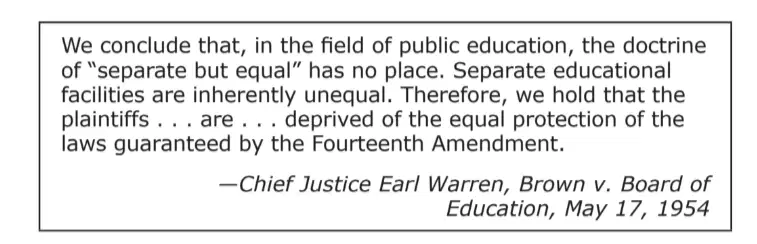
Which previous Supreme Court decision had protected the practice described in this excerpt?
Sweatt v. Painter
Hernandez v. Texas
Plessy v. Ferguson
Wisconsin v. Yoder
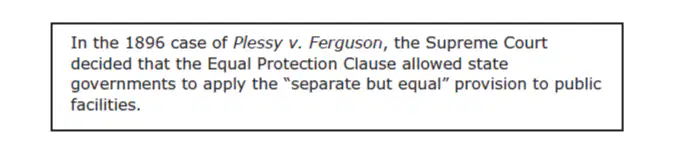
What was one way the decision described in this passage affected the United States in the first half of the twentieth century?
Minorities were not allowed to attend schools with whites.
Poll taxes in federal elections were ruled unconstitutional.
Affirmative action programs were ruled unconstitutional.
Minorities were not allowed to join the military.
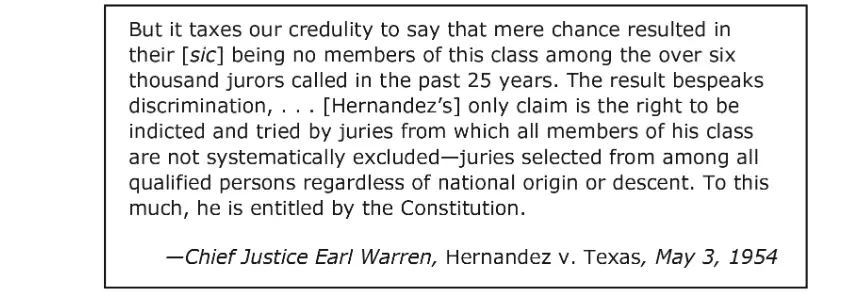
How did this Supreme Court decision affect judicial interpretations of the Constitution?
By expanding equal protection rights
By eliminating due process protections
By limiting free expression
By expanding the right of religious freedom
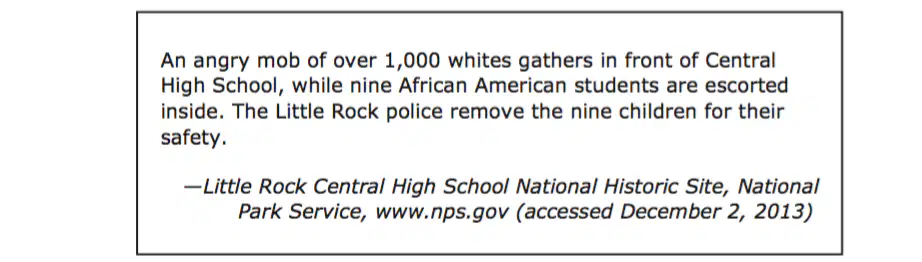
This confrontation centered around-----
disagreement over the use of taxes to fund public education
the refusal of federal courts to hear cases concerning civil rights violations
the denial of First and Fifth Amendment freedoms by southern state legislatures
resistance by state and local governments to the Brown v. Board of Education ruling
What was the significance of the Supreme Court decision in Tinker v. Des Moines (1968)?
It upheld the government's right to censor student newspapers.
It established that students have the right to free speech in schools.
It ruled that schools can ban all forms of student protest.
It determined that students must follow school dress codes without exception.
What was the importance of the Supreme Court decision in Wisconsin v. Yoder (1971)?
It allowed states to require all children to attend public school until age 18.
It upheld the right of parents to homeschool their children without state interference.
It ruled that Amish children could be exempt from compulsory education laws after 8th grade.
It determined that religious beliefs cannot be used to avoid school attendance.
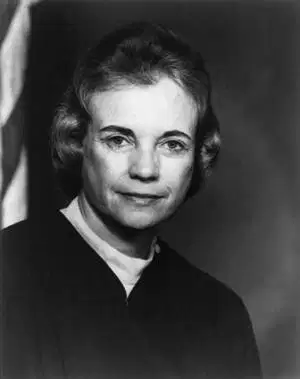
Who was the first woman elected to the Supreme Court?
Amelia Ehrhart
Sandra Day O'Connor
Eleanor Roosevelt
Ann Richards

Who was the first Black Supreme Court Justice?
George Washington Carver
Thurgood Marshall
Nat King Cole
Vernon Baker

Who was the first Hispanic Supreme Court Justice?
Rita Moreno
Dolores Huerta
Sandra Cisneros
Sonia Sotomayor

Which Supreme Court decision was based on the First Amendment?
Brown v. Board of Education
Marbury v. Madison
Tinker v. Des Moines
New Jersey v. TLO

