
 Worksheets
Electrical Safety Quiz
Total questions: 134
Worksheet time: 1hrs 7mins
What is the minimum current level at which a person can begin to feel an electric shock?
0.1 mA
1 mA
5 mA
10 mA
Why is standing on a wet floor more dangerous when handling electrical equipment?
Wet floors are slippery
Water conducts electricity better, reducing body resistance
It increases friction
Water attracts electricity
You see a classmate using a damaged power cord with exposed wires. What should you do?
Ignore it unless a teacher says something
Tell your classmate to finish their work quickly
Inform a teacher and stop using the equipment immediately
Cover the wires with tape and continue using it
Which type of fire extinguisher should you use for an electrical fire?
Water extinguisher
Foam extinguisher
Dry powder or CO₂ extinguisher
Wet chemical extinguisher
Which situation poses the lowest risk of electrical shock?
Using a metal screwdriver on a live circuit
Standing barefoot on a wet floor
Using insulated gloves and rubber shoes
Touching a plug with wet hands
What is the main purpose of grounding electrical equipment?
To improve electricity flow
To protect devices from dust
To provide a safe path for fault current
To reduce energy consumption
You are tasked with cleaning a piece of electrical equipment. What is the correct first step?
Use a wet cloth to clean it faster
Turn off the main power supply and unplug the equipment
Test the equipment while cleaning
Wear gloves and clean while it's running
Which of the following best reflects good housekeeping in an electrical lab?
Storing wires under desks
Leaving tools plugged in
Keeping the workspace organized and dry
Using long extension cords across walking paths
Why is it dangerous to replace a blown fuse without identifying the cause?
Fuses are expensive
The equipment might restart incorrectly
The underlying problem could cause another failure or fire
It slows down repair time
Your team is designing a safety checklist for new lab users. Which of the following should be included?
Always clean tools with water
Do not report minor shocks
Check all cords and switches before use
Assume all devices are safe if they power on
What is a common sign that an electrical device may be faulty or dangerous?
Low battery
Flickering lights or strange noises
Smooth performance
Shiny casing
Why should you avoid touching a circuit with wet hands?
Wet hands slip easily
Moisture reduces skin resistance and increases shock risk
It might cause burns
It makes the device malfunction
You accidentally spill water near a power strip. What should you do first?
Wipe it quickly with a cloth
Unplug all equipment immediately
Use a fan to dry the area
Report to the lab supervisor and shut off the power safely
What does a fuse do in an electrical circuit?
Increases power supply
Connects wires safely
Breaks the circuit when current is too high
Lights up when power flows
Which of the following work habits would most likely lead to an electrical accident?
Regular inspection of equipment
Wearing dry, rubber-soled shoes
Ignoring warning signs like sparks or smoke
Turning off equipment when not in use
What is one benefit of good lab housekeeping in terms of safety?
It makes the lab look nicer
It speeds up electrical flow
It reduces clutter that may cause accidents
It helps students find snacks
What is the best footwear when working with electrical tools in the lab?
Sandals
Leather shoes
Wet sneakers
Rubber-soled, closed-toe shoes
Which student is practicing safe behavior in the lab?
Syabil plugs in multiple high-powered tools into one outlet
Inarah dries her hands before switching on the power
Danil uses a metal pen to press electrical buttons
Yang Ming cleans near the socket with a wet cloth
Your lab group is planning a safety demo. Which idea would best show the danger of electricity and the importance of safety?
A video showing people working quietly
A diagram of a fuse
A roleplay of what to do if someone gets shocked
A poster about saving energy
A fuse keeps blowing every time a machine is turned on. What is the most logical reason?
The fuse is too expensive
The switch is stuck
There is an electrical fault or overload
The machine needs more water
Which type of electric power generates a current that flows consistently in one direction without reversing?
Single-phase power
Three-phase power
Direct current power
Alternating current power
Which one of the following devices/appliances that can provide a direct current electrical output?
Hair dryer
Solar Cells
Refrigerators
Portable generator
Rectifier is an example of
Single-phase power supply
Three-phase power supply
Direct current power supply
Alternating current power supply
Generated from sunlight, wind, and water are examples of the
fossil fuels sources
nuclear energy sources
generator power sources
renewable energy sources
Generated from coal, oil, and natural gas are examples of the
fossil fuels sources
nuclear energy sources
generator power sources
renewable energy sources
What are the two types of electric power?
Alternating Current (AC) power and Direct Current (DC) power
Mechanical and Thermal Power
High Voltage and Low Voltage Power
Static and Dynamic Power
Which of the following are common applications of Direct Current (DC)?
Street lighting, ceiling fans, and electric ovens
Electronics and gadgets, renewable energy systems, and portable medical equipment
Power transmission lines, transformers, and industrial motors
Air conditioning systems, elevators, and traffic lights
An electrical shock is received when what is passes through the body.
Electrical current.
Electrical earthing .
Electrical voltage.
Electrical resistance.
How much of the electrical current passes through the body could prove fatal by contraction of the heart muscles?
5 mA.
10 mA.
20 mA.
15 mA.
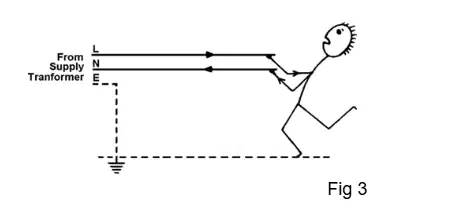
The below Fig 3 shows a person experiencing:
An electric shock on live only.
An electric shock on neutral only.
An electric shock between live and earth.
An electric shock between live and neutral
Electricity and water don't mix. Bare feet and wet skin will lower the body's electrical
power.
voltage.
current.
resistance.
Which of the following are benefits of good housekeeping in electrical work?
Faster internet speed, lower electricity bills, and longer cable lengths
Eliminates accidents and fire, improves productivity, and provides better use of space
Reduces voltage drop, increases current flow, and adds more sockets
Allows more devices to be used, reduces cleaning time, and increases wire thickness
Which of the following are important safety "Don'ts" in an electrical laboratory?
Never take risks, do not overload circuits, and avoid misusing equipment
Always use water to extinguish electrical fires, and re-close tripped breakers immediately
Use any available solvent near electrical apparatus
Use double adaptors freely to plug in multiple devices
If a wire has a resistance of 32Ω for a length of 800 meters, what would be the resistance of the same wire if its length is reduced to 250 meters?
10Ω
12.5Ω
16Ω
20Ω
A copper wire has a resistance of 40Ω when its length is 500 meters. What would be its resistance if the length is increased to 1,000 meters?
60Ω
50Ω
80Ω
100Ω
A copper wire has a resistance of 40Ω when its length is 500 meters. What would be its resistance if the length is increased to 1,000 meters?
60Ω
50Ω
80Ω
100Ω
If a wire has a resistance of 125Ω at a length of 500 meters, what would be its length if the resistance is reduced to 90Ω?
360 m
400 m
450 m
500 m
If a current of 2 A flows through a resistor of 6 Ω, what is the voltage across the resistor?
8 V
10 V
12 V
14 V
A circuit has a 12V power supply and a resistor of 3Ω. What is the current flowing through the circuit?
2 A
3 A
4 A
5 A
If a resistor carries a current of 0.5 A with a voltage of 6V across it, what is the resistance?
10Ω
12Ω
8Ω
6Ω
Which of the following statements is true about electric charge?
Electric charge is measured in Amperes (A).
Electric charge causes matter to experience a force in a magnetic field.
Electric charge is a fundamental property of matter, measured in Coulombs (C).
Electric charge can only exist in positive form.
If a current of 2 A flows for 5 seconds, what is the total charge transferred?
5 C
10 C
15 C
20 C
Which of the following best describes Ohm's Law?
(Ohm's Law states that V = IR,)
The relationship between power, voltage, and current.
The relationship between voltage, current, and resistance.
The relationship between current, voltage, and charge.
The relationship between energy, time, and resistance.
An electrical appliance operates at 240 V and draws a current of 4 A. What is the power consumed by the appliance?
480 W
960 W
1200 W
1440 W
A heater operates at 230 V and consumes 2 kW of power. What is the current flowing through the heater?
6.52 A
8.70 A
5.20 A
9.15 A
A machine draws 10 A of current when supplied with 120 V. What is the power consumed?
1200 W
1000 W
1500 W
1400 W
An electric motor requires 1500 W to operate and runs on 250 V supply. What is the current drawn by the motor?
5 A
6 A
7 A
8 A
An electric kettle rated at 2000 W is used for 30 minutes. How much energy is consumed?
1 kWh
0.5 kWh
2 kWh
3 kWh
An air conditioner uses 1500 W and runs for 8 hours a day. What is the daily energy consumption?
12 kWh
10 kWh
8 kWh
6 kWh
Which of the following represents the correct unit of electrical energy?
Watt
Ampere
Volt
kilowatt-hour (kWh)
Which of the following best defines Electrical Power?
The rate at which energy is consumed or produced.
The total amount of energy consumed.
The amount of current flowing in a circuit.
The resistance of a circuit.
Which of the following best defines Electrical Energy?
The ability to do work over time.
The speed of current flow.
The measure of resistance in a circuit.
The number of charges in a battery.
An electric fan operates at 100 W and runs for 6 hours. How much energy does it consume?
0.6 kWh
0.5 kWh
0.4 kWh
0.2 kWh
If a microwave oven draws 8 A from a 230 V supply, what is its power consumption?
1380 W
1840 W
1600 W
1800 W
A 220 V single-phase electric heater has a resistance of 44 ohms. What is the power consumed by the heater?
660 W
1210 W
2200 W
1100 W
Two resistors of 3.1 Ω and 7.2 Ω are connected in parallel. What is the total resistance?
2.17 Ω
3.15 Ω
5.50 Ω
10.3 Ω
Three resistors of 1 Ω, 1.5 Ω, and 2 Ω are joined in parallel. What is the equivalent circuit resistance?
0.33 Ω
0.46 Ω
0.53 Ω
1.23 Ω
Four resistors of 2 Ω, 4 Ω, 6 Ω, and 8 Ω are connected in parallel. What is the total equivalent resistance?
0.80 Ω
0.96 Ω
1.50 Ω
2.00 Ω
Three resistors of 2 Ω, 4 Ω, and 6 Ω are connected in series. What is the total resistance?
6 Ω
8 Ω
10 Ω
12 Ω
In a series circuit, if one component fails, what happens to the current?
It increases
It stops completely
It decreases slightly
It bypasses the failed component
In a series circuit, the total resistance is:
Smaller than the smallest resistor
Equal to the largest resistor
The sum of all the resistors
The average of all the resistors
A series circuit has three resistors: 10 Ω, 20 Ω, and 30 Ω. What is the total resistance?
20 Ω
30 Ω
40 Ω
60 Ω
In a series circuit, the components are connected:
Across multiple branches
In a straight line, one after another
Randomly
In opposite directions
In a parallel circuit, components are connected:
In one single line
End to end
Across the same two points
In series first, then parallel
In a parallel circuit, if one component fails:
The entire circuit stops working
Only that component stops, others keep working
The current stops flowing everywhere
The voltage drops to zero
Which of the following is true for a series circuit?
The current is different in each component
The voltage is the same across all components
The current is the same through all components
It has many paths for current
Which of these is true for a parallel circuit?
The same current flows through each branch
The voltage divides across each branch
The voltage is the same across each branch
The components share the same current
Three resistors (2 Ω, 3 Ω, and 5 Ω) are connected in series. What is the total resistance?
10 Ω
5 Ω
6 Ω
8 Ω
Two resistors (4 Ω and 6 Ω) are connected in parallel. What is the total resistance?
2.4 Ω
4.8 Ω
5 Ω
10 Ω
In a parallel circuit, two resistors (6 Ω and 3 Ω) are connected. What is the total resistance?
1.5 Ω
2 Ω
2.1 Ω
4.5 Ω
What is the main function of a cell in an electrical circuit?
Convert light energy into chemical energy
Store electrical energy
Convert chemical energy into electrical energy
Generate heat through resistance
Which of the following is true about a battery?
It can only be used once
It consists of a single cell
It is a device that stores heat energy
It is a combination of cells
What does the internal resistance of a cell consist of?
The temperature of the cell
The shape of the terminals
Resistance of electrodes and electrolyte
The material of the outer casing
What is the symbol and unit for Electromotive Force (EMF)?
V, Volts
I, Amperes
E, Volts
R, Ohms
What is the terminal voltage of a cell?
Voltage across a cell when it is idle
Maximum voltage it can supply
Voltage across terminals when supplying current
Voltage of one terminal only
How does terminal voltage compare to EMF when a cell is supplying current?
Terminal voltage equals EMF
Terminal voltage is greater than EMF
Terminal voltage is less than EMF
Terminal voltage is not measurable
How are cells connected to increase total current?
In series
In parallel
In loop
With resistors
A 1.5 V cell is connected to a 5 Ω circuit. What is the current?
0.2 A
0.3 A
0.5 A
0.75
What happens when cells are connected in series?
The voltage remains the same
The current increases
The total voltage increases
The internal resistance is removed
Which of the following factors affects the internal resistance of a cell?
The ambient temperature only
The amount of current drawn
The type and dimensions of materials used
The color of the battery casing
What is the main benefit of using a wiring diagram?
It outlines operating principles
It simplifies the design process
It enhances aesthetic appeal
It assists in identifying faults
What is the main benefit of using a wiring diagram?
It outlines operating principles
It simplifies the design process
It enhances aesthetic appeal
It assists in identifying faults

Calculate the current in the circuit
8A
1.25A
10A
800A
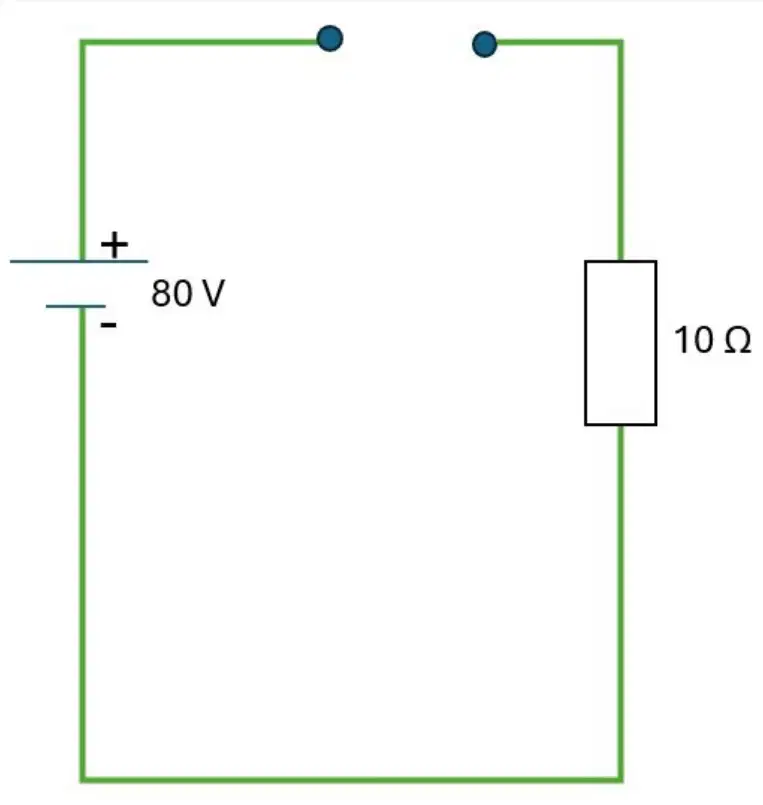
What is the current in the circuit?
0A
8A
1.25A
800A

What is the measured voltage to display on the voltmeter?
30 VAC
30 VCD
-30 VAC
-30 VCD
What is an open circuit fault?
When all resistors are connected in parallel
When the pathway for current is broken
When current finds a lower resistance path
When voltage exceeds the rated limit
What happens to the current in a series circuit when there is an open fault?
It continues unchanged
It stops entirely
It flows through alternate paths
It increases rapidly
What does a reverse polarity fault involve?
Connecting a power source backwards
Which law is commonly used to analyze the effects of open and short faults in circuits?
What does a short circuit create in a circuit?
A short circuit creates a stable voltage level in the circuit.
A short circuit creates a high-resistance path that reduces current flow.
A short circuit creates a low-resistance path that can lead to excessive current flow.
What does a continuity test check for?
Insulation resistance.
Voltage levels.
Battery charge
Open or closed circuits
What tool is used to measure resistance?
How is voltage measured using a multimeter?
By connecting the probes to the power source only
By placing the probes across two points in parallel
By connecting in series to the circuit
By touching the probes to a ground wire
What is the unit of measurement for resistance?
What type of meter allows current measurement without disconnecting the circuit?
What instrument mode is commonly used to perform a continuity test?
Continuity mode or ohmmeter
What is the main purpose of electrical testing?
Which tool can measure voltage, current, and resistance?
In voltage measurement, the multimeter probes must be connected:
Why is calibration important in electrical testing instruments?
What is the most common source of Direct Current (DC)?
Solar panel
DC generator
Battery
Inverter
Which of the following devices generates DC electricity by converting sunlight?
Generator
Solar Cell
Transformer
Inverter
Which of the following is the most common AC power source?
Power grid
UPS system
Portable generator
Inverter
Which AC power source is commonly used during power outages for homes and businesses?
Portable solar panel
Standby generator
Clamp meter
Battery bank
What is a grid-tie inverter used for?
Converting AC to DC
Disconnecting from the power grid
Feeding converted DC power into the grid
Monitoring electricity usage
How does a person receive an electric shock?
By standing near electrical equipment
By touching a live wire while standing on an insulator
By hearing a loud noise from the equipment
When current passes through the body
What can increase the severity of an electrical shock?
Keeping tools organized
Standing on wet ground
Standing on dry wood
Wearing rubber gloves
What does a current of about 20 mA potentially cause in the human body?
Tingling sensation
Muscle relaxation
Fatal heart muscle contraction
No effect
Why should tools with non-conducting handles be used in electrical work?
They are easier to clean
They cost less
They reduce the risk of shock
They look more professional
What must be done before plugging leads into a power source?
Ensure they are clean
Make sure they are connected to a complete circuit
Check for color coding
Confirm they are labeled
What is the primary purpose of electrical drawings in industries?
To design mechanical components
To communicate information about equipment production, installation, and service
To manufacture wires
To analyze employee performance
Which of the following electrical drawings provides a conceptual overview without showing actual wiring?
What do block diagrams primarily emphasize?
What is the main function of a wiring diagram?
To illustrate the electrical connections and layout of a system.
Why are schematic diagrams widely understood across different regions?
They use standardized symbols
A cell with 1.5 V is connected to a circuit of resistance of 5 Ω. Calculate the current in the circuit.
A battery is best defined as
A group of cells connected together
A single chemical cell
What are the two main types of batteries?
Solar and nuclear
Wet and Dry
Lead-acid and lithium
What does a voltmeter measure when connected across a cell not supplying current?
In a parallel cell connection, what remains the same across all cells?
What happens when more cells are added in parallel?
What does a voltmeter measure when connected across a cell not supplying current?
What allows an electric current to be produced in a material?
Movement of free electrons
Presence of insulation
Movement of atoms
Which of the following is a good insulator?
What material is commonly used in house wiring due to its good conductivity and affordability?
Gold
What is the unit of resistivity?
volt-meter (V)
ampere-meter (A)
watt-meter (W
ohm-meter (Ω)
According to Ohm’s Law, what happens to current if voltage increases and resistance remains constant?
The formula derived from Ohm’s Law is:
V = I x R
If a 220 V supply produces a current of 2.77 A in a heater, what is the resistance?
53.5 ohms
What is the unit for electromotive force (emf) or potential difference?
What is the energy consumed (in joules) if a 25 Ω resistor draws 10 A current for 10 minutes?
15,000 J
150,000 J
150 J
1500 j
In which configuration does connecting more resistors decrease the total resistance?
Series
Parallel
Star
Delta
What type of circuit fault occurs when the current path is broken?
Open Fault
Short Fault
Overload
Reverse Polarity
What is the power consumed by a 100 Ω resistor carrying 0.5 A current?
50 W
25 W
100 W
12.5 W

