
NEW
Font size
S
M
L
XL
 Worksheets
Continental Drift Test Review
Total questions: 20
Worksheet time: 2hrs 40mins
Name
Class
Date
1.
Which statement does NOT summarize one of the lines of evidence used by Alfred Wegener to support his theory of continental drift?
a)
Glacial deposits indicate a different climatic condition.
b)
Similar fossils are found on widely separated continents.
c)
Similar geologic formations occur on both sides of the Atlantic Ocean.
d)
Bands of rock are older the farther their position from a mid-ocean ridge.
2.
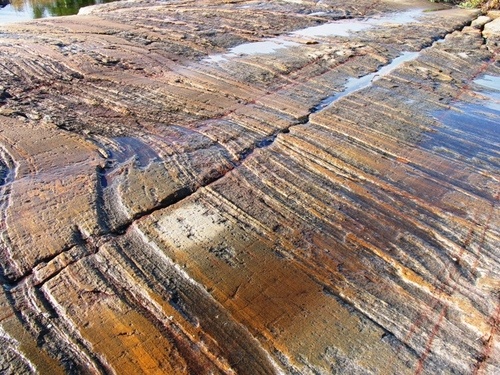
This is a picture of glacial scars found in Africa. What are these evidence for?
a)
Africa has always been near the equator.
b)
Africa was once in an area of the Earth that had a very cold climate.
c)
The continents have not moved.
d)
sea floor spreading
3.
Which of the following best explains the difference between continental drift and plate tectonics?
a)
Continental drift describes the motion of Earth's continents only; plate tectonics describes the motion of the crust beneath Earth's oceans as well.
b)
Continental drift is supported only by observations of similar coastlines and geologic features on opposite sides of an ocean; plate tectonics is supported by a wide range of fossil evidence as well.
c)
Plate tectonics was Wegener's theory that Earth's continents rest on sections of Earth's crust that drift together and apart over time; continental drift is a hypothesis describing how plate tectonics might happen.
d)
Continental drift was Wegener's hypothesis that Earth's continents were once part of a supercontinent that has since broken apart; plate tectonics is the theory that explains HOW continental drift happens.
4.
How does fossil evidence support Wegener's hypothesis of continental drift?
a)
Similar fossils are found along continental margins that appear to join together.
b)
Fossils are found in areas where the present-day climate could not have supported the organisms that made the fossils.
c)
Similar fossils of giant, land-dwelling dinosaurs are found on continents separated by oceans.
d)
all of the above
5.
Which of these does NOT provide evidence for the theory of continental drift?
a)
megladon fossils high in the mountains
b)
matching rocks and mountain belts in continents that are now separated
c)
mesosaurus fossils on widely separated continents
d)
glossopteris fossils in Antarctica
6.
Which evidence supports Wegener's continental drift hypothesis?
a)
similar fossils found on opposite sides of an ocean
b)
meteorite impact craters in continental crust
c)
the buildup of sediment along continental margins
d)
all of the above
7.
What does the theory of continental drift state?
a)
The continents were once joined in a super-continent and have moved over time.
b)
Continents are stationary and do not move.
c)
The Earth is broken into lithospheric plates that move due to convection currents.
d)
none of the above
8.
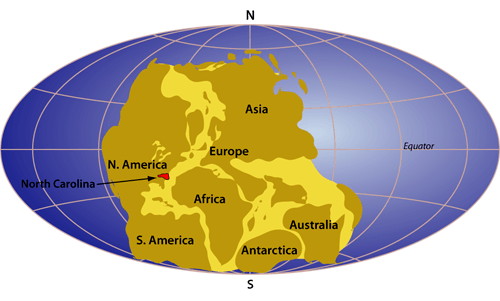
What is this a picture of?
a)
plate tectonics
b)
continental drift
c)
Pangaea
d)
glacial scarring
9.
According to Wegener's continental drift hypothesis, the continents were once part of a supercontinent called
a)
Antares
b)
Europa
c)
Mons
d)
Pangaea
10.
Which statement best compares the theories of plate tectonics and continental drift?
a)
Plate tectonics and continental drift are two names for the same theory.
b)
Plate tectonics proposes that the continents move; continental drift proposes the mechanism for how the continents move.
c)
Continental drift proposes that the continents move; plate tectonics proposes the mechanism for HOW the continents move.
d)
Continental drift proposes that the continents move; plate tectonics proposes that the continents are stationary.
11.
What is one of the first pieces of data that Wegener collected that led him to believe that the continents had moved?
a)
He discovered the mid-ocean ridge.
b)
He found convection currents that caused plate movement.
c)
He discovered that Greenland's longitude had not always been the same.
d)
He found that Africa and South America were connected.
12.
Which statement best summarizes the theory of continental drift?
a)
Only the continents move, traveling slowly over and through Earth’s crust.
b)
All of the continents were once joined together into a single supercontinent.
c)
The continents are fixed and have always been located in their present positions.
d)
Earth’s crust is divided into plates that move slowly over, against, and apart from each other.
13.
What two specific continents fit together most noticeably?
a)
Africa and North America
b)
South America and Europe
c)
South America and Africa
d)
Antartica and Africa
14.
During what time period did Wegener develop his theory of Continental Drift?
a)
early 2000s
b)
late 1700s
c)
late 1800s
d)
early 1900s
15.
What branches of science did Wegener have a degree in?
a)
petroleum geology and biology
b)
paleontology and geophysics
c)
meteorology and astronomy
d)
chemistry and marine biology
16.
Which statement best explains how the continents have changed over the last 200 milion years, according to the continental drift hypothesis?
a)
They drifted into and out of about seven different supercontinent configurations.
b)
They drifted into and out of about fifteen different supercontinent configurations.
c)
They split apart from a supercontinent and very slowly moved to their current positions.
d)
They formed a stable supercontinent until the last ice age, when they rapidly moved to their current positions.
17.
What is the name for lava that is still inside the earth? (bonus)
a)
lava
b)
granite
c)
magma
d)
molten fissures
18.
Which statement best explains Wegener's hypothesis of continental drift?
a)
Volcanic activity slowly reshapes the continents throughout Earth's geologic history.
b)
The continents shift locations as a result of major catastrophes like meteorite impacts and earthquakes.
c)
The continents rapidly change places from one hemisphere to another when Earth's magnetic field reverses.
d)
The continents were once part of the same landmass and have drifted very slowly to their current positions.
19.
Fossils of a fern-like plant have been found in Antarctica. These fossils show that the climate in that area was much warmer at one time. What is the name of this plant?
a)
Glossopteris
b)
Mesosaurus
c)
Striations
d)
Cotswalds
20.

Who is the person credited with developing the theory of continental drift?
a)
Harry Hess
b)
Galileo
c)
Alfred Wegener
d)
Newton
Reset

