
Font size
 Worksheets
WW1 EOC - 25
Total questions: 17
Worksheet time: 13mins
What effect did the sinking of the Lusitania have on World War I?
Germany joined the Central Powers.
U.S. public opinion shifted against Germany.
Germany refused to join the League of Nations
U.S. leaders proposed a military alliance with Germany.
What was the MAIN reason tanks were introduced during World War I?
To locate and remove land mines from the battlefield
To transport military supplies to the front lines
To overcome trench defenses and end stalemates
To monitor enemy troop movements
The United States is the world’s best hope, but if you fetter her in the . . . quarrels of other nations, if you tangle her in the
intrigues of Europe, you will destroy her powerful good, and endanger her very existence. Leave her to march freely through
the centuries to come, as in the years that have gone. Strong, generous, and confident, she has nobly served mankind.
—Senator Henry Cabot Lodge, 1919
Why did Senator Lodge express this opinion about the Treaty of Versailles?
He wanted to prevent the spread of the global flu epidemic
He wanted to protect secret U.S. nuclear technology.
He wanted the United States to join an international league.
He wanted to protect U.S. sovereignty in international relations.
Which question is associated with the passage of the Espionage and Sedition Acts during World War I?
Should industries be allowed to prohibit workers from joining unions?
Can the government require citizens to purchase war bonds?
At what age should citizens be required to enlist in a branch of the military?
Can the government limit the constitutional rights of citizens during wartime?
President Woodrow Wilson’s Reasons for Entering World War I
• Assert American rights to “freedom of the seas”
• Stop German plans to aid Mexico
• ?
Which additional reason BEST completes this list?
Increase trade with Asian nations
Assist the Allied powers against German aggression
Retaliate against Germany for imposing high tariffs
Prevent fascism from spreading throughout Europe
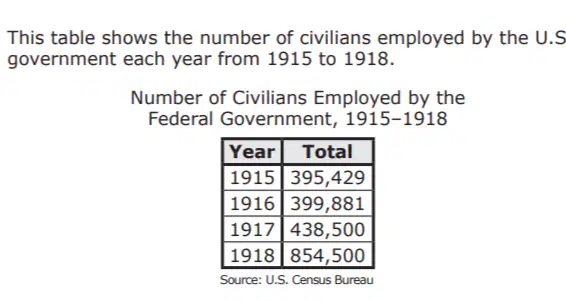
Based on this table, how did World War I affect the U.S. economy?
It led to decreased spending in order to conserve resources during the war effort.
It led to decreased pressure on private companies to supply the war effort
It increased the economic opportunities available for U.S. citizens.
It increased the number of immigrants searching for U.S. jobs.
Which statement describes why the U.S. military developed protective masks during World War I?
The masks were needed to stop enemy forces from recognizing commanding officers.
The masks were needed to prevent soldiers from breathing in smoke from the battlefields.
The masks were needed to lessen the smell of sewer gas for soldiers in the trenches.
The masks were needed to shield soldiers from chemical weapons used in the war.
Which results occurred on the home front because of U.S. involvement in World War I?
Select TWO correct answers.
Industrial production decreased as U.S. citizens bought fewer goods and services.
Wages decreased as companies faced rising taxes and governmental restrictions on exports.
Companies hired women to work in jobs traditionally reserved for men.
African Americans migrated to northern cities in order to improve their standard of living.
Job competition caused the U.S. government to expel Mexican Americans to Mexico.

This image is a U.S. Army recruiting poster from 1917.
In the context of World War 1, the recurring poster above would have supported which of the following government actions?
The creation of the open door policy
The passage of the selective service act
The enforcement of big stick diplomacy
The passage of the sedition act
What was the primary role of the War Industries Board during World War 1?
To negotiate a peace treaty with enemy nations
To provide military training to American soldiers
To manage income tax collection that supported the war effort
To coordinate the production and distribution of war supplies.
Which postwar plans for world peace were proposed by President Wilson in his Fourteen Points? Select Three
Self-Determination
Colonial acquisitions for victorious nations
Free Trade
Open Diplomacy
Increased weapons for production for security
"We intend to begin on the first of February unrestricted submarine warfare. We shall endeavor in spite of this to keep the United States of America neutral. In the event of this not succeeding, we make Mexico a proposal or alliance on the following basis: make war together, make peace together, generous financial support and an understanding on our part that Mexico is to reconquer the lost territory in Texas, New Mexico, and Arizona." - Arthur Zimmermann, German Secretary of Foreign Affairs, 1917
Based on the excerpt, how did the Zimmermann Telegram contribute to the U.S. decision to enter WW1?
It showed that Germany was planning to surrender, which encouraged the U.S. to join the allies.
It revealed Germany's proposal for peace, which the US rejected in favor of supporting the allies.
It confirmed Germany's attempt to forge an alliance with Mexico, intensifying anti-German sentiment in the US.
It exposed a secret plan by the Allies to involve the US in the war, causing American public opinion to shift.
What aspect of General John J. Pershing's leadership during WW1 was MOST significant in contributing to the success of the American Expeditionary Forces (AEF)?
His willingness to use US troops in support roles, which led allied leaders determine strategy.
His decision to maintain American forces as an independent unit ensuring a distinct us presence in the war effort.
His strategic use of naval blockades to cut off supplies to the Central Powers
His implementation of guerilla warfare tactics, which were unfamiliar to European Armies.
The Treaty of Versailles in 1919 required (a) to pay reparations for the damages caused by the war. The amount was approximately (b) .
Determine to which alliance each of the following nations belonged during World War 1.
Britian
France
Russia
U.S.
Austria-Hungary
Italy
Germany

What action during World War 1 made Corporal Alvin York a hearo and earned him the congressional medal of honor?
Negotiating a peace treaty with the German forces
Inventing a new type of weaponry used by the Allied forces
Shooting down many enemy airplanes in dogfights
Caputring a significant number of German soldiers with a small force
Which statement best describes the significance of the U.S.'s participation in the Battle of Argonne Forest during World War 1?
U.S. troops provided critical reinforcements that helped the allied powers break through German lines.
The U.S. used the battle to test new tank technologies that would dominate later warfare.
U.S. forces provided intelligence and information that were significant in defeating the enemy
The U.S. experienced the highest casualties for any countries in any single battle during the war.

